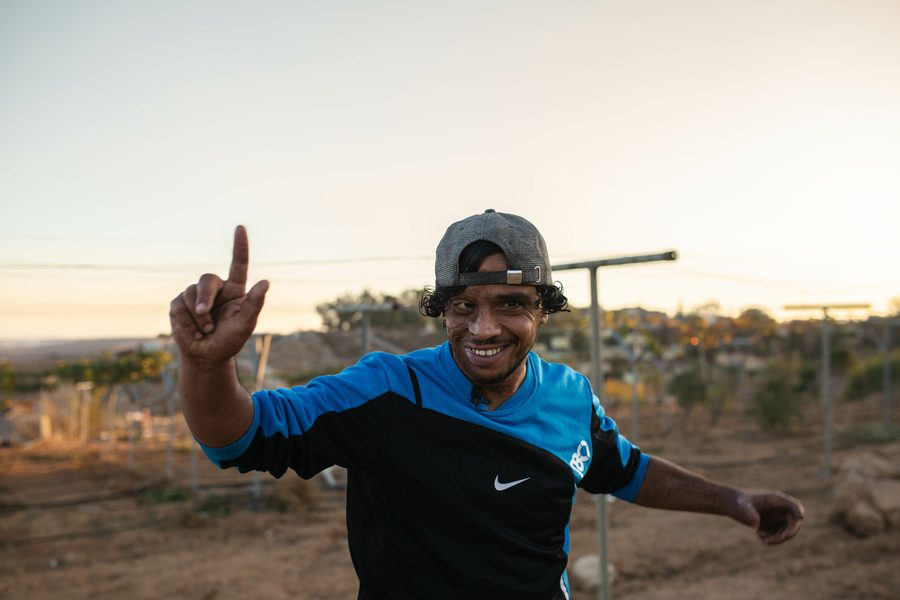
Awdah Hathaleen in Umm al-Khair.
Remembering Awdah Hathaleen
The Palestinian activist turned hospitality into a tool of sabotage against the ongoing Nakba.
On the night before he was killed, Palestinian schoolteacher, activist, and father of three Awdah Hathaleen addressed solidarity activists from around the world in a webinar that we hosted to strengthen support for the Palestinian struggle in the Masafer Yatta region of the West Bank. Awdah was from the Palestinian Bedouin hamlet of Umm al-Khair, where he had been born in 1994, just under 50 years after his family was expelled from the Naqab desert during the Nakba, and a decade after the encroaching Israeli settlement of Carmel was established as part of a strategic corridor of illegal developments designed to systematically expel Masafer Yatta’s rural communities. Awdah played a central role in efforts to counter settler attacks, land expropriation, and state violence throughout the region, all of which have intensified over the last years, especially since October 7th. “Here in Umm al-Khair, every day, something is going to happen. We don’t know when, we don’t know why, we don’t know what. But something will happen,” Awdah shared on the last night of his life. “I want to be safe. I want to tell my family: ‘Nothing is going to happen tomorrow.’”
We first met Awdah ten years ago, when our international community of Jewish co-resistance activists began to support Palestinian direct action and popular struggle in Masafer Yatta. The two of us and Awdah were in our early twenties then, part of a cohort that all came of age and into our activism together. Awdah, who soon became one of our dearest friends, brought a particular warmth and grace to the world of dissident politics. Over the years that followed, he emerged as an essential coordinate in a constellation of direct action networks opposing the forced displacement of Palestinians. He drew us into the daily life of his community: Soon we were helping them to replant olive trees destroyed by settlers; rebuilding homes after demolitions by the army; organizing civil disobedience actions in defense of water rights and global solidarity campaigns against forced transfer; joining for weddings, funerals, and birthdays; and spending more winter nights by the fire and languid summer days playing with the children than we could ever count. Whenever we were in Umm al-Khair, Awdah would host us, insisting we stay for tea. When the tea was finished, he would insist on dinner. If we agreed to that, he would insist we spend the night or risk offending his hospitality. And in the morning, he would insist that the only logical thing would be to stay another night. Days turned into weeks, weeks into months, and months into a decade of being with Awdah in Umm al-Khair, and bringing others there as well.
For Awdah, the Bedouin tradition of hospitality was a primary strategy and cherished value in the work of countering the ongoing Nakba, and he had the remarkable ability to befriend every guest who ever passed through Umm al-Khair. As our lives became more and more imbricated with the life of Umm al-Khair—hosting delegations, actions, gatherings, or work days together nearly every week—we watched Awdah develop his graciousness and charm into a principle technology in the practice and process of liberation and in defense of his community. In his hands, hospitality became a tool of exquisite sabotage against an ever more refined system of partition—an offensive mechanism deployed like a carefully placed wrench in the gears of the bulldozers and a crowbar prying apart the stone wall of the state’s supremacist logics.
When we saw the message that Awdah had been shot, we both immediately thought of his constant exhortations to be present for one another, especially in the most difficult moments. Just the night before on the webinar, he had shared: “Sometimes you’re in a position where you feel alone, and it’s really the hardest feeling ever . . . It’s important to have people, to have friends everywhere who share your stories, who stand and shout for you.” We looked at each other, threw a few essentials into our backpacks, and headed to the car. On a stretch of highway about half an hour from Umm al-Khair, we got a call from friends who had rushed to the Be’er Sheva hospital where Awdah had been transported. He hadn’t survived. A single bullet, shot by the settler Yinon Levi, had pierced Awdah’s heart as he stood on the community’s basketball court, filming the destruction of the village’s olive trees by a settler’s excavator, which had also hit his cousin Ahmed, knocking him unconscious. Awdah, always fully committed to documentation, to telling the world of the injustice he saw, ended up filming his own murder, the footage cutting off after he falls to the ground, his two-year-old son shouting “Ya Rab, ya Rab!” (“Oh God, oh God!”) over and over.
When we arrived at the village that night, people were huddled together, dazed. Mourning tents had been hastily erected, and the sound of wails echoed in the nighttime air. Awdah’s blood was still wet on the basketball court at the center of the village. We stood looking in disbelief, recalling the iftar meals we had shared on this court, the liberation seder Awdah had insisted we host here, all the meetings where we had gathered here to plan actions. A phrase from the Book of Psalms, repeated in elegies for Tisha B’Av and penitential prayers for the High Holidays, describes the blood of the righteous, of martyrs, as having been “poured out like water.” Over the days that followed, we spoke to each other of the cruel irony of that image; here in Umm al-Khair, water was not casually poured out but carefully protected. Awdah had, in fact, been killed during a settler attack targeting the village’s main water pipe. A week later, the settlers would succeed in cutting that pipe. In an interview conducted last year for a report in these pages, Awdah had spoken of a similar attempt by the settlers: “People can live without homes. People can live with arrests, raids. But it is impossible to live without water,” he said. He conceded that if the settlers succeeded in cutting the pipes, it would be hard to continue living in Umm al-Khair, but, he said, “No one will leave this place. The people will leave only in one way—if they get killed here.”
That first night after Awdah was murdered, no one slept. At around 3 am, we watched as the police entered the village and the murderer himself stepped out of the police car. We watched as Levi pointed to the place where the incident had unfolded, animatedly telling the officers his account of the story. No one came to ask any of the Palestinian witnesses for testimony.
The very next morning, the excavator returned, accompanied by the military. The rhythmic clanging of the hulking machine hollowing out the land that Awdah fought for was the constant sonic background to our collective grief. During military raids in the nights that followed, 20 men from the village—Awdah’s brothers and cousins—were arrested for “interrogation,” most of them held for many days. Levi was released to house arrest a few days after the shooting, a condition that was lifted a few days after that. By Monday, a week after he killed Awdah, Levi was back in the village, gun in hand, directing his construction crew in the continuation of the broader project to expand the adjacent settlement. Many of Awdah’s relatives remained in jail, where they later reported being tortured: severely beaten; blindfolded and handcuffed; taunted and threatened; denied access to food, water, and bathrooms.
It was hard to be in Umm al-Khair in the days, then weeks, after Awdah’s murder. The army would enter and declare a closed military zone and drive us out with stun grenades; settlers would walk through the village in blatant provocation and on Fridays gather for Shabbat services at the new settlement construction site adjacent to where Awdah had been killed. The women of the village went on hunger strike to protest the Israeli authorities’ refusal to release Awdah’s body for burial—a common practice Israel employs after Palestinians have been murdered, exerting control even in death. Multiple women fainted over the course of these days and had to be taken to the hospital. At night, sleeping in Awdah’s family’s home at the request of his widow Hanady, Maya and other women activists would hear the toddler who had witnessed his father’s murder screaming “Abooey, Abooey!” (“Daddy! Daddy!”).
But however hard it was to be there, it was even harder to be at home. At least in Umm al-Khair, it was possible to be busy. Every day, there were new tasks. We spent one afternoon on our hands and knees, looking for the bullet that had exited Awdah’s back, in the hope that it might help in the legal proceedings. We had to coordinate signing for the release of Awdah’s relatives and picking them up from detention. There were journalists who wanted to come, and who needed introductions, quotes, and translation. There were kids to cook for, protests to plan, an international media and advocacy campaign to help coordinate.
Most of all, being in Umm al-Khair felt like being closer to Awdah, every nook and cranny of the village associated with him in some way, imprinted with some memory. At least in Umm al-Khair, Awdah’s voice was everywhere—in a certain sense literally, as everyone sat and watched videos of him throughout the day: interviews, virtual tours, old audio notes and silly videos from WhatsApp, and then the news reports about his death. His voice rang out across the village, ricocheting off the tin walls of the homes, the plastic slides and swings of the playground. We all spoke of him in a mix of Arabic, English, and Hebrew, and the lack of fluency meant the verb tenses were never quite right; this was the only place where Awdah was not condemned to the past tense.
The fervor of our struggle to get Awdah’s body back made it easy to forget that we actually weren’t fighting to get Awdah himself back. On the tenth day after his murder, at 6 am, we were notified that his body would be released. Despite the police’s promise that they would not interfere with the funeral, the military set up checkpoints to prevent entrance, turning away car after car. Thousands should have been there, and would have been, were it not for military restrictions. The funeral was small and quiet. Some of his relatives were still in prison, many others held back by military checkpoints. Teenage boys shoveled dirt and moved rocks for his grave, poured water on the gravesite so the fine desert sand wouldn’t fly away. On so many work days, this is exactly what we had done—shoveled dirt, moved rocks, for some new agricultural or building project. The dirt piled up. A military drone buzzed overhead.
In 2018, Awdah spearheaded the building of a honeybee farm in Umm al-Khair, and it became a tradition for us to organize solidarity activists to visit it ahead of Rosh Hashanah as a way to help usher in a “sweet new year” of partnership and shared action. A few years later, settlers from Carmel complained to the army that the bees were flying over the fence into the settlement, and the military forced Umm al-Khair residents to relocate the farm to a site outside the village. Several of the boxes housing the beehives were damaged in the process, so this past April, we worked with Awdah and other activists to rehabilitate the honeybee farm. Just a few weeks ago, he called us full of excitement to let us know that the first batch of honey from the farm we rebuilt together had been harvested.
It is painful to imagine continuing to do this work without Awdah. How will we plan campaigns, start projects, and dream beyond what we thought possible? “Woe to the one who did not learn” from him, the Talmud teaches about the righteous. Woe to those in the future, who will not know Awdah; his sons, who will not remember him beyond the haziest of images; the community and activists who will not have him to rely on. And yet, on the day the mourning period ended, Awdah’s brother spoke to us about continuing the honey harvest. That same day, we talked to his cousin about planning a day to plant olive trees where the bulldozer had attempted to raze them. There are so many projects we worked on with Awdah, which he has left us and the community to continue—work days to harvest za’atar, cucumbers, and sage; initiatives to bring new activists to sleep in the village’s guesthouse; ways to coordinate overnight shifts for protective presence ahead of expected demolitions; and fundraising efforts for people in the village who need medical treatment. “What allows us not to stay stuck in the fear, stuck in the pain, is the relationships between us,” Awdah once wrote, in words that now propel us forward, teaching us how to mourn and honor him. “We find that this pain . . . heal[s] over time through the relationships we hold, through each act of resistance.”
Awdah lived out this message by elevating hospitality as a political medium, a crucial practice for building relationships of solidarity within collective struggle. These bonds of trust helped us escalate our action together, allowing us to take greater risks even under increasing repression. He liked to remind us of the Bedouin coffee tradition: The first cup is known as “al-haif,” the cup of the guest, a polite sign of hospitality. The second cup is “al-dhaif,” the cup of enjoyment, of congenial camaraderie. The third is “al-kaif,” the cup of “taste,” for enjoyment of the flavor itself. And the fourth is “al-saif,” the cup of the sword. If you stay for the fourth cup of coffee, you are obligated to join your hosts in battle against any forces that seek to do them harm—the act of hospitality alchemizing the categories of “guest” and “host,” subtly subverting them through the creation of a unit of defense and solidarity. Over the last decade, we have stayed well beyond the fourth cup of coffee and we will remain with our hosts for the struggle ahead, ready to join with the people of Masafer Yatta against the attacks that are sure to come, in a world that will be forever diminished by Awdah’s absence but guided always by his vision.

I’m Arielle Angel, editor-at-large of Jewish Currents. Before you go, there’s something I need to ask.
We’ve seen over and over how the mainstream media falters in telling stories on our beats—whether it’s antisemitism, Israel/Palestine in American politics, Jewish identity, or the American left. At Jewish Currents we’re committed to uncompromising analysis and longform reporting on these issues and more—stories you won’t find anywhere else. In a media landscape that obscures injustice and flattens discussion, we’re changing the conversation. But we need you.
If you believe in this work, please consider making a donation—or even better, a recurring one—to ensure that we are able to keep publishing stories like this one. We can’t do it without you.

Maya Rosen is an assistant editor at Jewish Currents.
Erez Bleicher is a solidarity activist and writer living in Jerusalem. He is a member of All That’s Left and the Green Olive Collective.