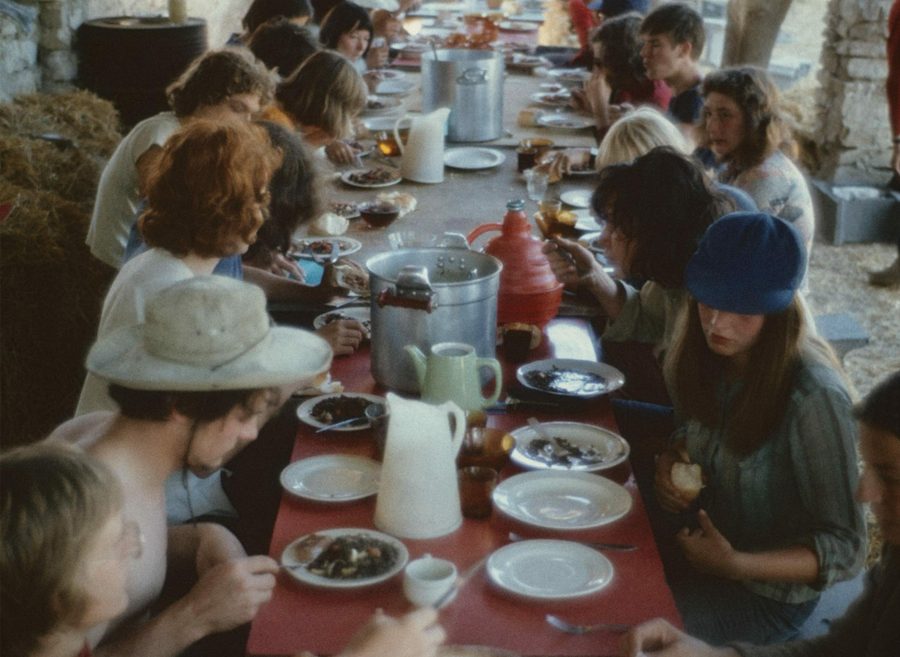
Longo Maï, an agricultural cooperative in Limans, France.
Wikimedia CommonsNo Exit
Rachel Kushner’s Creation Lake cedes the sense of possibility that animates her earlier novels.

Discussed in this essay: Creation Lake, by Rachel Kushner. Scribner, 2024. 416 pages.
In an essay included in her 2021 collection The Hard Crowd, the novelist Rachel Kushner pays homage to the Italian writer Nanni Balestrini, whose work forced her to question the link she had previously drawn between “style and cynicism.” In her youth, she writes, she had “regarded a lack of nihilism as an artistic weakness,” reasoning that in order “to leave nothing sacred” one had to feel a certain “contempt for humanity.” But Balestrini’s novels convinced her otherwise; they seemed to derive their subversive power not from misanthropy but rather from “a kind of indestructible belief in revolutionary possibility.” This insurgent literature was rooted in the writer’s lifelong commitment to radical politics: He was a founding member of the leftist group Potere Operaio (“Workers’ Power”), and his celebrated novels We Want Everything (1971) and The Unseen (1987) emerged from his involvement in the revolutionary struggles of the 1960s and ’70s. Incorporating testimony he had collected from the workers and activists he met in the movement, Balestrini recast the literary protagonist as “a speck in the multitude, a witness,” Kushner writes—“not a person receding from the crowd, but the anonymous political subject, scored with the knife of history.” Thus, she argues, he rejected the bourgeois novel’s traditional focus “on consciousness as distance, distinction, observation, or inner experience,” and with it the individualist ethos that undergirds the status quo. His fiction embraced an interest in the many rather than the chosen few.
Reading between the lines, one can glimpse some of Kushner’s own views on the novel: the idea that it possesses a special capacity to capture the unfolding of collective experience—or, as she put it in a recent interview with The Drift, quoting the literary theorist Fredric Jameson, that it constitutes “time’s relief map, its furrows and spurs marking the intrusion of history into individual lives or else its tell-tale silences.” The supposition that, to realize this potential, the author must strip away some of her characters’ selfhood to make room for the moments that transform their sense of reality. And the thesis that only then might the form animate the possibilities that are eclipsed in hindsight, dismissed when foreclosed as if they never were—a project that involves avoiding both the calcifications of nostalgia and the certainties of cynicism.
These beliefs shape Kushner’s own widely read and award-winning novels, Telex from Cuba (2008), The Flamethrowers (2013), The Mars Room (2018), and, most recently, Creation Lake (2024). Her characters are often ciphers who stumble into moments of historic uncertainty—people who are fundamentally anonymous even to themselves, and who become instruments of upheaval by virtue of their malleability. For instance, her debut, set during the Cuban Revolution, includes among its large cast of protagonists a weapons-running, allegiance-shifting French aristocrat who views revolt, regardless of its ideological bent, as “a luminous bubble” in which a shrewd person finds everything ripe for the taking. In The Flamethrowers, it is the very blandness of the young narrator known only by the nickname “Reno”—the everywoman status underscored by her “cake-box face” and all-American naivety—that allows her to blend into various scenes and subcultures, landing finally in the world of 1970s Italian radicals much like the ones Balestrini described. At a march in Rome that gives way to a violent riot, she witnesses a “kind of counterreality,” a suspension of ordinary order, encapsulated in the sole image she records on her camera, of a flock of rising white balloons. As Kushner’s characters lose themselves in the tumult, the reader, too, is invited to savor the impersonal, transportive energy of the crowd, the bite of the knife of history.
Kushner’s latest novel, Creation Lake, positions her most evasive protagonist to date at the site of another attempted rupture. Our narrator is a woman currently calling herself Sadie Smith, a secret agent who freelances for faceless masters of the universe, at what she’ll have us know are first-class rates. The year is 2013, and Sadie has been sent to the south of France to infiltrate a far-left commune, Le Moulin, whose members are suspected of sabotaging a state project that would destroy the region’s delicate ecosystem to serve the needs of corporate “megagrowers.” Her assignment is to find evidence of the Moulinards’ guilt or catch them in some new act of lawbreaking, even if she has to engineer it herself. Kushner has had a career-long fascination with questions of performance and authenticity—with the idea that identities are “things [one] does,” as she writes in Telex, “things [one] is by virtue of doing them”—and the figure of the spy pushes this thesis to its logical conclusion. Sadie can become anyone (a bleeding-heart activist, a hardened biker chick, or, for the purposes of this job, a grad school dropout adrift in France) because she recognizes that the self is an easily falsifiable construct; nobody is who they claim to be, or who they believe themselves to be at that. While all of Kushner’s characters share a certain swagger, Sadie proves superlative in this regard as well, boasting about her unerring instinct for exploiting others’ weaknesses, even or especially when benumbed by her own barely managed drinking problem. In her rare dalliances with introspection, she seems to be daring the reader to ask what kind of person could think such a thing, precisely so she can then refuse us an answer—as when she emphasizes her lack of remorse over entrapping a young eco-activist on terrorism charges, and her readiness to do it again.
Creation Lake, then, is one answer to Kushner’s own question about what happens when a novel rejects the premium on inner experience. But if Kushner does not reward the reader’s interest in Sadie as an individual, nor does she immerse us in the kind of multitude that is present elsewhere in her work. While her three prior novels contain multiple narrators, she confines herself this time to a single, sometimes suffocating point of view: Sadie is a relentlessly lonely protagonist, a woman who seeks to manipulate every person she interacts with across 400 pages. Kushner’s left-wing idealists turn out to be every bit as self-serving, and the lack of social connection in a novel ostensibly about a commune presents a kind of synecdoche for the absolute hollowness of every supposedly radical idea encountered here. This might seem to have the makings of an incisive critique of certain political subcultures, but the book stops short of becoming one: Kushner never takes the content of these leftist experiments seriously enough to suggest that one might learn from their failures; they register instead as validation of Sadie’s belief in the ugliness of everything. In its detachment, Creation Lake ultimately gives us cynicism as style, a world in which not only is nothing sacred, but everyone is deserving of ridicule. Its nihilism may reflect our political moment, in which a better future often seems out of reach, but it cedes the sense of possibility that animates Kushner’s other novels, proving far too airless to support the flicker of a counterreality.
In its detachment, Creation Lake ultimately gives us cynicism as style, a world in which not only is nothing sacred, but everyone is deserving of ridicule.
As Sadie leads the reader into the world of the commune, it is difficult to distinguish her scornful attitude from the novel’s own. Professed egalitarian ideals notwithstanding, Le Moulin operates according to a clear hierarchy, with young men from wealthy families at the top, responsible for authoring the group’s sweeping manifestos, and women on the bottom, tasked with minding the grimy pack of small children and making meals in a squalid shared kitchen. The Moulinards’ leader, Pascal Balmy, a charismatic son of the Parisian elite, pays lip service to the injustice of this situation, lamenting, “We are not the first group of people to discover that a division of labor between the genders reasserts itself when you try to live in a communal structure.” But it seems that the search for a more equitable approach will have to wait until after the revolution: “We don’t have a magic solution,” he shrugs. In keeping with its regressive gender politics, the commune is infected by a pervasive nostalgia. Pascal worships the French left of the ’60s, especially the theorist, filmmaker, and idol of the 1968 Paris uprising Guy Debord; to underscore the point, Kushner plants a minor character from The Flamethrowers among Le Moulin’s members, a New York radical named Burdmoore who was already mourning the lost revolutionary energy of past decades when readers met him in the ’70s. This adds up to a portrait of people who speak of changing the future but in truth are only playacting scenes from the past.
The fatalism of Kushner’s depiction may derive in part from her source material. Le Moulin is modeled to some extent on the Tarnac commune, named for the small village in central France where a collective of young activists established a farm in the mid-aughts. The group is best known for its probable authorship of the manifesto The Coming Insurrection (2007), a messianic screed against contemporary life published under the byline the Invisible Committee. The text infamously begins from a point of impossibility: “From whatever angle you approach it, the present offers no way out . . . Everyone agrees that things can only get worse.” Dismissing all traditional forms of activism as “useless,” it exhorts us to refuse hierarchies and “form communes,” which will coordinate via “proliferating horizontal communication” to commit acts of sabotage that accelerate and exploit the crises to come. While the tract inspired a generation of anarchists and saboteurs, it also became a weapon in the hands of the security state, which took the authors’ injunction to disrupt the flows of capital as sufficient cause to arrest multiple Tarnac members, subjecting some to yearslong prosecutions in an authoritarian bid to expand the definition of “terrorism.” Borrowing from this string of events, Kushner implies that the Moulinards’ act of sabotage has ultimately imperiled further attempts at resistance, serving mainly to attract the notice of Sadie’s employers, who decide to make an example of the group.
If Kushner’s communards are incapable of offering a way forward, the same could be said of a source of ideas to whom the novel devotes even more time and attention. As part of her work to infiltrate Le Moulin, Sadie hacks into the email inbox of a man the group reveres, an older radical who lives nearby in total seclusion. Bruno Lacombe, in his youth a ’68er and Debord acolyte, has become something far less ideologically legible. His present politics turn on his obsession with Homo sapiens’ ancient ancestors, especially the Neanderthal (or “Thal,” as he familiarly terms this lost forebear), to whom he ascribes a spiritual potential incompatible with our own species’ self-destructive hunger for power, a “stupendous preternatural capacity for a dream life.” In other words, long before humankind strangled earth’s flora and fauna with the kinds of monocrops currently tightening their grip on the south of France, we enacted the same process on our own genome, killing off its most transcendent source of possibility. For Bruno, our vestigial traces of Neanderthal DNA offer the faintest path to another reality—one he has tried to follow by withdrawing from the world, living in the style of our prehistoric progenitors. As Sadie recounts, his emails explain that “revolution, which back in 1968 he had believed was possible, he now understood to be foreclosed. The world ruled by capital would not be dismantled. Instead, it had to be left behind.” Sadie speaks for the reader when she asks in bewilderment: “What would we be exiting, besides reality? What would we tumble into, if not a void?”
The void has, in some sense, replaced the bubble of possibility that forms, pearly and fragile, at the heart of other Kushner novels.
The void has, in some sense, replaced the bubble of possibility that forms, pearly and fragile, at the heart of other Kushner novels. Those books viewed the space that they conjured with a generative ambivalence: In the Drift interview, Kushner emphasizes that, although all of her novels engage political questions, she never writes fiction from a posture of conviction, but rather “from a place of profound curiosity, and profound doubt”; her aim is always to arrive somewhere new through the process, and to offer the reader a similar experience. This commitment seems to drive Kushner’s affinity for thrill-seekers, self-dealers, and other figures who embrace change while remaining nonpartisan on the subject of outcomes. In Telex, the Frenchman says that he “loved revolt. It was his favorite part of revolution,” reflecting that his dearest wish is to “fight with conviction and for nothing.” The bravado of such lines conveys a specifically Kushnerian telos, a devotion to speed for speed’s sake and extremity at all costs—to pushing the limits, courting the crash. The author’s symbolic lexicon is notoriously full of motorcycles and muscle cars (these play a particularly prominent role in The Flamethrowers, where Reno wants to make art out of her own tire tracks, seeking meaning in the mere fact of acceleration). Though Kushner’s all-consuming interest in rush and rupture can feel, at times, like a form of nihilism, her refusal to turn to what comes after a cataclysm also allows her to dilate the rare moments when all things seem possible, and to convey their distinctive charge of alterity.
The dulling sensation of reading Creation Lake results from the absence of any such electricity. Here, the only chance of transformation seems to lie in the past, in the intimation of other worlds contained by Bruno’s strange atavism. One of the book’s most thrilling passages is a lengthy discourse on an apparently fictional medieval rebellion, in which France’s persecuted Cagot minority joined forces with the peasants who had traditionally shunned them to temporarily seize power from the local aristocracy. Convinced that the mem-bers of this racialized underclass were actually surviving Neanderthals, Bruno sees this moment of anomalous solidarity as a door briefly opened and then slammed shut. Other such portals are lodged deeper back in prehistory. As part of his retreat from modern life, Bruno has begun living part-time in the network of ancient caves that stretch beneath the region; he claims to find in the darkness a remnant of premodern consciousness, an attenuated access to the less rapacious worldview of much earlier man. And yet, if his vision of the future involves reclaiming the underground world, Bruno does not seem to mean this in any sense that could prove socially transformative, but rather in a mystical vein only accessible on an individual scale. (He dismisses people who “build bomb shelters, planning to survive some version of apocalypse” as “armed pessimists hoarding canned foods and fearing each other.”) There’s an undeniable power to these images—the Cagots storming the lord’s castle, the ghosts of a lost past looming up out of the dark—but they remain insubstantial, inaccessible, leading nowhere but back into an unyielding present.
The novel’s relentless dead-endedness does prove rewarding in one key respect: by facilitating Kushner’s sly subversion of her chosen genre. In Cover Stories, his 1987 study of spy thrillers, the cultural historian Michael Denning writes that they emerged in the early 20th century, an era “when the existence of rival imperialist states and a capitalist world system made it increasingly difficult to envision the totality of social relations,” to offer the novel a “short cut” to encompassing an “incomprehensible social order”; the secret agent returned “human agency to a world which seems less and less the product of human action.” According to this characterization, Creation Lake might be understood as a kind of anti-espionage novel, permitting us to see only the limits of our own field of vision, and Sadie’s evacuated interiority might be said to reveal a world where even the consummate operative is stripped of agency, and life is ruled by obscure forces and random chance. Indeed, for a figure designed to peel back the layers of history, Sadie shows herself to be veiled in ignorance, having accepted the anonymity of the shadowy elites who hired her—are they private interests? government surrogates?—and acknowledged that she can’t fathom why they have assigned her to monitor not only the Moulinards but an unpopular third-tier minister. Where the classic spy story might include a dip into paranoia followed by a resolution in which all becomes clear, Sadie never pulls out of her own nosedive of self-delusion, growing progressively drunker and increasingly overconfident. But if this play on genre is the book’s most intriguing turn, it still ultimately reinforces the prevailing sense of claustrophobia: Once again, the novel loses its bearings instead of finding them, leaving the reader shrouded in fog.
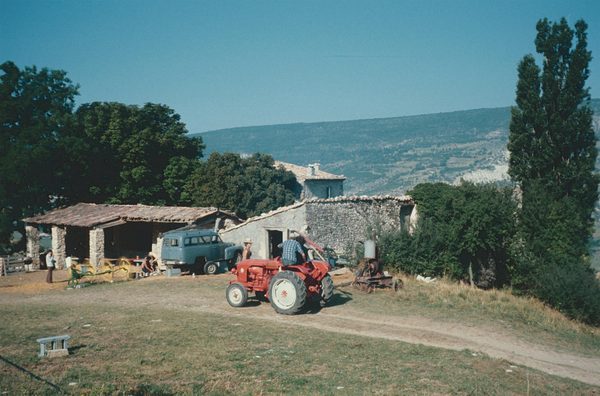
Longo Maï.
At times, Kushner seems to undercut not only the genre of the spy thriller, but the form of the novel itself. What is Sadie but a metafictional joke on the very idea of a character—one that she herself makes explicit, summarizing the scant résumé she sketched out for this role and asking derisively, “What else would a person need to know?” (Since she shares hardly more of her past with the reader than she does with her targets, this quip seems to be delivered partly at our expense.) The concept of plot comes in for similar treatment. After Pascal rationalizes a slipup of Sadie’s as a “coincidence,” she thinks contemptuously that his belief in serendipity works to her advantage, concealing what “is instead a plot.” But when Sadie’s mistakes accumulate, it’s a coincidence that saves her ill-conceived plan from failure, undermining her claim to be the one who pulls the strings.
Of course, even though Sadie loses her grip, the novel’s finale remains under command of that more skillful manipulator, the author herself. Kushner has floated the idea that the novelist is a form of secret agent, lurking incognito inside a text. “What interests me,” she told The New York Times shortly before Creation Lake’s publication, “what I know, understand, is people who find ways to build their own reality,” who believe “they are authoring the world around them.” It’s a telling formulation, framing the work of greatest interest—the arranging of possibilities, on the page or within it—as inherently solitary, even antisocial in that it consists of bending others to one’s own will. Previously, Kushner’s fiction has been propelled by a much more am-bivalent relationship to individualism: Her protagonists romanticize the freedom of self-reliance—the untouchable in-dependence of soaring recklessly on a bike in The Flamethrowers, or, in The Mars Room, the brittle solitude of an off-the-grid cabin—even as they yearn to merge with the multitude, to join a wave of people so big that it might overwhelm the constraints of our presently unfolding history. Creation Lake casts its lot more definitively, disrupting this taut balance. The sole exception to Sadie’s near-total emotional isolation is the reverence she gradually develops for Bruno, who never learns of her existence, though she addresses him as an intimate friend in her head. Bruno himself is even more alone, writing long emails to acolytes who cease to respect him, listening in the cold of the caves for the echoes of our long-lost ancestors, a “deep cistern of voices, the lake of our creation.” This is the only form of connection that the novel offers: parasocial communion with the idealized unknown, the preternaturally cloistered, the dead.
For Sadie, the primary relationship is ultimately the one with the self, whose essential reality she turns out to believe in, even as she dismisses its most recognizable features. In a key passage, she insists that “there are no politics inside of people. The truth of a person, under all the layers and guises, the significations of group and type, the quiet truth, underneath the noise of opinions and ‘beliefs,’ is a substance that is pure and stubborn and consistent. It is a hard white salt.” The image reifies a binary between the self and the world, suggesting that only what sits beyond others’ influence can be considered authentic. But is any part of us really immune to the effects of material circumstance and social experience? And why should the qualities acquired through interrelation—in love or antagonism, pressure or solidarity—be any less real than the rest?
Reading Creation Lake, I found myself thinking about another novel of unrelenting political cynicism. If Doris Lessing’s most famous work, The Golden Notebook, is partially a tale of political disappointment—of Communists reckoning with their break from the Party and the death of all the dreams it represented—then The Good Terrorist, published more than two decades later in 1985, burns with a more bitter brand of disillusionment. Its young radicals’ rage against the world is utterly incoherent, pathetically impotent; they screech about “fascists” whenever challenged (even by a “comrade”), and take it upon themselves to bomb London in the name of the IRA (even after the organization turns them away). And yet, Lessing treats the substance of this wretched band’s lives with the utmost seriousness, detailing their shifting relationships and the difficult work of making their latest squat habitable with a close attention that conveys, in itself, a certain respect for the labor of building a fragile alternative.
Kushner, too, has portrayed social worlds that are simultaneously repellant and richly alive. The Mars Room, about a women’s prison, investigates the savagery of American fantasies about freedom, exploring how our mythology of self-reliance requires the violent disappearance of anyone who interferes with the narrative. Its incarcerated characters share these common dreams of domination and untainted solitude. But they also find, in one another, a redemptive form of community. To write the novel, Kushner undertook extensive research, cultivating relationships with incarcerated women, and her fictional prison is full of intricate shared life. Women pass contraband via the toilets and impose rigid systems of order and cleanliness—and, in their moments of greatest despair, recast one another as surrogate family. They can’t access freedom in prison, even for a minute, but they can offer each other some refuge, if only fleetingly.
Social life—which is to say, life in general—is nowhere to be found in Creation Lake. Sadie comes closest to sharing a moment with another person when she approaches an old man whom she believes to be Bruno. He claims to have no idea who she’s talking about, and they part ways without another word. A different novel would have staged a real encounter, a meeting that might have precipitated some shift in the book’s world or at least in Sadie herself, affirming that such transformation is possible. But this non-connection turns us, again, toward absence—of our narrator’s inner life, of community that might feed it, of a future we could imagine, or even hope for.

I’m Arielle Angel, editor-at-large of Jewish Currents. Before you go, there’s something I need to ask.
We’ve seen over and over how the mainstream media falters in telling stories on our beats—whether it’s antisemitism, Israel/Palestine in American politics, Jewish identity, or the American left. At Jewish Currents we’re committed to uncompromising analysis and longform reporting on these issues and more—stories you won’t find anywhere else. In a media landscape that obscures injustice and flattens discussion, we’re changing the conversation. But we need you.
If you believe in this work, please consider making a donation—or even better, a recurring one—to ensure that we are able to keep publishing stories like this one. We can’t do it without you.

Nora Caplan-Bricker is the executive editor of Jewish Currents.