Israel’s Collective Amnesia
Even as Israel continues killing Gazans, its liberals are ready to forget the genocide.
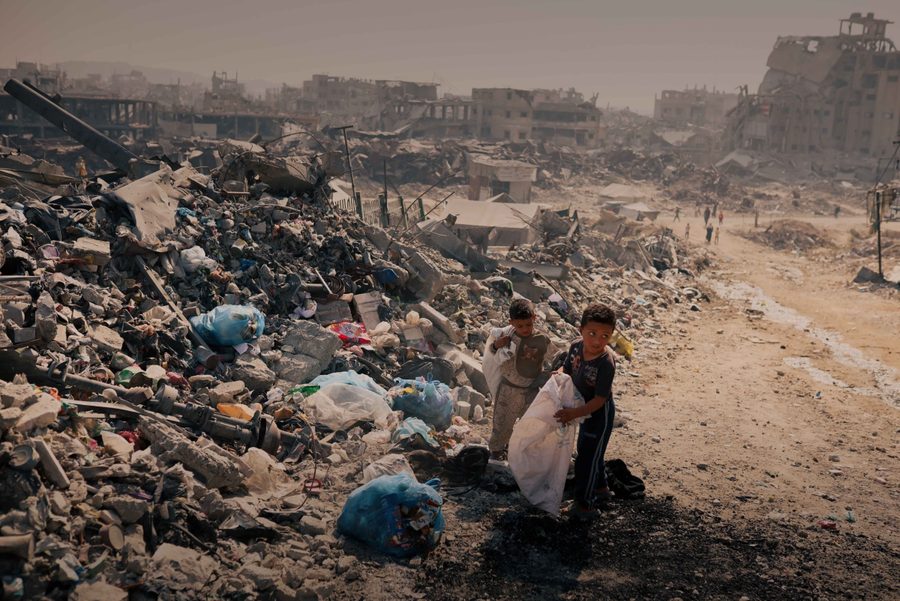
Palestinians walk amid the rubble of destroyed buildings in Gaza City, November 5th, 2025.
On October 13th, three days after the ceasefire between Israel and Hamas took effect, the current head of the Israeli opposition, centrist liberal Yair Lapid, gave a speech in which he declared that “all those who demonstrated against Israel these past two years . . . were deceived.” Before his fellow Knesset members and visiting US President Donald Trump, he announced: “There was no genocide, no intentional starvation.” The well-documented facts—that Israel pursued a relentless policy of starvation, including entirely blocking aid from entering Gaza for 11 weeks straight—were thus rewritten on live TV. This revision of reality laid the groundwork for what was soon to come: a quiet, collective act of forgetting, which aims to make the decimation of Palestinian life in Gaza simply disappear from Israeli memory.
Even as Israel continues killing Gazans, this willful amnesia has begun taking shape in a variety of ways across liberal Israeli society, the very spheres from which one would hope to see an honest reckoning. Proponents of brutality have been uncritically embraced. Yair Golan, rising star of the Zionist left, invited retired general Giora Eiland—who conceived the notorious Generals’ Plan, which proposed starving Gazans who would not leave their homes, and advocated for the utility of epidemics in killing Palestinians—to speak at his party’s event honoring Yitzhak Rabin. Meanwhile, institutions and public figures have moved to assert the boundaries of acceptable memory by rendering certain narratives about the past two years unspeakable. Haaretz, Israel’s leading left-leaning newspaper, published an op-ed by a psychiatrist who works in the public health services system dismissing accusations of genocide from Jews in Israel and elsewhere as a deluded “fantasy of morality,” a pathological form of self-harm that amounted to “moral masochism.” This logic of denial has also found expression in the routines of public life, under the pretext of a return to normalcy. As the Israeli academic year commenced, the country’s two leading universities put out joyful messages, noting with relief the return of the Israeli captives and reiterating their support for students who have been serving as reservists in the military, but saying nothing about the losses of Palestinian students with families in Gaza.
This consolidation of forgetting builds upon widespread Israeli indifference to Palestinian suffering over the past two years. Many Israeli liberals have spent this time trying to look anywhere other than at the devastating consequences of Israel’s actions: A June 2025 poll found that two thirds of Israelis—including 44% of opposition voters—thought that Israeli media did not need to cover the humanitarian crisis in Gaza. (The poll also found that some two thirds of Israelis, including 67% of self-identified centrists and 30% of leftists, believed there were no innocents in Gaza, in essence legitimizing their targeting in the war; other polls have shown that 47% of Jewish Israelis support the widespread, intentional killing of civilians in Gaza and 82% favor the ethnic cleansing of Gazans, with 56% backing the same fate for Palestinian citizens of Israel.) Indeed, Israeli media never paid much attention to the destruction of Gaza, which served as background noise while other stories—the many retellings of October 7th, the hostage crisis, global antisemitism—took precedence.
Ultimately, the liberal Israeli attempt to forget what Israel has wrought on the Palestinians of Gaza is a bid to return to the status quo that reigned from the moment Hamas took over Gaza in 2007 until October 7th. For the vast majority of that period, Gaza and its people remained conveniently invisible to Israelis—periodically erupting into the news cycle in the context of brief but increasingly horrifying spasms of violence, only to vanish from Israeli consciousness once again. In this sense, collective forgetting when it comes to Gaza is hardly new; it’s been an ongoing process for nearly two decades. The past two years of continuous violence made Gaza impossible to ignore, requiring more active modes of forgetting—and now a concerted effort to solidify a whitewashed national narrative that exonerates Israel of wrongdoing. But that passive, normalized neglect of Gazans’ rights, and even their existence, is precisely what led to the tragedy of October 7th and the violence that followed. In their eagerness to forget, Israelis are sowing the seeds of the next catastrophe, allowing them to germinate in plain sight but out of mind.
Over the course of the war, state and media institutions honed an effective strategy for facilitating collective amnesia about Israeli atrocities in real time. Whenever a case of Israeli brutality stirred public controversy, the same basic pattern of events followed: The news breaks; the state waits for it to disappear; if it doesn’t, the state performs some symbolic and utterly insufficient accountability process that at most targets a few grunts; the media fails to follow up, or does so only after Israelis have moved on, and finally, the story dies.
For instance, in early 2025, the Israeli military submitted to international pressure and began investigating six cases of the “mosquito procedure,” in which Israeli troops treated Palestinians as human shields, sending them unarmed, sometimes wearing IDF uniforms, into tunnels and buildings in the Gaza Strip. This practice was used regularly enough that a senior combat officer described it in an anonymous letter as creating a literal slave class. A handful of soldiers were interrogated by military police, the results of the investigations were never published, and the story—and the practice—receded from public attention. In March 2025, Israeli soldiers killed 15 paramedics and first responders in Rafah; the military first denied being involved, then attempted to cover up their crimes with a series of falsehoods that were debunked in the following weeks and months. Israeli media refrained from seriously investigating the incident, leaving international media to uncover key aspects of what happened. No one faced meaningful consequences: Eventually a commander was reprimanded, and a single reservist was discharged from military service—more for his lies in an internal military investigation than for the killings themselves.
Similar dynamics have played out in the notorious case of Sde Teiman, where detainees were abused physically and sexually and where the local infirmary had patients constantly blindfolded, in diapers, and chained to their beds. Although abuse was widespread, only a handful of soldiers were questioned about just one of the many instances of mistreatment at the military base—sexual abuse caught on camera and leaked to the media last summer. Even this limited response was so anathema to Israeli norms that right-wing mobs, which included Knesset members, overran the two military bases where the interrogations occurred. The investigation for breaking into the bases, in which people who were identified by the police were not interrogated for months, is advancing at glacial pace, with no trial in sight. And almost a year and a half after the initial revelations, only five soldiers have stood trial for the actual abuse, in a case that is still ongoing. (A recent poll reveals that over 60% of Jewish Israelis oppose the investigation of Israeli soldiers accused of abusing Palestinian detainees or prisoners.) The whole matter was generally forgotten in Israel until it was revealed in late October that the military advocate general was the one who leaked the incriminating video. Even as the story has returned to national headlines, public attention has focused on that official’s misdeeds and her dramatic fall from power, with some publications portraying the soldiers as victims of her actions.
These instances of insufficient accountability and evanescent attention are the exception; far more commonly, Israeli perpetrators of violence against Palestinians have faced no accountability process at all, their crimes never entering the public consciousness. I’ve seen this clearly in my own efforts to synthesize the evidence for Israeli war crimes since October 7th—confronting countless incidents of violence that most Israelis never heard about—and through the work of professionals who have catalogued this violence systematically. Last August, the leading Israeli human rights group, B’Tselem, put out an extensive report detailing abuses against Palestinians in the Israeli incarceration system entitled “Welcome to Hell”; a year later, the group concluded that Israel was committing genocide in Gaza and released another comprehensive report. None of this received significant coverage in Israeli media. Even in Haaretz, these findings quickly vanished from the front page, allowing liberal readers to treat such reports as passing media events rather than assimilate them as enduring revelations about Israel and its conduct. The result is a pervasive cultural ethos of permissiveness and impunity, in which Palestinian suffering goes almost entirely unacknowledged.
That ethos has been fostered even by the Supreme Court—the very institution Israeli liberals took to the streets to defend, as one of the last bastions of Israeli democracy, in the months before October 7th. The court refrained from looking into the mounting allegations of widespread abuse of detained Palestinians and from examining the possibility of widespread harm to Palestinian civilians in Gaza, avoided enforcing investigations into the thousands of cases where such harm was recorded, and allowed the state to continue its campaign of starvation. This lack of scrutiny from the very institution charged with serving as a check on power helped keep this violence out of the public eye as it unfolded, paving the way for the public forgetting of this moment.
Domestic mechanisms of amnesia are now being aided and abetted by international ones. Despite immediate and continued Israeli violations, the ceasefire has been enough to convince too many bodies and states to move on. Almost immediately after the truce was announced, the European Broadcasting Union postponed a vote about Israel’s participation in the Eurovision song competition, a symbol of Israeli connection to and acceptance within European culture. Germany, which had declared that it would stop selling Israel offensive weapons in August, signaled that it would lift its embargo only a couple of days after the ceasefire went into effect, and recently followed through. (A week after the ceasefire it had already signed a two billion Euro deal to acquire Israeli Spike missiles.) And French President Emmanuel Macron went back on his commitment to exclude Israeli companies from a major arms expo. If such efforts to hold Israel accountable continue to collapse, Israelis will understand that the horrors of the past two years can safely be forgotten—an understanding cemented by the Israeli media, which has emphasized these reversals while downplaying the overall effects of weapons bans, thus reassuring the public that the world has moved on and any lasting impact will be insignificant.
Together these forces are helping Israel’s refusal to face the reality of what it has done, and thus to maintain the core national myths that the past two years have clearly disproven, like Israel’s military, economic, and diplomatic independence, or the idea of the IDF as “the most moral army in the world.” With this violence firmly forgotten, Israelis will be free to return to a more comfortable, passive mode of neglect of Palestinian life. For both domestic and international critics, disrupting this amnesia will be extremely challenging. After all, Israel allowed the pre-October 7th status quo with Gaza to persist because it secured many benefits and cost little. And of course, the Israeli tradition of forgetting is deeply rooted, extending all the way back to Israel’s origins: Since 1948, both state and society have rigorously strived to forget the founding violence of the Nakba through means ranging from enacting legislation to physical destruction. Winning justice for Palestinians—and the enduring security that Jewish Israelis claim to want—will require reckoning with this entrenched national ethos of denial. Until we are finally willing to remember the horrors we’ve already wrought, there will surely be more to come.

I’m Peter Beinart, editor-at-large of Jewish Currents. Before you go, I need to ask something of you.
In recent years, I’ve watched as mainstream Jewish institutions and media have chosen ethnonationalism over liberal democracy and mass slaughter over the pursuit of a just peace. Jewish Currents offers something different. It’s a magazine built on intellectual curiosity and respect for the dignity of all people.
But a project like this doesn’t sustain itself, and we can’t do it without your help. If you share my belief in the importance of this mission, please consider making a donation—or even better, a recurring one. We need you with us.
Lee Mordechai is founder of the Bearing Witness project and a senior lecturer in the Department of History at the Hebrew University.