Egypt’s Hidden Refugee Crisis

Thousands of Palestinian evacuees are living in limbo on Cairo’s peripheries, neither able to return to Gaza nor allowed to build lives in Egypt.
The Tadamoun complex housing Palestinian medical evacuees in Obour City, northeast of Cairo.
Palestinians living in the new housing complex call it “Tadamoun,” Arabic for solidarity. The apartments are located on the outskirts of Obour City, northeast of Cairo. The rooms inside are freshly painted, the furniture still stiff with newness. Residents do not pay rent or utilities, something 36-year-old Alaa[1]—who was evacuated from Gaza nearly 16 months ago—really likes. But every time she leaves or returns, Alaa must sign a thick, cardboard-bound ledger where her movements are recorded in columns of looping handwriting. The same goes for the few visitors who are ever allowed in. Egyptians and non-Palestinians are generally barred without special permission from the senior guard, a restriction this reporter navigated to gain a rare first look inside. And even after gaining pre-approval, visitors must still list their contact information in the ledger and hand over ID cards to the uniformed security guards standing at the makeshift gate, walkie-talkies in hand and eyes full of distrust.
Alaa’s journey to Tadamoun was paved with horrors. She recalled that it was 10 am on a Monday in December 2023 when an Israeli missile buried her and her five children in the rubble of their Deir al-Balah home. She emerged clawing through concrete to find nine-year-old Dua bleeding profusely from severe wounds in her leg, and her then two-month-old infant son, Ahmed, flung across the room. “Only God saved Ahmed from that strike,” Alaa told me. At the hospital in Gaza, doctors immediately scrambled, through the Palestinian Health Ministry, to coordinate with Egypt on the emergency evacuation that was needed to save Dua’s leg. Eventually, Alaa and her children were sent in an ambulance through the Rafah crossing, the Gaza Strip’s only window to the outside world, into Egypt, a trip the family made “with only the house gown I was wearing; not even identity documents with us,” Alaa said. The health ministry assigned the family to a government-run hospital in Tanta, 55 miles north of Cairo. And after 11 months of treatment there, during which Dua’s leg underwent several operations and was fused with twelve surgical nails and a platinum rod, the family were sent to the Tadamoun complex, where Dua awaits reconstructive surgery. “Thanks to Egypt, we have a roof over our heads. We don’t have to worry about kids having to sleep on the streets,” said Alaa. “But we feel isolated. We live in uncertainty not knowing what tomorrow is hiding for us.”
The family’s case was one of hundreds of such wartime evacuations the Egyptian Health Ministry allowed before Israel seized control of the Gaza side of the Rafah crossing on May 7th, 2024. According to a press release from the Egyptian Health Ministry, prior to last May, medical evacuees—a term that covers the injured, the chronically ill, and those otherwise vulnerable—crossed Rafah at the rate of at least 50 people per day, 60% of them children. A recent WHO report estimated that by April 2025, 4,045 of Gaza’s 7,229 medical evacuees remained in Egypt (the rest were ultimately treated in a third country after transiting through Egypt). Many medical evacuees were in need of burn care, reconstructive surgery, and treatment for serious illnesses such as cancer or cardiovascular conditions, much of which was unavailable in Gaza even before the war. Once in Egypt, these Palestinians were scattered across some 160 hospitals in areas ranging from Sinai near the Gaza border to Luxor 600 miles south—and when discharged, many of them landed in the Tadamoun complex.
Indeed, while the complex’s 28 seven-story concrete blocks were originally built to absorb Cairo’s population overflow, Jewish Currents has found that ten of these buildings have now been quietly repurposed as an ad hoc shelter for at least 1,500 medical evacuees from Gaza, according to residents’ and food distribution volunteers’ estimates. Over the years, Egyptian leaders have taken pride in declaring that Egypt does not have refugee camps on its soil. “Egypt has continuously offered refuge to those fleeing conflict and persecution, adopting an out-of-camp policy and implementing inclusive policies,” Ambassador Wael Badawi, Deputy Assistant Foreign Minister for Migration and Refugee Affairs, told the United Nations Office of the High Commissioner for Refugees (UNHCR) just last month. But the existence of Tadamoun—which Egypt has not revealed to its public—calls this claim into question. (Neither the Egyptian Health Ministry, in charge of receiving medical evacuees at Rafah, nor government spokespeople or officials of the Red Crescent who operate at the complex, returned multiple phone calls seeking clarification about it.)
The Tadamoun complex’s 28 seven-story concrete blocks were originally built to absorb Cairo’s population overflow, but ten of these buildings have now been quietly repurposed as an ad hoc shelter for around 1,500 medical evacuees from Gaza.
The Egyptian government’s decision to receive Palestinians from Gaza while concealing their presence reflects a broader pattern in which officials are trying to support evacuees while ensuring their stay in the country remains uncontroversial, and more importantly, brief. “Egypt has repeatedly emphasized the temporary nature of any Palestinian stay,” said Oroub El-Abed, Professor of International Migration and Refugee Studies at Birzeit University. This is true not only for the thousands of medical evacuees from Gaza—who have largely come to Egypt either without visas or on tourist visas secured with the help of humanitarian organizations—but also of the more than 100,000 non-medical evacuees who have entered after paying steep fees of up to $5,000 per adult to the Egyptian coordination company Hala. Like their medical evacuee counterparts, these Palestinians have also been denied refugee status, which would come with obligations to provide them with permission to work, access to courts and education, and other basic rights.
The result has been a hidden refugee crisis, unfolding not in white tents marked with telltale UN flags, but instead in isolated housing complexes like Tadamoun and Cairo neighborhoods like Nasr City, home to a large population of new Palestinian arrivals. In these areas, Palestinian evacuees have been living for months on expired visas. Lacking residency documents, they are prevented from getting a job or new shelter; accessing public schools, hospitals, and universities; and other basic tasks such as opening bank accounts or obtaining SIM cards in their name. Many have burned through their savings to escape, and are living on dwindling support from relatives and friends in what feels like a permanent limbo, where both returning to Gaza and building a life in Egypt remain equally unviable. Kelsey P. Norman of Rice University’s Baker Institute for Public Policy told Jewish Currents that, by leaving Palestinians “unable to access basic assistance or employment, Egypt—despite its outwardly pro-Palestinian stance—ultimately hopes they will be forced to return to Gaza.” In the process, Jeff Crisp, former head of Policy Development at UNHCR, told Jewish Currents, “many of the basic principles of international humanitarian, human rights, and refugee law have been routinely violated.”
Egypt wasn’t always so hostile to Palestinians. “Historically, Egypt welcomed Palestinian refugees, particularly under [former President Gamal Abdel] Nasser in the 1950s and 1960s, treating them almost as nationals with access to employment and public services,” El-Abed said. But that policy underwent a stark shift after the 1979 peace agreement Nasser’s successor Anwar Sadat signed with Israel—and especially after a Palestinian militant faction assassinated a key Sadat advisor. Afterwards, Palestinians living in Egypt were swiftly stripped of fundamental rights, including access to public education, state employment, and essential services, and from that point forward, they have largely been treated as foreigners. El-Abed noted that “this restrictive posture continued under successive governments,” becoming particularly prominent under President Abdel Fatah Sisi, whose close alliance with the US and Israel has reinforced “a securitized, politically cautious approach to Palestinians, avoiding any policy that could antagonize these allies or appear to support Palestinian militarism.”
At the same time, however, Egypt cannot wholly ignore the Palestinian cause, which enjoys immense support among its people. Thus, analysts say that the country has had to strike a careful balance since October 7th to manage public outrage over the devastation in Gaza and ensure that it didn’t turn into mass protests. “They’re afraid of the street,” said Mahienour El-Massry, a lawyer and activist based in Cairo. “Their popularity is already dangerously low because of the bad economy. Add to that the repressive political climate and any movement by the people starts to look like a threat to their hold on power.” As a result, El-Massry said, “from the beginning of the genocidal Gaza war, El-Sisi’s government has projected a posture of public solidarity with the Palestinians,” tolerating mild forms of support for the Palestinians—donations, aid convoys, Friday sermons, and grassroots relief efforts—while still adhering to Israel’s security demands that prevent the movement of goods and people through the Rafah crossing, refusing to take any diplomatic action against Israel, and harshly cracking down on pro-Palestinian protests at home.
The issue of Palestinian evacuees from Gaza has only compounded Egypt’s dilemma. Starting in October 2023, Israel has repeatedly pressed Palestinians to leave Gaza while relentlessly bombing and starving the enclave. Under the Trump administration, the US has joined in, proposing total ethnic cleansing of the Palestinian population and the transformation of the area into a luxury “Gaza riviera.” Any of these plans would require Egypt to accept Palestinians en masse. So far, the country has refused to do so. Experts say that this position has to do with a fear of internal instability alongside the concern, per El-Abed, that “hosting refugees permanently or creating camps in Sinai could be seen as absolving Israel of its obligations under international law and undermining any remaining claim to a two-state solution.” But even as it has refused to help empty Gaza thus far, “today’s Egypt lacks both the capacity and the courage to confront the policies of Israel and the US,” said Dima Alsajdeya, a researcher at the Paris-based Collège de France. This is evident in the fact that Egypt has still had to accept over 100,000 Palestinians fleeing Israeli assaults that it cannot meaningfully oppose. Egypt’s strategy in dealing with these evacuees has been one of containment: Take them in but keep them secluded and quiet; overlook visa overstays but deny any path to a more permanent resettlement.
Egypt’s strategy in dealing with Palestinian evacuees has been one of containment: Take them in but keep them secluded and quiet; overlook visa overstays but deny any path to a more permanent resettlement.
For displaced Palestinians in Egypt, this set of political conditions has offered a paradoxical life: safe, yet stifling; livable, but only just; an exile disguised as a short-term stay. Alaa articulated these ambivalent feelings over several conversations we had in Tadamoun, describing how the restrictions of her new situation became obvious as soon as the family arrived in Cairo on Eid al-Fitr. The day should have signaled joy and presents from relatives. Instead, the six members of the family were confined to one hospital room for nearly 11 months, never allowed outside “not even close to the elevator’s door,” Alaa said. Nadia, 37, who was also confined in the same hospital for a rare blood disorder, said patients were told the regulations came from “the health ministry and from the [Palestinian] embassy. We had to comply.” Over time, as Alaa and Nadia developed a relationship with sympathetic nurses and other patients, the restrictions became a bit easier to navigate: Once, Alaa recalled, a nurse helped them sneak past the hospital’s surveillance cameras to go get extra groceries, while another took the children to a local park.
This combination of care and constraint has followed Alaa, Nadia, and their fellow medical evacuees to Tadamoun. Residents are relieved the Egyptian government doesn’t charge for their stay, but say there are no schools, clinics, shops, or public transportation amenities nearby. The unmarked complex stands in relative isolation, accessible only by private car or tuk-tuk along a desert toll road connecting Cairo and Belbis. This remoteness, coupled with their lack of funds and legal status, effectively prevent them from integrating into Egyptian society.
In this situation, many residents rely on aid for survival. In interviews, Palestinians housed in the complex said they receive some humanitarian supplies, but it is only a trickle compared to the scale of their need: a single food box every three weeks from the Egyptian Red Crescent with rice, noodles, tea, and some sugar. A few cash handouts from private individuals arrive, too: 200 Egyptian pounds ($4) here and 500 ($10) there, brought by NGO staff, volunteers, and distant relatives who can make the journey. Nadia said that she and her five kids end up chasing tips for assistance. “Every day, we fill out forms for aid online. Every day, there’s a new link to follow,” Nadia said. “We tried everything. Nothing leads to anything.” Nadia is particularly on the lookout for extra help because her 13-year-old daughter, Amina, has cerebral palsy and requires diapers, frequent hospital visits, and physical therapy. She is also gradually losing her sight. “She now finds her way by touching the walls,” Nadia said.
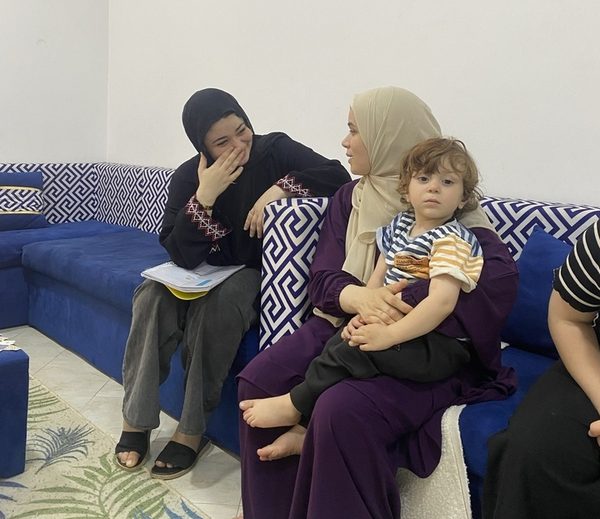
In her Tadamoun apartment, medical evacuee Alaa cradles her two-year-old Ahmed.
It is not just the medical evacuees who are struggling to subsist in their precarious new lives in Egypt. For the tens of thousands of non-medical evacuees, too, survival has been tough. Most, like Umar, a 23-year-old engineering student from Khan Younis, now lives with his mother and brother in a small apartment they’ve rented for 15,000 Egyptian pounds ($300) a month. But, like many other families, after their 45-day tourist visas expired, their lives came to a halt. The expiration date on the triangle-shaped Egyptian entry stamp has now become an impassable wall: “Without it, you can’t apply for anything,” Umar said. “Not internet, not utilities.” In Gaza, Umar had two years left on his degree. In Egypt, universities refused his credits, requiring him to start over and pay exorbitant international student fees that he cannot afford.
According to statements by Diab al-Louh, Palestinian ambassador in Egypt, Umar is one of some 7,000 Gaza university students who crossed Rafah into Egypt; the vast majority of them are still unable to finish their degrees. Another 25,000 school-age minors came as well, al-Louh said. He told me that Egypt’s al-Azhar Islamic University, which operates its own nationwide 1-12 grade school system, agreed to admit 6,000 Gazan students as auditors. Others have enrolled in online classes affiliated with the Palestinian Authority’s education system in the West Bank. The rest have been left adrift, forced to figure out a way to educate themselves through homeschooling or expensive private tutors.
As a result, Umar, like many others, has given up on education for now. Instead, he paces Nasr City’s streets, knocking on shop doors for work. “Our biggest problem now is finding a job,” he said. Without a permit, he would need to find employment in Egypt’s vast informal economy. Many others in his position are doing the same, seeking work as day laborers, sellers of traditional dishes or clothing via social media, or unlicensed drivers. These jobs are often a step-down from incomes families had in Gaza. For instance, 31-year old Moin—son of a retired university professor—was an accountant in Gaza. Now, in the Cairo neighborhood of Al Rehab, the only work he has found is as a part-time car driver. His mother, Umm Moin, supplements the family’s income by selling baked goods online on Palestinian groups, but the money is still too little: “Education fees for foreigners are high. Rent is very high. Fees for everything are high,” Umm Moin said. Her 77-year-old husband is severely depressed. “At this age, he was not expecting that kind of torment for us . . . the loss of everything in just one day,” she said. “By God, we are exhausted financially and psychologically.”
Had these families had refugee status, they might have secured some access to formal international aid. But such assistance, whether from the UNHCR or other NGOs, is not typically provided to visa holders. Support from the Palestinian Authority’s embassy in Cairo has been largely confined to a one-time $100 payment, and Palestinians say that additional help from the embassy is limited to those with contacts in Mahmoud Abbas’s Ramallah-based government. (Two embassy officials declined to comment on these allegations, and directed Jewish Currents to recent Palestine TV interviews with al-Louh, in which he blamed the shortfalls on limited resources.)
Absent an income and sufficient aid, many Palestinians in Egypt are currently living on funds from family members living abroad. For instance, Umar’s family’s survival now depends on another brother who works in Saudi Arabia and wires them enough money to keep them afloat. Others rely on the charity of strangers, such as the Egyptian nurses who took pity on Alaa and Nadia and began giving them Zakat money (the 2.5% yearly share of savings that practicing Muslims must give to the poor and the needy), or the volunteers who have begun holding classes for children every day in Tadamoun. And yet, it is not enough: Facebook and Telegram groups for Palestinian in Egypt remain rife with requests for help from charities and NGOs.
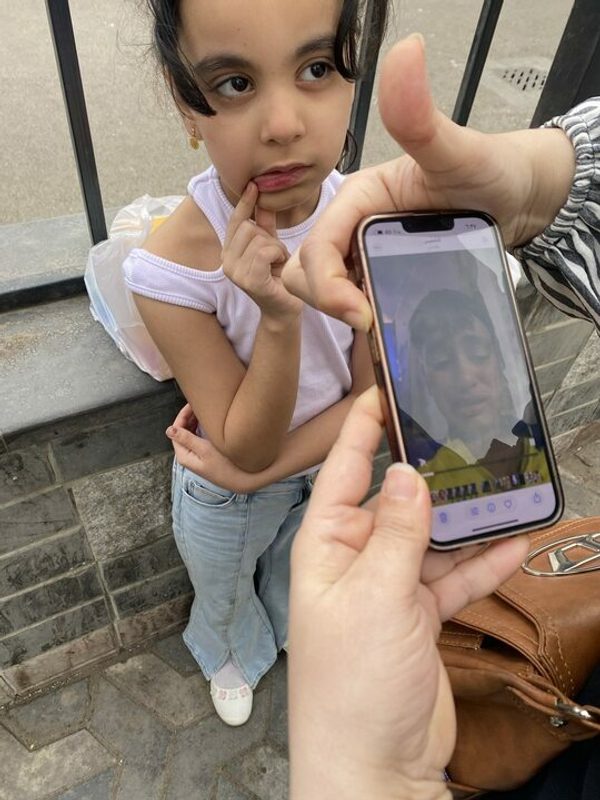
Rabab, a Palestinian evacuee, watches a video of her son left behind in Gaza.
As they eke out lives on Cairo’s dusty margins, many Palestinians are also dealing with the trauma of separation. Umar, for instance, left behind an older brother, who was married with three children and was priced out of the $17,250 fee Hala required to provide passage and secure visas for his family of five. Likewise, Rabab, 42, had to accompany her cancer-stricken sister to Egypt; she was allowed to bring along only her five-year-old daughter Hafa while leaving behind four sons and a husband, her mother, and father. “I taste death every day,” she says, as she wakes up every morning wondering if her children survived the last Israeli strike. She broke down sharing a video of one of her sons still in Gaza pleading: “I want water and food. We’re hungry. Rescue us, Mom!”
Despite this daily witnessing of Gaza’s devastation, however, many of the uprooted still think of returning to Gaza, especially given the precariousness of their lives in Egypt. “If the Rafah Crossing opens tomorrow morning, I’d be the first in line,” Alaa said, cradling Ahmed in one arm. “There, we won’t be guests like we are here.” Nadia, Umar, Rabab, and many others interviewed for this article echoed similar resolve: Gaza is their home. When pressed that Gaza has become unlivable, with no roads, schools or hospitals, these evacuees did not waver. “At least there, we’d be with our loved ones and could pray beside the graves of the many people we lost. If we die, it will be on our land,” Alaa said. Evidence of the strength of this feeling comes from November 2023, when the Rafah Crossing briefly reopened during the first ceasefire. Then, some 1,760 people returned to Gaza within the first six days alone, according to al-Louh’s public statements. “That was a clear sign to us and to the Israelis that many will return,” he said. “Those who had arrived from Gaza in Egypt came for humanitarian reasons and were not part of any willful immigration.”
Whether these Palestinians will have that opportunity to return remains unclear. For now, their reality remains one of displacement and a lack of legal status in Egypt: Children going without schools, parents without work, medical problems compounding. According to Norman from Rice University, Israel ultimately bears responsibility for this situation, as the country that made it impossible for Gazans to be treated in Gaza. But, she added, “Egypt, as the host state, should also bear responsibility for providing a more formal status for Palestinians effectively stuck there. Instead, Egypt has left them in an intentional legal limbo.” As a result of this abdication, “Palestinians in Gaza have been almost completely abandoned,” Crisp said. “They have been denied what is supposed to be a universal right to seek asylum elsewhere.”
Pseudonyms are being used for all Palestinian evacuees to protect their safety.

I’m Arielle Angel, editor-at-large of Jewish Currents. Before you go, there’s something I need to ask.
We’ve seen over and over how the mainstream media falters in telling stories on our beats—whether it’s antisemitism, Israel/Palestine in American politics, Jewish identity, or the American left. At Jewish Currents we’re committed to uncompromising analysis and longform reporting on these issues and more—stories you won’t find anywhere else. In a media landscape that obscures injustice and flattens discussion, we’re changing the conversation. But we need you.
If you believe in this work, please consider making a donation—or even better, a recurring one—to ensure that we are able to keep publishing stories like this one. We can’t do it without you.
Emad Mekay is an independent journalist with extensive experience reporting from the Middle East and US. He has served as a foreign correspondent for Reuters and Bloomberg and his recent work has appeared in outlets including Euronews and Global Insight.