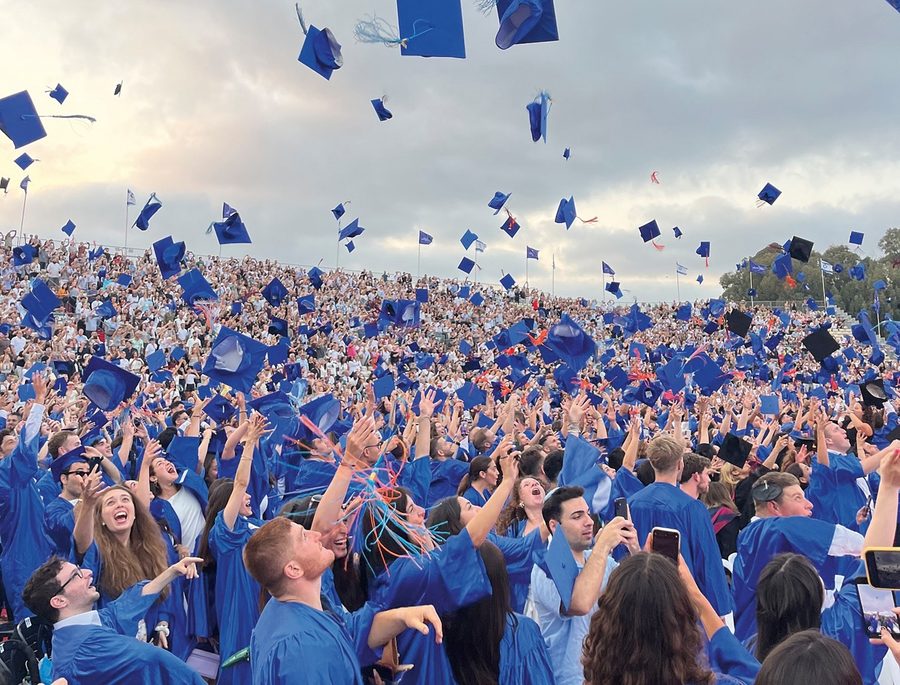
Graduation day at Reichman University in Herzliya, Israel, June 2025.
Degrees of Separation
Israel’s new international college programs offer American students an escape from campus activism while training them as state cheerleaders.

On a sunny afternoon in April, I filed into an auditorium at Reichman University in Herzliya, just north of Tel Aviv, with some hundred prospective students and their families. Outside the auditorium, staff handed out brochures, pens, and tote bags emblazoned with the motto of Reichman’s international school: “Live in Israel, study in English.” We watched a short promotional video for the school, featuring smiling students and grassy quads. Afterward, Jonathan Davis, the head of the international school and the university’s vice president for external relations, took the stage. His presentation was largely like any other college information session: We heard about the school’s majors, dorms, sports teams, and an alumni network he boasted was comparable to those at Ivy League universities. But there was one important difference between those schools and Reichman, Davis explained: “We’re a university where you won’t find any woke or cancel culture or antisemitism.” The crowd cheered.
At a time when university campuses around the world regularly erupt in protests against Israel, Reichman University offers a markedly different option. “We’re not embarrassed to call ourselves Zionist,” Davis told the prospective students. “You’re going to find yourself in a very comfortable situation on this campus.” On the other hand, he noted, “if you’re an avowed anti-Zionist and you support BDS, I don’t think you’ll feel comfortable here.” Davis went on to describe the “tremendous amount of unity” on campus in support of the Israeli military, boasting that 55% of Reichman students had served in reserve duty since October 7th. The school encourages former combat soldiers to enroll by offering them reduced admissions requirements and has even adapted aspects of Israeli military hierarchy into its own social structure: Each new student is assigned to an older student counselor, most of whom, Davis explained, are former military officers.
Reichman, Israel’s only private university, has an enrollment of some 8,500 students, about a third of whom came to the school from outside the country. This international student body is growing, including since October 7th: For the 2024–25 academic year, it increased by 6%. Among the influx were several dozen students who transferred to Reichman from US universities in the middle of the school year. Applications were up for this year, too, and Davis believes the school’s unabashed Zionism is “a big selling point. People don’t want anti-Israel, antisemitic demonstrations,” he told me. “They don’t necessarily want Palestinian flags in their face. And they don’t want to be made to feel bad.”
Reichman has operated its English-language international school since 2001, making it something of an outlier among Israeli universities. Most of its peers have run study abroad programs for decades, and in some cases have offered undergraduate degrees to a small number of international students in particular fields—but full-scale undergraduate BA programs for foreign students were by and large not part of their educational model. Now, though, these schools are following Reichman’s lead; in fact, nearly every research university in the country—including Hebrew University, the Technion, and Tel Aviv University—has opened or significantly expanded English-language BA programs since October 7th or plans to soon. The trend is also spreading to smaller colleges like Kiryat Ono and Western Galilee, which are opening English-language BA programs for the first time in the 2025–26 academic year.
Nearly every research university in Israel has opened or significantly expanded English-language BA programs since October 7th.
Overall numbers of international students in Israel remain small, but they are growing quickly. According to a report by the Kohelet Forum, an influential conservative Israeli think tank, some 1,500 international undergraduates were enrolled in BA programs in Israel in the 2021–22 academic year, a number that doubled to around 3,000 in 2023–24. A spokesperson for Ariel University, which is located in the occupied West Bank, told me the school had seen a 50% increase in enrollment in its English-language program since October 7th; a promotional video for Bar-Ilan University, posted by Jamie Geller, an online influencer who has worked with the school to promote international recruitment, claimed that applications to its international school were up by 40% in the same period. Many of these students’ home communities report the same trend: “It’s night and day in terms of how many students are considering college in Israel, more than ever before,” Esther Genuth, a college-guidance counselor at the Modern Orthodox Frisch School in New Jersey, told me. A few years ago, she said, “there’d be a handful of students looking into Israeli colleges.” Now, “the numbers are really astounding.”
They are increasing in the context of a post-October 7th Israeli immigration boom: Between October 2023 and September 2024, Israel’s Ministry of Aliyah and Integration reported a 62% increase in American Jews opening immigration files—a total of more than 6,000 applications—compared with the same period the previous year. (“Aliyah” is a term used to describe Jews moving to Israel; it literally means “ascension.” Anyone with at least one Jewish grandparent is eligible for citizenship in Israel under the country’s Law of Return.) Increases in applicants from other countries during that period were striking as well: France’s pool of would-be immigrants to Israel topped 5,550, an increase of 355% from the previous year, and Canada’s files numbered over 800, an increase of 87%. The Israeli military is seeing the same trend: During this past March–April recruitment period, for example, enlistment of new immigrants arriving to join the army increased about 40% compared with the same period in 2023. Many of these immigrants are “October 8th Jews,” a term coined by the right-wing American commentator Bret Stephens—and now broadly popular among conservatives—to describe Jews whose commitments to Jewish identity and Israel intensified after October 7th. When I spoke with Geller, the Bar-Ilan-associated influencer, she referenced the “October 8th” concept and explained that “there’s a pipeline” from increased Jewish engagement to studying in Israel to, eventually, aliyah—“the ultimate realization,” she explained, of a “Great Jewish Awakening” that followed October 7th.
Some on the right have been trying to direct diaspora Jews into this pipeline for years, focusing especially on university students. In a 2019 article for right-wing Tablet magazine, the writer Liel Liebovitz called for American Jews “to radically rethink their choices when it comes to higher education” in response to the alleged phenomenon of campus antisemitism and promoted the “crazy idea” of college in Israel as a way forward. When campus pro-Palestine organizing accelerated two years ago in response to Israel’s military campaign against Gaza, the same pundits seized the moment to normalize this “crazy idea” and render it urgent. “Jews need to get out of academia, and they need to get out now,” Liebovitz urged in November 2023 in Makor Rishon, a newspaper associated with Israel’s Religious Zionist movement. “They must understand that there is nothing left for American Jews in the world of academia.” A few months later in the Jerusalem Post, conservative historian Gil Troy proposed “encouraging America’s best students” to attend college in Israel as a way of “draining the academic swamps” in the United States.
Far from empty rhetoric, this sort of hyperbole advertises a political project with increasing formal backing by the State of Israel. Since October 7th, and especially following the rise of encampments on US campuses in the spring of 2024, Israeli university administrators, politicians, and organizations have been urging their government to do more to absorb Jewish students from abroad. Last April, Peretz Lavie, the former president of the Technion—a highly ranked university in Haifa that specializes in science and engineering—published an op-ed in the business newspaper TheMarker comparing the situation of Jewish students at Ivy League schools today to that of German Jewish students in the 1930s. “Now is the time to open wide the doors of Israeli academia to Jewish students,” he wrote, calling on lawmakers to make this project “a national operation.” Days later, Israel’s Association of University Heads released a statement offering to assist Jewish students and faculty “who wish to join Israeli universities and find a welcoming academic and personal home.” In January 2025, the Kohelet Forum published a policy report proposing a plan for doing just that. Like other iterations of this idea, the report argues that at Israeli universities, these students would find “a much more supportive and welcoming environment than at elite institutions” abroad. Projecting this vision into the longer term, it goes on to argue that, over time, “parents and children will change their views on continuing education in American universities. The idea of pursuing a degree in Israel will begin to permeate.” Perhaps most notably, the report positions young diaspora Jews as an “important human capital reserve” for the State of Israel, imagining international students as “strategic assets” who would go on to serve an ambassadorial role on the country’s behalf. In the future, the report concluded, this “Zionist reserve” might play a pivotal role in “enhancing the global reputation of Israeli universities” and “creating a foundation for the advancement of Israel’s academia and economy.” The report’s authors told me that the Ministry of Diaspora Affairs and Combatting Antisemitism adopted this plan and has begun implementing it this year.
The calculating language of the Kohelet report underscores the fact that the push to expand Israeli international schools is not just ideological but strategic. As the scholar Maya Wind, whose book Towers of Ivory and Steel maps out Israeli universities’ role in Palestinian dispossession, noted in an interview, foreign students function as a tool of soft power in the practice of Israeli statecraft: These students, and the esteem and connections they bring with them, have the potential to burnish Israel’s image on the world stage. “It’s a question of prestige, a question of funding, a question of political legitimacy,” Wind explained. Similar to the Kohelet report, multiple advocates I spoke to explicitly framed the presence of international students in Israel as a matter of national interest—even if they don’t ultimately complete the pipeline and move to Israel. “A certain percentage will want to tie their fate to Israel. That helps the state. On the other hand, those who return to the US will be ambassadors of goodwill,” Lavie told me. This comes in the context of Israeli officials’ concern that “what’s happening on US campuses is a strategic threat” to the State of Israel, as Knesset member Oded Forer declared during a parliamentary hearing last May. “The American president, in another 15, 20, 30 years, is a student today . . . on one of these campuses.” For the recruiters of American students, this same threat can also be recast as an opportunity. Yuval Sinai, the co-author of the Kohelet report, was blunt about his plans: He and his colleagues hoped, he told me, to “take advantage of the crisis of antisemitism and the difficulties that students are experiencing” as “an opportunity that would bring diaspora Jews closer to the State of Israel.”
Israel is developing this new soft power strategy as an older one breaks down. Since the 1990s, the Israeli government and Zionist organizations in and outside the country have tried to shore up attachment to Israel among diaspora Jewish youth through tourism and exchange programs that promote an image of Israel as a liberal democracy and support for it as apolitical. As that image becomes increasingly difficult to maintain, these programs have struggled. Their flagship initiative, Birthright Israel, which has brought a total of close to a million diaspora Jews on free trips to Israel since 1999, is now a bellwether of this decline: Participation in the program had already significantly dropped by the summer of 2023. This shift also marks the broader collapse of a multigenerational liberal base receptive to Zionist messaging, particularly in the United States. “There’s a bifurcation going on,” said Nadia Abu El-Haj, an anthropologist and scholar of Middle East studies at Columbia University, referring to the emergence of two opposing poles: a left-wing student movement galvanized by the genocide and a countermovement of young Jews who have embraced a stridently right-wing pro-Israel identity.
The push to expand Israel’s international student body might be understood as an attempt by pro-Israel institutions to cultivate a smaller, more committed base that can substitute for the broad liberal constituency that has been lost. Multiple sources for this piece described Israel’s growing international school network as an intensified heir to Birthright; as the Kohelet report puts it, the older program was like “a good first date; now it’s time for the relationship between Jews abroad and Israelis to take the logical next step” of integration into Israeli society. In framing this narrowing as a “logical next step,” rather than as evidence of contraction, Zionist organizations appear to be attempting to rebrand retreat as progress—and to transform the loss of wider appeal into a show of vitality. In the process, they are drawing on a long-established international tradition of using foreign study programs to serve political goals. Internationalizing its campuses is a “very important legitimizing mechanism” for the state, according to Wind, even if the strategy “has mostly succeeded in attracting Zionist Ashkenazi Jews.” Furthermore, she added, “escalating this strategy over the past two years and in the wake of the student encampments is intended to reinforce the Zionist narrative that American campuses are dangerous for Jewish students and that Israel”—a country that has committed itself to perpetual war—“is the safer choice.”
The push to expand Israel’s international student body represents an attempt to cultivate a smaller, more committed base that can substitute for the broad liberal constituency that has been lost.
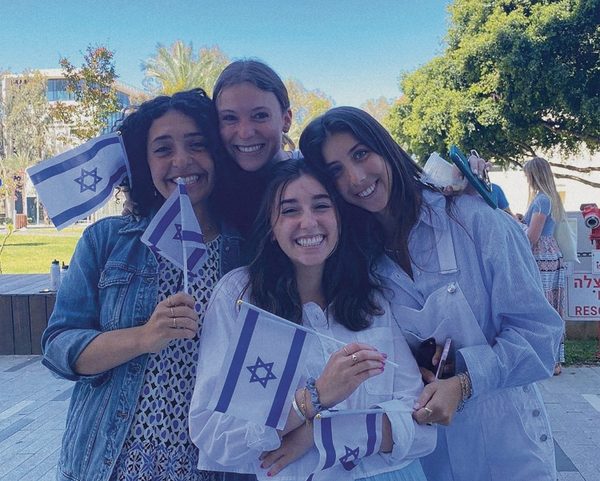
Promotional material from Thrive Study Abroad’s Instagram page
The campaign to recruit international students to Israeli universities has involved the combined efforts of the Israeli government, American Jewish foundations and communal institutions, and the universities themselves. Israel has supported the project largely through its Ministry of Diaspora Affairs, which has grown significantly in the past few years (its annual budget increased from 93 million NIS to 230 million NIS—or $27.8 million to $68.8 million— between 2022 and 2024, including subsidies for settler and other right-wing propaganda initiatives). According to Sinai, the Kohelet report author, the ministry has started funding scholarships for eligible foreign students beginning in the 2025–26 academic year. It has also advertised money for Israeli academic institutions that want to establish additional English language programs and market them to Jewish students abroad, prioritizing those from “hotbeds of antisemitism.” The call specifies that programs must be “Zionist and pro-Israel in nature” to receive funding and that they must require students to participate in a Zionist ideological program developed by the ministry called “Right to Identity.” Other Israeli state funding has been provided by the country’s Ministry of Aliyah and Integration, which recently launched a slew of “academic integration programs” geared toward students coming from abroad who plan to stay in Israel. Last year, 15 tracks opened at 11 institutions, and at least seven more tracks are opening in the 2025–26 academic year, according to Avital Feldman, the head of the English language desk at the Israeli government’s Student Authority, a department within the Ministry of Aliyah and Integration that offers potential immigrants guidance on college admissions. Participating students receive a year of English language courses alongside intensive Hebrew language study, then transition into courses taught in Hebrew.
Much of the private funding for the creation of these academic integration programs in Israel has come from an American venture capitalist named David Magerman via his foundation, Tzemach David. Formerly a major donor to the University of Pennsylvania, Magerman cut ties with his alma mater shortly after October 7th. “There is no place for self-respecting Jewish people at an institution that supports evil,” he wrote in an open letter castigating the university’s president and chairman for failing to explicitly condemn Hamas. “My only remaining hope is that all self-respecting Jews, and all moral citizens of the world, dissociate themselves from Penn.” Magerman told me he now believes that American Jewish parents are engaging in “a form of child abuse” if they send their kids to a top university with a pro-Palestine presence. “The golden age of Jews in America is over,” he added, echoing the title and argument of former New Republic editor Franklin Foer’s popular 2024 piece in The Atlantic. “I view myself as post-America.” Magerman’s pessimism has prompted him to take on a new role in the university fundraising landscape: “diverting money, students, and other resources from American colleges to convince people to support and attend Israeli colleges.” Last summer, he began by redirecting a $5 million gift of his own: Originally earmarked for Penn, the money went to five Israeli institutions of higher education in order to implement the Ministry of Aliyah and Integration’s academic integration program for Hebrew language learners.
One of Magerman’s guiding conceits is that families are more likely to take the idea of college in Israel seriously if it is presented early and often in kids’ secondary education. “Ultimately,” he told eJewishPhilanthropy last June, “we need to get middle school parents to start thinking about Israeli college.” For now, he hopes to make the idea ubiquitous at Jewish high schools in the US and has enlisted college-guidance counselors, mostly from Modern Orthodox schools, to serve, in his words, as its “cheerleaders.” To that end, last summer, Tzemach David—together with Israel’s Ministry of Diaspora Affairs, a Religious Zionist organization called World Mizrachi, and an Orthodox Union program called the Jewish Learning Initiative on Campus—flew ten guidance counselors to Israel, where they toured nine college campuses in four days. Several participating counselors I spoke with afterward seemed to embrace their mission. Rafael Blumenthal, the director of college guidance at the Modern Orthodox Ramaz School in New York City, told me Ramaz has started sharing information about college in Israel with its freshmen and sophomores because “there’s a better chance that they will be intrigued and [the idea will] catch hold earlier on.” Tzemach David ran a second trip to Israel for a new cohort of counselors this summer, and more are planned. The foundation has other initiatives in the works: Early next year, it will debut a new program that will send American Jewish high school sophomores to school in the West Bank settlement cluster of Gush Etzion for a semester, in the hope that they will later attend college in Israel and ultimately settle there.
Israeli universities have also increased their direct recruitment in the US. Last year, Israeli consulates launched college fairs in cities including Chicago, New York, Los Angeles, San Francisco, Houston, and Washington, DC. Multiple guidance counselors I spoke to credited these fairs with their students’ rising interest in college in Israel. “We’re planning to make these annual events,” said Gal Braun, the director of academic affairs at the Israeli consulate in New York. “Jewish high schools are asking us to do them even more often.” Israeli university representatives have likewise ramped up visits to high schools—mostly Jewish ones, but sometimes public schools with large Jewish populations—as has the Israel Student Authority.
Israeli universities can advertise some concrete advantages to American students facing soaring tuition costs at home. Public universities in Israel cost around $4,000 annually (and are free for students who decide to officially immigrate), and even private Reichman, the country’s most expensive school, tops out at $16,900 a year—a fraction of the cost of most US private colleges. Most bachelor’s degrees in Israel take three years to complete rather than four, and professional degrees in fields like law or social work can be attained in the course of undergraduate study. “It’s kind of a no-brainer,” said Orit Coty, the marketing director for Tel Aviv University’s international school, for American students to accept a steep discount on “the level of education equal to a very, very highly ranked university in the States.” Still, it may not be easy to sell many American Jewish families on abandoning the elite American universities that serve as core status symbols in certain milieus. Magerman admitted that one obstacle to his project is that he sees parents “burying their heads in the sand and hiding from reality because they so desperately want their kids to get a diploma with a famous college name on it.” As a result, he said, he anticipates that getting enough American students on board will be a more significant challenge than building Israeli capacity to absorb them.

Promotional materials from Thrive Study Abroad and Rimon Jerusalem’s Instagram page.


In the last few decades, universities around the world have undergone a process scholars call internationalization, pouring resources into programs that foster academic cooperation across borders: study-abroad programs and faculty exchanges, joint research projects, foreign-language degree tracks, and grant partnerships. These projects often have clear economic benefits: NAFSA, a nonprofit that supports international education, estimates that foreign students contributed $43.8 billion to the US economy in the 2023–24 school year and that decreases in international student enrollment for 2025 due to new US immigration practices could cost the country some $7 billion. Universities also get a prestige boost from the presence of international students, with higher-education rankings using this data as a factor in their metrics—a fact that the authors of the Kohelet report pointed out to me numerous times. But foreign student programs have also served a more directly political function since they were popularized during the Cold War. In the mid-1940s, for instance, the US government started the Fulbright Program—one of the first large-scale academic and cultural exchanges of its kind—as part of an attempt at “establishing a democratic empire,” the education scholar Ravinder Kaur Sidhu writes in his book Universities and Globalization; the program’s goal, Sidhu argues, was to “persuad[e] elites from other nations to regard the United States as a friendly authority with whom they shared common interests as members of a ‘free world.’” (The Soviet Union maintained its own international student programs, including Patrice Lumumba Peoples’ Friendship University, founded in the early 1960s to educate elites from newly decolonized countries tuition free.) Today, the US may be retreating from such tactics because of Trump’s preference for hard power over soft—in addition to suspending student visa opportunities, the president has proposed slashing Fulbright funding—but the approach remains alive and well around the globe: In the words of a 2018 Chinese government document, foreign students were meant to “tell China’s story and spread China’s voice” upon returning home, while British government documents from the aughts and 2010s refer to their international students as “unofficial ambassadors” and “long-term advocates.”
Israel has participated enthusiastically in this global trend. In 2017, the country’s Council for Higher Education (CHE), the body that oversees higher education policy and allocates university funding, launched a national five-year plan, with a budget of 435 million NIS ($130 million), to centralize and accelerate the internationalization process. The council’s Study in Israel initiative, which began in 2019, aimed to more than double the number of international students in the country by 2022. The CHE has been explicit about the fact that international partnerships are important not simply for research or profit, but also as a means of securing legitimacy for institutions facing international scrutiny: After a government committee convened in May 2024 allocated 90 million NIS ($26.9 million) to fighting academic boycotts against Israel, of which 32.6 million NIS ($9.8 million) was allocated to the CHE, the Chair of the CHE and Minister of Education Yoav Kisch said that he would work “to incentivize international collaborations in research, and to enable the brightest Israeli and Jewish minds who wish to do so, to complete their research in Israel through unprecedented research grants.” Historically, this tactic has been evident at Ariel University, the only Israeli university located in the occupied West Bank. Ariel has long been excluded from prestigious international research collaborations and funds and has responded by boasting of its international partnerships, which number at least eight with universities in the US, including a 2019 agreement with Florida Atlantic University and most recently with the University of Utah. International collaborations thus become evidence of normalcy; global recognition from certain quarters becomes a defense against boycott from others.
Today, Israeli universities within the country’s 1948 borders are being treated as pariahs in ways once more typical of Ariel, in part because of increased attention to their violation of Palestinians’ rights and their role in supporting the military—the latter of which includes 57 current programs at Israeli universities for active soldiers and those set to be conscripted. The push to boycott Israeli academic institutions, as called for by the Boycott, Divestment, and Sanctions movement, continues to gain steam. Many student encampments in the spring of 2024 explicitly called on their universities to cancel exchange programs and research collaborations with Israeli universities, as with a campaign at Columbia University to close the university’s Tel Aviv Global Center and end its dual degree program with Tel Aviv University. In February 2025, the Association of University Heads in Israel released a report warning of a dramatic increase in boycott activity, documenting a 66% rise in “incidents”—including suspended partnerships, canceled conferences, rescinded invitations, grant refusals, and journal editors declining to publish Israeli scholarship—between October 2024 and February 2025 compared with the previous year, with US cases doubling.
The CHE’s five-year plan was in part an attempt to get ahead of this shift: It established internationalization offices at every Israeli university and tasked them not only with academic collaboration but also with responding to the growing pressure of boycotts. Over the past several years, these offices have gone on to establish programs like Ben-Gurion University’s Desert Academic Research Experience, or DARE, which brings scientists from abroad to the university for a funded summer sabbatical. Ben-Gurion’s vice president for global engagement, Michal Bar-Asher Siegal, told me that the program aimed to humanize Israelis in the eyes of visitors: “They’d meet us, they’d know who we are, and it would be much harder afterwards to imagine us as monsters who eat Palestinians for breakfast.” The name, she noted, was meant to challenge them: “We dare you to come.” She hoped that exposure to Israeli academia would cultivate a more “balanced” perspective less likely to lead to support for BDS. Other initiatives have taken a more overtly political approach to shaping international perceptions. This October, for instance, Ariel University opened an English master’s degree track in “communication, public advocacy, and combating antisemitism” aimed to help students “be ready to legally and rhetorically resist antisemitism in a campus environment.” In another case, an organization called Thrive offers international undergraduates at Hebrew University, Tel Aviv University, and Reichman University a “boot camp” experience to simulate Israeli military training. The program, explained marketing director Rena Zoldan, was designed to counteract media narratives around the Israeli military by giving students “a first-hand understanding” of life within it: “They spend 24 hours under fake fire learning how to shoot and crawl,” followed by a weekend with soldiers. “If you’re just at Tel Aviv University going to the beach every day, maybe you’ll meet soldiers,” Zoldan said, “but you’re not going to get to these conversations and these nuanced views of Israeli life.”

Students in the Thrive Study Abroad program participate in a 24-hour “training” experience with the Israeli military.
This dynamic—at once embattled and opportunistic—has helped shape the state’s approach to encouraging foreign students to come to Israel, especially for full-degree programs. Emmanuel Nahshon, a former Israeli diplomat who works to combat academic boycotts for the Association of Israeli Universities, said he has been in talks with the country’s Foreign Ministry to promote Israel as a destination for international students. His office proposed a 20 million NIS ($6 million) annual initiative to fund tuition and scholarship aimed at “turning Israel into a safe haven for Jewish students from around the world,” though Nahshon stressed the program would also recruit non-Jews. “The idea is to open the doors of the Israeli universities as much as possible,” he told me. “Those who are looking to destroy Israel know that our universities need to interact with the broader academic world,” he explained, “and they see this as a weak point. We must make sure they don’t succeed.”
Israel’s academic community is now confronting a situation reminiscent of South Africa’s in the 1980s, scholar of Middle Eastern studies Seth Anziska said in an interview. The African National Congress first called for an academic boycott in the late 1950s; in December 1980, the United Nations passed a resolution calling for the academic boycott of South Africa, initiating an era of heightened debate and polarization in the international community about how to relate to collaborations, conferences, exchanges, and other work with South African institutions and scholars. As Anziska noted, the South African boycott’s power ultimately lay in “creating an atmosphere of unacceptability,” marking apartheid as beyond the bounds of legitimate engagement. Even if the boycott’s material impact remains a subject of debate among scholars, it helped designate South Africa as an international pariah—an outcome that resonates in Israel today, where boycotts are producing the very sense of isolation that many American Jewish students imagine they are escaping when they choose to study there.
There’s “a fragility about dealing with the reality of Palestine, a fragility in thinking about Israel as a perpetrator of obscene violence,” Anziska said. In Israel, by contrast, these students feel like “lords of the land.”
Even beyond the reach of the boycott movement as such, it is unclear whether the project of internationalizing the Israeli university remains viable in the face of perpetual war. In the past two years, US State Department travel warnings have complicated exchange programs between American and Israeli universities, and many American universities have called off and suspended their programs. Flight cancellations, inflated ticket prices, and limited airline options have further hindered mobility. Israel’s own international student programs are not immune to these logistical challenges: While every program administrator and government official I spoke to had their sights set on expansion, several also reported serious barriers to increasing international enrollment since October 7th.
Still, for the students who will choose Israeli universities, such material barriers, and even dangers, may not outweigh the emotional comforts on offer. When I spoke with Anziska, he emphasized that what Israeli campuses really offer their potential applicants—who feel increasingly alienated in the diaspora yet are insulated from the material realities of Israel’s war in Gaza—is psychological refuge. “It’s a fragility about their identity in America,” he said. “A fragility about dealing with the reality of Palestine. A fragility in thinking about Israel as a perpetrator of obscene violence.” In Israel, by contrast, these students feel like “lords of the land.” The Israeli international schools have made this a clear selling point. A video advertising Hebrew University’s new English-language bachelor’s program opens with footage of Palestine solidarity encampments and the sound of explosions. “Stop. You’re Jewish, yet you’re considering attending universities that you know don’t support your heritage and facing dangerous groups that you know want your people erased?” its narrator asks. “Don’t do this to yourself. Come to Israel . . . Israel is your home. Choose pride. Choose your people.” Now that that program is in its second year, it can also use current students to deliver this message themselves. “The biggest thing for me is that I can proudly assert my Jewish identity on campus,” Shira Litvack, a student in the program, told prospective applicants at an open house. Litvack said that she had started her degree in Canada but had dropped out because of antisemitism. At Hebrew University, she said, “I don’t feel like I have to hide.” The cost, according to Anziska, is that students will accede to “a suspension of reality. They’re in a silo of anxieties, fears, and messaging,” he said.
At the same time, history suggests that there is no guarantee that study abroad programs will achieve their desired political goals. Scholarship shows that students often arrive in a host country on the basis of preexisting sympathies and maintain them—but as the education researcher Sylvie Lomer notes, international study can also lead students to “reach their own, potentially critical, conclusions and act accordingly.” While Israel has made a bet on recruiting passionately Zionist students who are unlikely to change their views, it could still be hard to keep all of them in the fold under the pressure of Israel’s never-ending, and increasingly escalating, aggression. Although the organized Jewish community wants to use the turmoil on US campuses to their benefit, “without resolving the political crisis at the heart of it, it’s just window dressing,” Anziska said. “There’s mass killing 40 kilometers away. It’s dissonance—an illusion.”

I’m Arielle Angel, editor-at-large of Jewish Currents. Before you go, there’s something I need to ask.
We’ve seen over and over how the mainstream media falters in telling stories on our beats—whether it’s antisemitism, Israel/Palestine in American politics, Jewish identity, or the American left. At Jewish Currents we’re committed to uncompromising analysis and longform reporting on these issues and more—stories you won’t find anywhere else. In a media landscape that obscures injustice and flattens discussion, we’re changing the conversation. But we need you.
If you believe in this work, please consider making a donation—or even better, a recurring one—to ensure that we are able to keep publishing stories like this one. We can’t do it without you.

Maya Rosen is an assistant editor at Jewish Currents.