Ayman Odeh’s Failed Impeachment Is a “Win-Win” for the Right
Experts say the attempt was a means of suppressing the vote of Palestinian citizens of Israel and delegitimizing their political participation.
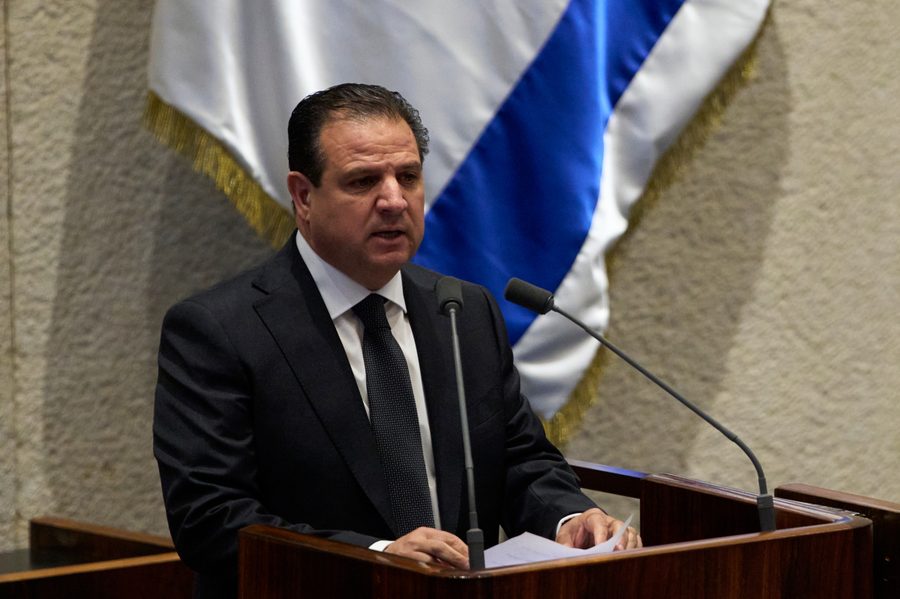
MK Ayman Odeh speaks during his impeachment hearing at the Knesset in Jerusalem, July 14th, 2025.
At around 10 pm on Monday, July 14th, members of Israel’s Knesset gathered in the main plenum for a vote on the impeachment of Ayman Odeh, the most prominent Arab lawmaker in the country. The chamber was raucous. Odeh, head of the Communist Hadash-Ta’al party and longtime advocate for Jewish–Arab political partnership, was granted 15 minutes to speak. But he could barely get out a sentence without being interrupted. “You represent Hamas!” yelled MK Tali Gottlieb, a member of the leading Likud Party. A dozen MKs were called to order. Three were ejected for unruly behavior.
The official reason for the impeachment effort was a tweet Odeh posted on January 19th, the day Hamas released three Israeli hostages and Israel released 90 Palestinian prisoners, to begin an eight-week ceasefire. “Happy for the release of the hostages and prisoners. Now we must free both peoples from the yoke of occupation. We were all born free,” he wrote. The right claimed he was equating Israeli hostages with Palestinian “terrorists,” and accused him of “supporting terror.” (Most of the Palestinian prisoners—69 women and 21 teenagers and children—had never been charged with anything.)
Odeh’s speech was less a defense than a restatement of principle: “This is not Arabs against Jews, and not Jews against Arabs . . . Only together will we defeat fascism and Kahanism, and build here a future of peace and democracy,” he said from the podium. “We have a dream, and our dream has three words: equality, partnership, peace!” He closed with a stanza from the poem “I Believe” by 20th-century Hebrew poet Shaul Tchernichovsky, which socialists, like those in the Hashomer Hatzair movement, have long proposed as alternative or additive to Israel’s national anthem, “Hativka”: “For my soul still yearns for freedom / I have not sold it for a golden calf / For I still believe in humankind / In its spirit, a mighty spirit.” Next to the podium was Ofir Katz, chair of the Likud Party and the governing coalition, who had overseen the impeachment hearings in committee. “This is what a terrorist in a suit sounds like,” he announced.
Then they voted. Seventy-three members of Knesset—including prominent members of the opposition like MK Pnina Tamano-Shata (Blue and White) and Simon Davidson (Yesh Atid)—voted to impeach, shy of the 90 votes necessary for removal. But Odeh’s survival was not the result of a groundswell of support. Only 14 members voted against impeachment—all 10 Arab MKs and all four MKs from the liberal Labor Party. The only reason the measure failed was abstention: The ultra-Orthodox refused to vote with the coalition because of a continued boycott over mandatory military conscription, and most of the “center” parties simply didn’t show up.
In the wake of the impeachment hearing, experts say that the effort was an attempt to delegitimize Odeh’s identity as a Palestinian citizen of Israel—one who felt deep relief at seeing both Israelis and Palestinians freed—and a challenge the permissibility of his vision for political equality. “They want to show us that we are not part of the political game and that our representatives are not legitimate in the Knesset,” said Nassreen Hadad Haj-Yaya, a Palestinian citizen of Israel and longtime researcher of Arab society. Odeh himself put it more bluntly in an interview with Jewish Currents: “They are taking advantage of the war to strengthen Jewish supremacy and put us in the position of subjects, not citizens.” He said that he’d seen photos of his likeness in public areas of the ultra-Orthodox city of Bnei Brak wearing a Hezbollah uniform. “It reminds me of Rabin with the SS,” he said—a reference to the infamous anti-Oslo Accords poster that circulated in the months before the assasination of Israeli Prime Minister Yitzhak Rabin, depicting him in a Nazi uniform.
But Hadad also said the attempt was intended to put a finger on the scale of the upcoming elections. Israel’s next elections are currently scheduled for late October 2026, though there’s a strong chance they’ll happen sooner. Polls show that if elections were held today, Prime Minister Benjamin Netanyahu would lose to Naftali Bennett, who briefly served as prime minister from 2021-22 in an anti-Netanyahu coalition. But if Palestinian citizens of Israel stay home, the relative weight of each vote for Netanyahu’s far-right coalition increases. Banishing Odeh would demoralize his constituency. “It was a calculated move,” Hadad said, “the intention was to suppress the Arab vote in Israel.”
Polling done by Hebrew University’s aChord Center bears this out. An aChord poll from April found that 59% of Palestinian citizens of Israel planned to vote in the next election. But, when asked whether they would vote if the Knesset prevented a top Arab political leader or party from running, that number dropped to 41%. Yaniv Roznai, a constitutional law scholar at Reichman University, said he wouldn’t rule out further efforts to suppress the Arab vote, including changes to election rules, legislation to exclude Arab parties, and circulated rumors about violence at Arab polling places. “It’s enough that voter turnout drops by 10%, the story’s over,” he said. Odeh, too, is highly concerned. “Election day will be difficult,” he said. “They aren’t going to let the democratic process run smoothly. We’re preparing. We have to do everything we can to increase voter turnout.” Netanyahu won the 2022 election in part because two small parties—the secular socialist Meretz and the Palestinian nationalist Balad—failed to cross the electoral threshold by a fraction of a percentage point. “If they had passed,” Roznai told me, “the whole map would’ve looked different.”
Even Odeh’s accusers seemed to know that their claims against him wouldn’t hold. His statements did not constitute “support for terrorism,” and would likely have been overturned by the courts. Odeh told Jewish Currents that this would have created another venue for the right’s continued assault on the judiciary. “They wanted my case to reach the court,” he said. “So they can say: ‘Who decides? Ninety elected representatives or seven unelected judges?’”
Though their effort failed, it was still “a win-win for the coalition,” according to Roznai. “It positioned all the members of the opposition [who voted for Odeh] as disloyal,” and now “they are afraid.” Indeed, opposition leader Yair Lapid announced days before the vote that he would be voting for impeachment. It was only once he understood that it would not pass due to ultra-Orthodox abstention that he allowed the MKs in his party, Yesh Atid, to vote their conscience, or absent themselves entirely. On the day of the vote, 32 MKs were no-shows. “From [the right’s] perspective it’s excellent. It’s political propaganda. Why not push [impeachment] every day? It’s cheap,” said Roznai.
Roznai said that the shift towards inclusive democracy must come from the so-called Israeli “center.” “As long as Arab parties are not perceived as an integral part,” he told me, “as long as there’s not a joint Jewish-Arab party that clearly can be part of the coalition, there will be no change in the political map. No dramatic shift.” For his part, Odeh insists that Palestinian citizens of Israel are key players in the push to make Israel a place that can call itself a democracy with integrity, and in any just transformation in the region. He told me that the unique position of his constituency—Palestinians who make up 20% of the citizenry of Israel, and 20% to 25% of all Palestinians between the river and the sea—is that they can speak to the aspirations of both Israeli Jews and Palestinians. “That’s our job. To tell both nations: Excuse me, we know both of you very well and we know that you want the same peace,” he said.
But Odeh’s hope is constantly being caught in the net of reality. This past Saturday, Odeh was assaulted by right-wing protesters as he traveled to an anti-war protest in Ness Tziona in central Israel. Chants of “death to Arabs” and curses could be heard as they attacked him, spit on him, and cracked the windshield of his car. Odeh had to leave under police escort. The next day, on Israel’s channel 13, Odeh responded to the attack: “Against facism, we stand strong. We do not bow.”

I’m Peter Beinart, editor-at-large of Jewish Currents. Before you go, I need to ask something of you.
In recent years, I’ve watched as mainstream Jewish institutions and media have chosen ethnonationalism over liberal democracy and mass slaughter over the pursuit of a just peace. Jewish Currents offers something different. It’s a magazine built on intellectual curiosity and respect for the dignity of all people.
But a project like this doesn’t sustain itself, and we can’t do it without your help. If you share my belief in the importance of this mission, please consider making a donation—or even better, a recurring one. We need you with us.

Elisheva Goldberg is the deputy vice president for communications and policy for the New Israel Fund and a contributing writer for Jewish Currents. She has written for The Daily Beast, The Forward, The New Republic, and The Atlantic.