As Americans Sour on Aid to Israel, Jewish Anti-Occupation Groups Split on Strategy
Rival House bills show fractures between factions.

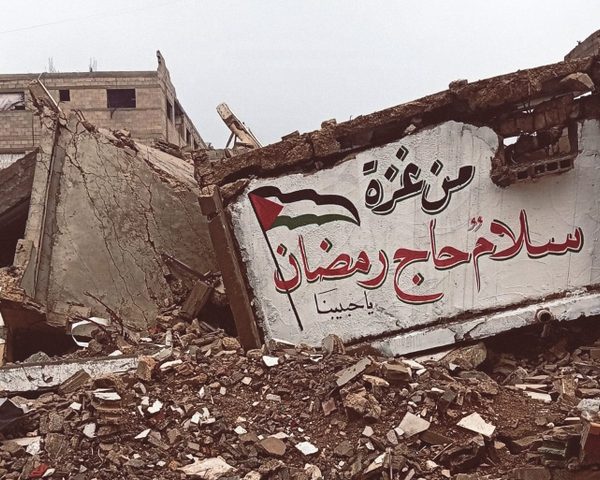
The Jabalia refugee camp in Gaza this month. A large US-made bomb dropped there in 2023 destroyed an entire apartment block, killing over 100 people.
This article first appeared in the Jewish Currents news desk newsletter. Subscribe here.
A new House bill introduced this week that would set conditions on Israel’s use of US weapons is setting off a fight over political strategy between left and liberal Jewish anti-occupation groups, as activists clash over how to take advantage of growing public opposition to US military aid to Israel.
Since May of last year, more than a quarter of House Democrats have signed on as cosponsors of the Block the Bombs Act, which would ban the US from sending 2,000-pound bunker busters and certain other munitions to Israel. That bill has the support of the anti-Zionist group JVP Action, along with a number of Arab and Palestinian-led organizations, including the IMEU Policy Project and the US Campaign for Palestinian Rights Action.
J Street, the leading liberal Zionist advocacy group, doesn’t oppose Block the Bombs. But late Monday, it backed a new House bill, introduced by Illinois Democrat Sean Casten, called the Ceasefire Compliance Act, which would set conditions for restricting Israel from using all US weapons in the West Bank and Gaza.
J Street says that the Ceasefire Compliance Act doesn’t conflict with efforts to organize behind the Block the Bombs Act. “This is not in any way taking away from support for Block the Bombs,” J Street president Jeremy Ben-Ami told Jewish Currents on Tuesday. “I think it’s additive.”
JVP and its allies, however, are condemning the J Street-supported bill as a weaker measure that risks spoiling Block the Bomb’s momentum. “A bill like this effectively acts as an off ramp for members of Congress who are feeling pressure to take concrete steps to actually block weapons from going to Israel,” says JVP Action’s political director, Beth Miller. The Casten bill seems designed to appeal to national security-minded moderate Democrats: Its language emphasizes Israel’s security needs, and its conditional bans on the use of US weapons would only apply in the West Bank and Gaza. It would place no limits on the Israeli use of US weapons against Iran, or any of Israel’s other regional rivals. The Block the Bombs Act, by contrast, would entirely stop the US from giving Israel the weapons named in the bill.
The fight over these bills is in some sense symbolic: Neither of them will pass in the current Republican-led House, and neither have any hope of becoming law under the current administration. But the two bills illuminate the strategic disagreement between the liberal Zionists on one side, and the anti-Zionists on the other, over how to best take advantage of a political moment in which a majority of Americans, and a large majority of Democrats, oppose sending more aid to Israel.
Underlying the strategic conflict between JVP and J Street is strong opposition from Palestinian activists to the J Street-backed Casten bill. Casten’s House district on the outskirts of Chicago includes one of the largest Palestinian communities in the US, but Casten’s relationship with Palestinian American leaders appears to be strained. “He has never engaged local Palestinians on the issue,” said Faith Powell, a consultant with the Justice Coalition, a Palestinian American-led political organization based in Chicago that has endorsed Casten’s opponent in the upcoming Democratic primary.
Abdelnasser Rashid, a Palestinian American State Representative in Illinois whose district overlaps with Casten’s, told Jewish Currents that he saw Casten’s bill as undermining the Block the Bombs effort. “I am not aware of a single conversation that Congressman Casten has had with his constituents, including his Palestinian constituents,” about the bill, said Rashid. “I believe that the intent of this bill is to provide an alternative to Block the Bombs. We see through it and we reject it.”
The IMEU Policy Project, a leading Palestinian advocacy group in Washington, also told Jewish Currents that it does not endorse Casten’s bill. “Rather than detracting from existing substantive legislation, we encourage Members of Congress to cosponsor the Block the Bombs Act, which has real momentum and the backing of a broad, grassroots coalition,” the group said.
A spokesperson for Casten said that the congressman had consulted with “a diverse range of stakeholders” while drafting the bill, including Palestinian and Muslim-led groups, and Palestinians living in the West Bank. But Casten’s press release announcing the bill cited support from two progressive Jewish groups, J Street and New Jewish Narrative, and no Palestinian or Arab organizations. (The release also named two DC-based advocacy groups, Foreign Policy for America and Refugees International, as endorsers of the bill.)
Ben-Ami told me that J Street prefers the Ceasefire Compliance Act to Block the Bombs, because the former bill is designed to influence Israel’s behavior, rather than block specific weapons. The bill would predicate Israel’s ability to use American weapons in the West Bank and Gaza on their compliance with certain conditions, like refraining from annexing the West Bank and abiding by the terms of the October Gaza ceasefire. It sets up a process to determine whether Israel is meeting those conditions and, failing that, a monitoring group to determine whether Israel has actually stopped using US weapons in the West Bank and Gaza.
But Ben-Ami also said that Casten’s bill gives more Democrats a chance to signal support for conditioning aid to Israel. J Street endorses roughly 50 of the 62 Democrats who have signed on as cosponsors of Block the Bombs, but has roughly 70 other endorsees in the House who have not. “I think most of those 70 would like to be able to express in some way that they think there have to be limits and restrictions and conditions on our aid,” Ben-Ami says.
The bill currently has 25 cosponsors, including many who also cosponsored Block the Bombs. “I would urge groups that are very invested in Block the Bombs not to view this as zero sum, but to view this as a win, win,” says Ben-Ami. “If at the end of this Congress, we have a majority of the Democratic caucus on these two bills combined, then we will have established that the balance of the Democratic Party is in favor of ending the blank check to Israel.”
New Jewish Narrative, created in 2024 as a merger of two older liberal Zionist groups, has endorsed both the bills. “There are people who haven’t been on Block the Bombs who will get on this; that’s frankly probably the point of this bill,” says Hadar Susskind, New Jewish Narrative’s president and CEO. “My preference would be they would get on Block the Bombs. But if there are people who aren’t going to do that who will get on this, that’s also a net positive.”
For some groups to J Street’s left, though, the Casten bill represents a betrayal. JVP and its allies have been using Block the Bombs as a wedge and a litmus test for candidates in Democratic House primaries now ongoing across the country. Brad Lander, the former New York City Comptroller running for Congress in Brooklyn, endorsed Block the Bombs in The Nation early this month; his opponent, incumbent Rep. Dan Goldman, has not. (Lander’s campaign told Jewish Currents Wednesday that he would also support the Casten bill; Goldman’s campaign did not respond when asked if Goldman supports either bill.) In a heated Democratic Congressional primary in Illinois, one leading candidate, Daniel Biss, has said he would support Block the Bombs, while another, Laura Fine, has said she would not. Casten himself is facing a primary challenge in his Illinois district from a candidate, Joey Ruzevich, who supports Block the Bombs.
“What should be happening is that we should be pressuring all members of Congress onto the Block the Bombs Act, or similar mechanisms,” says JVP Action’s Miller. “When I look at [the Casten] bill, I understand it to be something that is undermining the momentum of the Block the Bombs Act.”
Even some who generally support the Casten bill have criticized its lack of support from Palestinian Americans. A New Policy, a lobbying group focused on US policy towards Israel/Palestine co-founded by Josh Paul, who resigned from the US State Department in 2023 over military aid to Israel, supports both bills, though it recommends some tweaks to the Casten bill. “It is important for members of Congress who want to work on these issues, and in this space, to realize that justice is something that must be built in collaboration with the Palestinian American community, rather than without them,” Paul said.

I’m Peter Beinart, editor-at-large of Jewish Currents. Before you go, I need to ask something of you.
In recent years, I’ve watched as mainstream Jewish institutions and media have chosen ethnonationalism over liberal democracy and mass slaughter over the pursuit of a just peace. Jewish Currents offers something different. It’s a magazine built on intellectual curiosity and respect for the dignity of all people.
But a project like this doesn’t sustain itself, and we can’t do it without your help. If you share my belief in the importance of this mission, please consider making a donation—or even better, a recurring one. We need you with us.
Josh Nathan-Kazis is the news director at Jewish Currents. Previously, he was a senior writer at Barron’s, where he covered healthcare companies, and a staff writer at The Forward, where he investigated Jewish communal institutions.