“An Elegy for All of Palestine”
The Gazan poet Adel al-Ramadi reflects on making art under genocide.
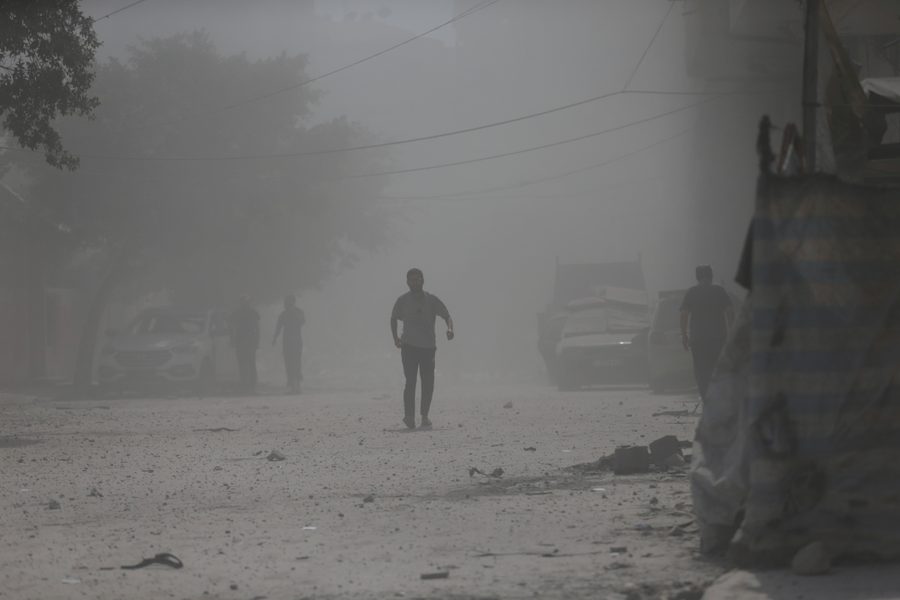
Palestinians walk through dust moments after an Israeli strike in Gaza City, September 15th, 2025.
In early July, the 28-year-old poet Adel al-Ramadi left his home in the Zeitoun neighborhood of Gaza City after Israeli forces bombed an adjacent residential block, killing his neighbors in their homes. On his way to the hospital, al-Ramadi—distraught, dressed in a dusty tanktop—improvised a poem into a camera. The shaky video, filmed from a moving vehicle as it passes through rubble, soon went viral on social media. “They want me stripped of flesh, of fat / of bone upon which I stand . . . My shadow overlaps another shadow / Behind me the sea / And all the land is poisoned / So where am I to go? . . . I came to you, my Lord, so how could justice look away? / Oh Lord, we are tired,” al-Ramadi cries. The recording introduced tens of thousands of people to the young poet, who has released three collections since the genocide began: Gray, A Thousand Tyrants and a City, and Under the Influence of Life, all published in Egypt. It caught the attention of Maram Faraj, also a 28-year-old writer from Gaza City, who reached out to al-Ramadi to discuss his poetry and what it means to make art under genocide.
In the weeks since their conversation, Faraj was able to evacuate Gaza—a nearly impossible occurrence, as the Rafah crossing remains closed even to many who need immediate medical care—to begin a master’s program in Ireland. During her first days ever spent outside Gaza, Faraj told me that the distance has already increased her admiration for al-Ramadi and his ability to keep writing. “When I was living there, I thought that this was something normal,” she said. Now that she no longer shares his immediate circumstances, she can see it as anything but: “Imagine someone who would write poetry while being starved, being bombed, being displaced,” she reflected. Over that same period, Israel has fully leveled al-Ramadi’s neighborhood. “The most beloved place to my heart has turned into ashes,” he told Faraj this week. Yet even in the face of this unthinkable loss, he remains committed to his craft, which is inextricable from a commitment to his homeland. His dedication recalls the words of fellow Gazan poet Refaat Alareer, who was killed in an Israeli airstrike in December 2023: “Israel wants to sever this relationship between Palestinians and land,” but “literature attaches us back, connects us strongly to Palestine.”
This interview has been translated from Arabic and edited for length and clarity.
— Maya Rosen
Maram Faraj: Living in Gaza, under the long shadow of bombardment, surviving is difficult, let alone writing. How did your poetic career commence?
Adel al-Ramadi: I begin in the name of Allah; in the name of poetry; in the name of love; in the name of the homeland—the homeland which is love and love which is the homeland. I have published three poetry collections during the genocide, written under the shelling, the hunger, the debris, and through injury. I have written during the genocide because I have always written. Like a newborn who breastfeeds without his mother teaching him how to suckle, or a toddler who begins to crawl without his father showing him the motions, that’s how I found myself writing.
MF: Why do you think a community needs poetry and poets, even or especially during a time of genocide? And how have you been able to continue writing amid such horrific conditions?
AR: I have heard it said that “just like the sky needs stars, society needs poets.” I take this to mean not only that poets can provide illumination in the darkness, but also that they can convert their inner solid essence into something that can be shared. Poetry nourishes the soul, just like nutrients nourish the body. Every society needs poets to express its sorrows, dreams, and aspirations.
As a poet loyal to my land, to my people, and to my pen, I try my best to write, no matter the conditions. The poem is the only tool I have with which to help myself and my people. I communicate the suffering of the people—which is also my own suffering—because I feel it’s my responsibility to express this pain.
MF: How has the war affected you, both as a person and as a poet?
AR: The war stripped me of everything. It changed my whole life. My house built of stone became one made of fabric. The war changed the colors that I write with; the suffering is so immense that I cannot write with other colors. The Adel of the past used to write poems about the homeland, love, and philosophy. Now all I write about is war. But of course, despite it all, my soul, my will, and my fingers have not raised the white flag of surrender.
MF: What are specific experiences that have affected you during this war?
AR: There are so many events that I would never have enough time to share them all. But I will tell you about one moment that impacted me a great deal: I was passing by a cemetery when I saw a child whose arms had both been amputated, crying bitterly. So I approached him and asked him why he was crying. He told me that his arms were buried there, and he wished only that the occupation had left him one arm, so at least he could wipe away his tears.
MF: I would like to turn now to the video that circulated widely of the poem you recited upon witnessing the recent bombardment and destruction of an entire residential block in your neighbourhood of Zeitoun. Can you tell me more about how this poem came to be?
AR: I had just witnessed a moment that is only suitable to lament, to elegy, to poetic howl. I saw charred bodies before my eyes—bodies torn apart and blood running like rivers. I witnessed brutality. I still don’t know how these words came out of my mouth. I had a small part of the poem written already, but most of it was improvised in the moment. This poem encapsulates my pain, which is, in turn, my people’s pain. I consider it an elegy for all of Palestine.
MF: We are used to seeing people crying or screaming after witnessing the loss of their loved ones. Your reaction was different; it felt unfamiliar.
AR: In this regard, I feel that I follow in the tradition of our great poets: We need another Samih al-Qasim, another Tawfiq Zayyad, another Mahmoud Darwish. I feel that these poets, along with the people of Gaza, held my hands and told me: Tell our suffering with your words.
MF: Does writing poetry help you live with this suffering, with this sadness?
AR: Poetry is my only rescue boat in the stormy sea of our homeland. Poetry allows me to turn what’s frozen inside of me into liquid. I feel relief when I write a poem, because I can express my inner self and liberate the weight in my heart. I turn my inner sadness into poems.
MF: Which poets have influenced your poetry? I am going to go ahead and guess Mahmoud Darwish.
AR: Of course Mahmoud Darwish! However, he wasn’t the first poet who influenced me; that was Abdel Rahman Shokry. We read his “Ode to the Beloved” in our Arabic language class; it was the first poem I read. From this moment onwards, I felt that poetry has a soul that can ignite my own passion, my own compassion. A poet never writes alone, because he always carries the influence of other poets. When I write, al-Mutanabbi writes with me too, and Nizar Qabbani and Arthur Rimbaud and Pablo Neruda and Mahmoud Darwish and Charles Bukowski.
MF: I am curious about the fact that you listed both Arab and non-Arab poets. How do you think about the connections and differences between different poetic traditions?
AR: There are many modern Palestinian poets who have been influenced by the Western tradition: Darwish was greatly influenced by Federico Garcia Lorca, while Qabbani was greatly influenced by Rimbaud. There are differences in style in Arabic poetry: Classical Arabic poetry is traditionally made up of metric verses divided into “sadr,” the first part of the verse, and “ajuz,” the second part of the verse, which operate with a strict rhyme, while Western poetry is mainly written in free verse, not necessarily following internal meter. I tend to write in a mix of classical Arabic style and Western style, and I believe that poets should explore how other cultures and traditions practice poetry; these differences can only strengthen our communities and our poetry.
MF: There are so many poets who have stopped writing during this excruciating time. How are you holding onto your pen?
AR: It’s so easy to surrender to desperation in Gaza, but I am committed to practicing poetry obsessively, to treating it as a necessity, just like a loaf of bread, rather than a luxury or a hobby. If I don’t write, I am a traitor. Indeed, when I don’t write, I feel I have betrayed myself, my dream, my homeland, and my people. I approach poetry as a way of living. I am willing to write while hungry; I am willing to write when I’m injured; I’m willing to write while I’m displaced, grieving, and enraged. And if they cut off my fingers, I will write with my tongue. And if they cut out my tongue, I will write with my eyes. And if they take out my eyes, I will write with my eyelashes.
MF: You write a lot about the beauty of our homeland and your hopes for it, but you also write a lot about our enemies who occupy our lands. What is your message to our enemies?
AR: As a refugee from al-Majdal [a depopulated Palestinian village], I always remind myself that our current travails exist within a historical context. And with that in mind, I dedicate the following message to our occupiers:
“Children of Palestine, young and old! The upright who are steadfast in resisting on their land, who are not blind to the truth and whose conscience defends what is right! Don’t believe that the land wouldn’t be returned. How many soldiers have stepped on its soil, but where are they now? Where’s the rule of the Greeks? Where is the rule of the Tatars? Or that of the Romans or the Persians? Where is the rule of the French and of the English? Where are their soldiers? You will grow up one day and ask: Where is the rule of the Jews? I will return to my land: I will collect my olives and pick my figs; I will drink from the sea of the Galilee and pray in Jerusalem. I will visit the Church of the Holy Sepulchre and of the Nativity, and I will visit the Soreq caves. I will return one day just like air is inhaled and returns to the lungs and the water to the well.”
MF: You have mentioned in the past that you feel the war has deprived you from writing in the time of “spring” and forced you to write in the time of “autumn.” What do you mean by that?
AR: I am tired of writing in the time of autumn: the war, the suffering, the wounds have worn me out. I want to write in spring: I want to write about love; I want to write about beauty; I want to write about nature and about philosophy, about humanity and about life. I don’t want to be the echo of the sound of a tear. Because of the war and the destruction around me, I have turned from a poet who writes with love and nostalgia into a poet who writes with a knife.
MF: What do you wish for the future?
AR: First of all, I wish for this war to end. And also for this war to spare me. Because when the actual war ends, there’s a possibility that I will not be spared because the war within me has grown more tumultuous and more difficult. Second, I wish to be able to use my words to contribute to the world. How are nations lifted from the debris? In the words of Imam Ghazali: ”If you want to revive a people, then invest in its talents! In contrast, if you want to destroy a people, get rid of its talented thinkers.” I want to devote myself completely to humanity through my words. But to do that I need basic conditions. That is all.

I’m Arielle Angel, editor-at-large of Jewish Currents. Before you go, there’s something I need to ask.
We’ve seen over and over how the mainstream media falters in telling stories on our beats—whether it’s antisemitism, Israel/Palestine in American politics, Jewish identity, or the American left. At Jewish Currents we’re committed to uncompromising analysis and longform reporting on these issues and more—stories you won’t find anywhere else. In a media landscape that obscures injustice and flattens discussion, we’re changing the conversation. But we need you.
If you believe in this work, please consider making a donation—or even better, a recurring one—to ensure that we are able to keep publishing stories like this one. We can’t do it without you.
Maram Faraj is a writer from Gaza City.