
“What if I rolled a golem out of mud,” she murmured, as if I wasn’t there. I could’ve been made of mud myself, for all the attention she was paying me. At first I thought maybe I’d misheard. I was sitting in her studio—the corrugated shack she calls a studio—in her only chair, sipping a post-work beer. Jess was squatting on the floor, clearing the gears of her pottery wheel, which were always jamming. There was a profound ugliness to her at that moment that I loved, and if I’d still been an artist I would have grabbed a fistful of modeling clay and sculpted her right then and there, like a skinny-legged, soft-bellied toad, or a ruined goddess, crouching in the ancient dirty clay bits on her floor.
Instead I kept playing the patient, supportive friend, offering advice—safe, normal advice, upbeat and Instagrammable. Jess didn’t respond, just rose and started spinning up a new pot from a lump of earthenware. The gallery had asked her to fill out her show with four more pieces by the end of the month. I blathered on and on from her chair, and drank her dark beer, as Jess sat on a splintered box and shaped the new pot into a solid, pleasurable shape, with cute little feet. Boring, spiritually beige stuff by her standards; I could tell she wasn’t thinking about her work from her own eyes but from others’, now that there would be others—and one person’s in particular.
“What Bertram did back then doesn’t have to stick to you today,” I told her. “You don’t have to let it stick. It’s your first real show, even if it’s on the small side. Don’t let him ruin it!”
She sped up the wheel, wired off a section, and let it whirl out of her hands. The loop of clay flew like a limp UFO for three whole feet before it hit the wall and slid into the dust. “I’m thirty-four,” she said. “I’m old for firsts.”
“She’s maaad,” Rahim likes to sing, “she’s maaaaad at the moooon.” I don’t know if this is a real song or one of the ones he made up, in which case I guess it’s real enough. Anyway he’ll sing it about Jess, he’ll sing it about me. He’s right: We are mad. Not like him, even-keeled and eternally unbothered, putting his annoyingly practical computer science degree to annoyingly practical use. He still finds time to make up his little songs and tend to the plants in our apartment with nearly artistic intuition, their leaves so rich and thick and green that each individual layer of membrane could maintain a tiny terraced city. Rahim never worries about any of the stupid shit that preoccupies me and Jess: juried shows and coveted grants, prestigious fellowships and tenure-track jobs, who gets to be a professional artist and who doesn’t, and shouldn’t. He doesn’t care about this kind of thing anywhere, for anyone—who gets a promotion at work, who gets invited to present at conferences. He doesn’t even have a LinkedIn.
Jess has never earned a fellowship; she’s never been awarded one of those magical grants. The art world showed little interest in her Medusa teacups, her tentacle medallions. These days she peddles her wacky pots at craft fairs and her standard ones on Etsy; she teaches ceramics at the Wolster community center, and every other weekend she drives to a prison fifty miles away to teach an art therapy course, even though the governor cut the budget and she has to invoice a local church for gas. That last part is why I love her, even as I hate her, because she’s never viewed herself as making it, as being a real artist; when I’ve never been close, when I’ve only ever worked in an office; and she isn’t even grateful to have made it now, officially into a gallery at last.
“Bertram might be impressed,” I said. “You never know.”
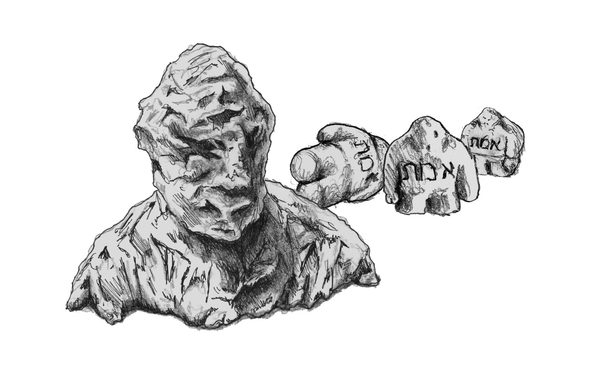
“If he even recognizes me.” Jess picked up the long rope of fallen clay, encrusted with all kinds of broken bits. Maybe there were dust people on her floor, too tiny to see, and this was their Roswell, their sacred encounter. Some of the moted dust people were trying to ascend with the returning UFO and were falling like angels, spiraling to the floor, slowed in the holy terror of the air. I watched Jess knead the wrecked clay to shapelessness. At one point she cut herself on a fired chip that had gotten mixed up in the larger mass, leaving a streak of blood in the clay. She just kneaded that in too. She squeezed it into a man, a careless little guy, forming his fluid imperfect limbs like it was nothing. It almost looked like the thing was breathing, or straining for completion. But she stopped there, at the attempt, the sketch, and stood the little clay man on the table, a bit more blood from her thumb smeared across his forehead. “I bet,” she said—not to me but to the little man—“he won’t remember me at all.”
Rahim wasn’t worried about the little man, not at first. But I couldn’t stop thinking about him. “Jess keeps working on that thing,” I coughed out a week or so later, as I lay curled up with Rahim on the couch, smoking.
“So?” Rahim blew a perfect ring and took another drag on his pen. He preferred vapes; they let him feel like Gandalf. “She’s got to work on her things, right?”
“No, no. She’s only working on the guy. The little guy. The golem. The show asked for four additional pots, not a single sculpture.”
“Whatever.” He waved away my misty exhalation and my concerns. “Golems are cool. The gallery will understand.”
Of course he thought golems were cool. He’s always been considerably more interested in Judaism than I am; he’s the one who insisted on having a mezuzah on the door, a chuppah at our politely interfaith wedding. And he’s always been irritatingly certain that everyone will be as chill about everything as he is. I’ve never been chill about anything, and neither has Jess. That was how she and I connected back in Hebrew school, over 80s goth rock and Gregorian chants. Our nails were always painted black with silver sparkles; we regarded ourselves with the tremendous moral seriousness acceptable for preteens and artists and no one else. Later we applied for the same prestigious art program at Wolster College, outside of Boston, and got in together.
And then I dropped out. And because I dropped out, what happened to Jess, what happened to the others, never happened to me. I’m not numbered among the professor’s victims: not the bronze sculptor with the Guggenheim fellowship, or the mixed-media installationist, or even Jane Does 1–12. The famous Bertram North didn’t care about me at all. He looked past my blobby sculptures, my mushy doubt, my lank and uninteresting body, and chose Jess’s sure and ferocious intensity instead.
Rahim and I smoked a little more, then a lot more. He watered the plants; I took the dog for a walk. We drifted along our neighborhood route, making the usual stops. Kirby sniffed for treats outside the Dead Poets bar, where popular professors would go out for drinks with their students—only the special ones, the ones who could take the attention.
Of course Bertram wanted to fuck her. Jess wasn’t stupid. In fact she thought she’d been smart enough to lead him along forever, parlay every drinks some other weekend? and I’d be happy to model for you later into a grant-funded graduate position, or at least a solid recommendation. She could play the game, she thought, of delicate denial. Wasn’t that eroticism: the impossible pursuit, the never-meeting of need? All the theory texts said it was, at least. In real life, though, I think he just got bored. And his reputation was catching up to him: The Guggenheim sculptress had spoken up, and the rumblings had started, the creaky machinery of academic bureaucracy, the old complaints shut away in a querulous drawer. Meanwhile, a position was opening up at a Parisian institute, an honor worthy of his esteem. So Bertram North was quietly packed off to Europe, the college more than happy to float the costs of his convenient exile. A student would join him later on a fellowship: not Jess, but that blonde from Phoenix who made the misshapen finger bowls. I heard he married her, eventually.
So Jess wasn’t one of the famous professor’s victims, not really. The facts would say that she’d been the one to try, and had been rebuffed, and any negative reaction on her part must arise from baffled ambition, unsatisfied desire. She had wanted that fellowship. She knew it was stupid. She kept telling me that. But just because it was stupid didn’t mean it was a bad idea: If it wasn’t him it would be someone else. That was the world, he was the world, or at least how she had to enter into it. I know, I know, but I promise it all made a brilliant and hard-edged sense when we were twenty-two. Jess knocked on the door of his office as he was hurriedly packing—dressed as cute as she could, black curls tied back and a dress cling-filming her short, stocky form. Then Bertram said what he said, abruptly, and with his back turned. The fellowship wasn’t right for her. She wasn’t the right fit for France. She was a born crafter, not an artist. She’d sell best at local fairs and farmers’ markets, and it was better for her to know her inadequacy now, and not later. Someday, she would be grateful.
When Kirby and I returned home, Rahim was already in bed, watching videos; I joined him. Someone, an invisible person, was patiently rolling glass jars down a staircase, jars full of every imaginable thing: olive oil and paint and ball bearings, fireworks and Disney princess figurines. We watched them break and crash and explode, over and over. My phone started buzzing—texts from Jess arriving in bursts, fast and furious.
I silenced the notifications and tried to focus on the videos, Rahim swiping to the next and giggling before they started. But I couldn’t help imagining her, ten miles away, sitting in that former guest cabin behind a rundown farmhouse. Soon after graduation, her parents had divorced—which gave her an excuse to start over, remaking loopy, cursive Jessica Soloway into hard, plain Jess Chen—and she bought the cabin with guilt money from her dad. Now she stewed out there in her hut with her crafty little pots and a vengeance she couldn’t take, her self-contempt and her stifled, extravagant rage. She wasn’t an artist and she wasn’t a victim and she wasn’t a destroyed little girl; she was a woman, and she resented. And resentment can kill you.
Somewhere between the video of the jar with the melting action figures and the one with the antique crystal egg cups, Rahim fell asleep. I snuck the phone out of his hand and put it on the nightstand; I took mine to the bathroom. On the toilet I finally looked at Jess’s messages. They were incomprehensible. More nonsense about golems: a link to a PDF I couldn’t download, and which didn’t look safe. A supposedly in-progress photo that was too blurred to make out—Jess had cracked the lens on her phone ages ago and couldn’t afford the new models. What do you think? she demanded. I have to know if it’s right.
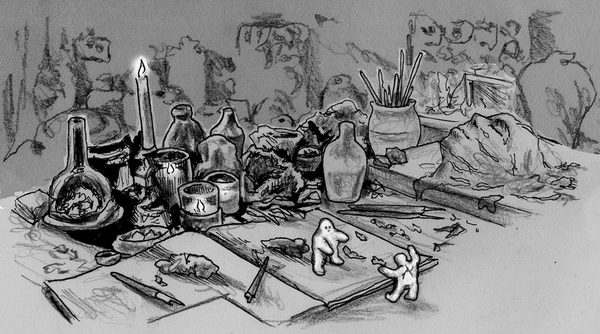
With a week to go before her pots were due, Jess still hadn’t started. I kept dropping by after work because she said it helped, having me there; and I wanted to help, turn her around, turn her show around, make it happen. But on every visit I found her huddled in a loose grey wrap that was almost like a tallit, researching golems, poring over weird shit she found online and musty kabbalistic books she ordered with expedited shipping that I knew she couldn’t afford. And her little man sculpture was turning from a temporary joke into a three-foot-tall totem, scratched here and there with Hebrew letters. She’d picked up an ancient Hebrew dictionary, too, even though she probably remembered as few words from Hebrew school as I did. But now she was scribbling the characters down on slips of paper scattered all over the shack, practicing before carving them into the statue’s flesh.
If you know me, you might be thinking: Sylvie, you’ve had your own occult obsessions, is it really fair to judge? Sure, there was the high school dabbling with Wicca and angelology, and yes, during the worst of the pandemic I fell far into the depths of horoscopes and tarot. That kind of thing can help: the shuffle of objects and words and the use of resonant nouns that feel like strength, that make you feel like yourself—and like something cosmic is on your side. Words are real, they have their own gravity. Under the right conditions, they can even be a shield, or a weapon.
An email had arrived last month from Debbie Bliss, owner of the gallery, breathlessly announcing to all members of her mailing list that the great Bertram North, her magnificent friend, had finally returned from abroad. Debbie didn’t mention the reason for Bertram’s long sabbatical. She just praised his responsibility for so many shining careers, so many well-regarded contemporary American artists, all his little stars. Not to mention—Debbie didn’t mention it; perhaps she was unaware—Bertram’s littlest star of all, thirty-four-year-old Jess Chen, in her first juried show, alongside three other lucky winners.
If something the great professor had said to her once, a couple of words, had derailed her career for a decade, then he must have been right all along and she really wasn’t very good. Debbie Bliss would think this; everyone would think this. We didn’t need to say it out loud, while I slugged too many of her beers, and she pounded away on that stupid sculpture, the one she wasn’t supposed to make. We both knew, just like everybody knows, that talent, real talent, glares like a star, like a theater light. Whatever you create is the true sign of yourself. Whatever happens to you is only what you deserve.
On Friday evening—a week before the opening of the show—I thundered down the choppy Wolster roads in a foul mood. I’d been burning my mind all week through spreadsheets and trackers and checklists, and while I was trying to be patient with the golem thing, I’d hit compassion zero. But for once Jess wasn’t working on her little man. She had three pots glazed and ready to be fired, and the fourth in progress. They were nice—strong and shapely, too odd for craft fairs or any practical use but flowing with the biological intricacy of Jess’s style, that a judge might look at and say it reminded them of the natural world, of actual life. That was the nicest comment the jury had made, the nicest comment people usually made about Jess’s art: that it reminded them of being alive.
I was glad to see the almost-finished pots, but less glad to see that someone was sitting in her chair, which was my chair. A big, broad-shouldered guy with a waxy, somewhat sick complexion and damp dark hair to his shoulders, wearing one of Jess’s more ridiculous muumuu smocks, the one spattered with abstract daisies and daffodils. He didn’t seem to mind the flowers. He wore it the way an escaped mental patient might wear their hospital gown: with shy dignity, and bridled violence. He might have had tattoos, or lines of ink like letters, already fading into his skin.
“You’ve got to be kidding me,” I said.
You might think: Okay, Sylvie, here you must have struggled, you must have doubted, you must have hysterically waved your arms and threatened to call some kind of exorcist. I don’t know. At this point in my life—late pandemic, I guess you could say—I was smoking a lot of weed. And on weekends Jess and Rahim and I would go do shrooms together in the woods, where stars would fall from the violet sky like snow, and leave bright laughter on my cheeks.
But the man sitting in Jess’s shack was no hallucination. He was solid, real as dirt, real as a mountain, real as the rock you stub your toe on. Bits of mud flecked his face, as if turned up by tire treads. Maybe he really was an escaped mental patient.
“I’m Sylvie,” I said.
He looked at Jess, the question clear despite his silence.
“We didn’t work that out,” she said. “Maybe—Greg?”
“Greg,” he agreed. Greg had a normal voice, low and a bit rumbly, but like a human, not like clay or mountains.
I didn’t know what to do. I couldn’t do anything. I offered him a beer.
He took the beer. He drank, like a person.
I texted Rahim to pick up some clothes—men’s size XL, I guessed. Rahim arrived soon after with oversized sweatpants and crew-cut jerseys in his own sleek style.
“Like dressing the Terminator,” he said in awe. But he quickly recovered from the novelty and offered the golem his vape. I helped Jess load the finished pots in the kiln as the men leaned against the shack and smoked. Greg laughed quietly at something Rahim had said. Sparks from the kiln flew up into the sky like stars, like bright new stars.
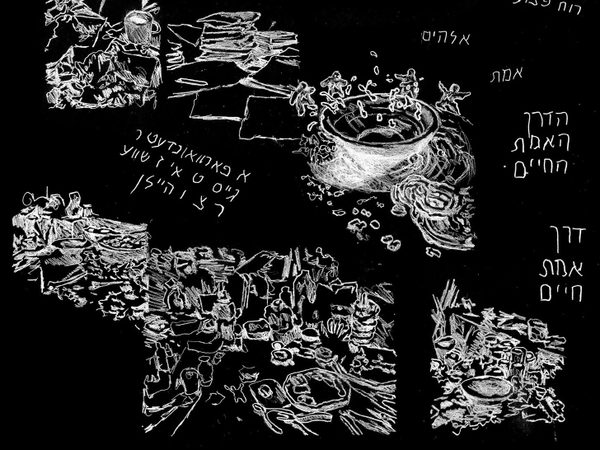
A golem is for vengeance. A golem is a wish, that you could do something when you can’t. And then you regret it after, that your justice was so hard: both hard to get, and hard to give. I picked this up from Jess, from the PDF that I eventually opened despite my certainty it would give my laptop a virus. The PDF was a scan of an old book about Rabbi Judah Loew of Prague, who once summoned a golem to stop a blood-crazed mob of antisemites. But the golem went too far and attacked the innocent, and if it continued it might have actually killed children and proved the false blood libel true after all. So Rabbi Loew put the golem to death, he killed it silently in the attic of the synagogue. Be careful what you wish for, is the moral of the story, except when the moral is something more like: unless, what if, if only. Nobody has ever found the body of the golem in the attic, but there’s an urban legend that a Nazi officer traipsed up there in the 1940s, hunting for the disincarnate golem only to die a strange and bloody death himself. That’s just a legend too; it’s nice to imagine, but probably isn’t true. Unless, what if, if only.
Jess’s revenge was a small and stupid one, in comparison. Even she knew that. Golems weren’t supposed to be personal, avenging your own weak and damaged pride: They were supposed to protect the people, the community, the city as a whole. Jess might pretend she was protecting Miss Guggenheim, and the installationist, and Janes 1–12, and any future victims to come. But she hadn’t asked their permission; they hadn’t consented to having her act as their avenging angel. They might just want to forget him. And anyway, they weren’t around.
Neither was Bertram North—at least not yet. I was fully drunk on the gallery’s watery, tasteless red wine, and making my fifth or sixth round of the art. The space’s first post-pandemic show—fittingly and stupidly titled post(?) pandemic(?)—had attracted quite the crowd. There were four open wings, one for each artist, and in the middle of everything a table held the wine, a small untouched box of surgical masks, and a display of ceramicist tools sticking out of a pile of fretted clay. Loop tools had been set up in a line like Odysseus’s axe heads; elephant ear sponges flared out of a ceramic elephant’s head. A huge harp tool was displayed like an actual harp, a sculpted figurine poised as if to play the single cutting wire. To the side, a basket held colorful modeling clay for kids. I tore off a piece and rolled it about in my fingers, and my fingers remembered it.
I remembered his voice too, immediately, like a clip from a famous movie, or the chords of a ’60s rock song. He boomed and chorused; he made no effort to hide himself. “Debbie!” Bertram cried, and threw his arms around her. Debbie cast a swift glance around after the cheek-kissing, as if to say I’m a woman, and I forgive him, and frankly I never believed it anyway. Bertram North looked much the same, but thinner, and taller if possible. His hair was a grey waxwork, and he wore a black jacket open over an artistically spattered shirt, like a sort of gaunt, rainbow Gérard Depardieu. He loomed over everyone in the gallery, loudly and laughingly shaking hands, as though he had just recovered from a long and dreadful illness, a happy warrior who had bested death.
Jess said nothing. Neither did Greg, but then he didn’t talk much in general. He stood by her side in all his solid realness as Bertram stooped, staring at her. The old professor’s eyes widened. A studied gesture of surprise. He took her hands. “Jessica Soloway!” he cried. “Although the name I’ve been hearing all night is Jess Chen.” He chuckled. “So where’s Mister Chen?”
He looked at Greg and Rahim, frowning at their failure to meet the expected appearance of Mr. Chen. Then he clapped an arm over Jess’s shoulders and began steering her around the gallery. “My student!” he boomed to no one in particular. He was changed. Lots of people were different right after the pandemic, had developed a kind of awkwardness, a shouty loneliness, their speech rhythms and word choices all wrong. But in him the shift was particularly extreme. There was something sad and louche and desperate about him now, as if he’d lost his own shape and was trying to stuff himself into a mold of borrowed Europeanness. I couldn’t imagine he’d acted like this in Paris, and if he had, he couldn’t have been very popular. He wasn’t wearing a ring, and sculptors often didn’t, but I still wondered what had become of the blonde from Arizona, and if her finger bowls had ever improved. Maybe she’d left him. Maybe he’d been sick after all.
I managed to tack around them without knocking over anybody’s work, which was impressive given how drunk I was. That let me approach from the front, giving Jess the chance to introduce me, which I hoped might grant her an opening to slip away. But Bertram held on. He glanced about the room, sunny and unfocused. “Sylvie Katz?” Jess tried again. “From Wolster?”
“Ah!” Bertram grinned and shook my hand vigorously. The bones of his fingers were thin and prominent. He still didn’t release her. “You have to introduce me to everyone you know,” he said to Jess, poking her in the bare shoulder. She wore a sleeveless yellow sack dress, billowy and flattering. He was already drawing her away from me, and from Rahim and Greg, who had followed; we were clearly no one she knew or ought to know. Is it more horrible to be known or unknown—recognized and used, or forgotten and ignored? A toss-up, really. The one envies the other, like the living and the dead.
A golem isn’t alive or dead. A golem doesn’t have any manners to have forgotten in the days of anxiety and shuttered human interaction. Greg went after them, fast; he met Jess and Bertram in front of the centerpiece with the tools and the clay and the wine. Jess said something, trying to pull away from the professor, I think. He draped his left arm around her with seeming lightness, and laughed.
And then—well, there are a lot of interpretations. I didn’t see anything. Greg blocked the view; he was broad as a linebacker, and nearly as tall as Bertram. The professor was wailing, a thin sad scream. Greg held the professor’s right hand, gently: He was slapping clay over Bertram’s knuckles. Jess stood to one side in her spattered, billowing dress. The fingers lay on the floor, in a tidy pool of blood and wine. The middle and ring fingers were crooked up, the first and pinky knocked flat, in a kind of devil horns. If they’d been arranged there on purpose they might have made a sculpture. I thought of the time I’d been at the MoMA and someone had dropped a glove on the floor: Dozens of patrons had circled around the object for hours, worried it was art.
“Get me a cup of ice,” Greg said to me, calm and patient as a mountain.
When the police arrived, Bertram had fainted and Debbie was screaming that a huge psychopath had torn off the professor’s fingers. But other guests who had been closer said that Bertram had swept his right hand in a big dramatic gesture and lost four fingers to the harp wire. A ceramicist’s tools can be terrifyingly sharp; the legendary art professor should have known better, which means he must have been drunk. Everyone was now sure that he had, in fact, been drunk. Bertram was back in America, where bad things only ever happen to people who deserve them, who already made stupid mistakes in the first place. I handed the cup of ice and fingers to the police. There were four officers and each seemed more baffled than the last. “Who put his fingers on ice? Who put clay on his injuries?”
For that, everyone was in agreement: They had seen Greg act quickly. “He used to be an EMT,” I said, and felt it was true, and maybe it could have been true. I don’t know, I was still very drunk myself. I had been standing there for ten minutes holding a cup of fingers. “He used to be an EMT,” I said again. “He said we should use ice to preserve the fingers. And clay to stop the bleeding.”
“That was quick thinking,” said one cop with admiration.
Another glared at Greg. “We should take him in,” the other officer said. “He’s covered in blood.”
But of course, so was Jess. So was everyone and everything within a four-foot radius of the centerpiece: the table, the clay, the tools. The harp wire was bloody, and dripping. Bertram North might have really cut himself on it, I don’t know. The cops were eyeing Greg. They needed somebody to get what they deserved. Rahim took a long drag on his vape and said, in his flawless stoner’s voice: “You think he just ripped this dude’s fingers off, man?”
That seemed to embarrass the cops sufficiently, and they let us go. The ambulance sang into the driveway as Rahim and I made our way to the roof of the gallery. There was pizza, newly arrived pizza, not blessed or cursed by wine or blood. Rahim had some whiskey in a flask. Jess and Greg joined us, having washed their faces and hands, their nice outfits still spattered in a red that was glazed to black by the shining dark.
“Oops,” said Jess. She worried at her lip, as the ambulance pulled away, shrieking, Bertram’s waking squeals finally drowned out. “Do you think they’ll be able to reattach his fingers? He was a great artist, once.”
Greg shrugged, the way a hill might, a big sighing and release of shoulders.
“I do feel bad,” she said. “Should I feel bad?”
“He won’t die,” Greg said with quiet confidence. Jess settled against him.
Rahim was passing around the vape. I needed it, if I was going to attempt the pizza. Later that night, when I was sobering up, I would vomit several times—I held a cup of human fingers in my hands, for ten fucking minutes—but at the moment, I was mostly sleepy, and hungry. What would my mother have said? She’d have wanted to know how the show went, though she was going to hear enough from Jess’s mom at their coffee date next Thursday. They would both agree, without needing to hear from us, that Jess had been brilliant: Everyone had loved her work, she was their shining star. It would be a small news item, no more, that an elderly professor had lost his fingers at the opening, and that they had been reattached: a miracle of modern surgical techniques, a real work of art.
Mom would also want to know when it was going to be my turn, my work, my show: When would I start making art again? It wouldn’t be enough, it would never be enough, for me to simply exist—to have my job and my dog and my husband. And I wouldn’t know how to tell her how dangerous it could be, going after these hard real things, that you could maybe have them but they were bloody. Living like this could only lead to a kind of art and a kind of being that wasn’t any good for mothers like ours, wasn’t anything they could show off; because beyond all the fellowships and awards and the scratching and biting for money and fame, there lurked something true, something awful, something not quite alive and not quite dead. A sacred fatality.
Rahim passed the vape to Greg, squinting at his forehead. “Your ink’s really faded,” he said. “Maybe that’s a problem, I dunno. That’s how golems die. You have to erase the aleph.” Rahim grinned at me, as he did when he knew something Jewish-related, and I didn’t. “Emet to met. From truth to death. I saw it on The X-Files.”
“The truth lives forever,” Jess said. She turned in Greg’s arms, and kissed him.

I’m Arielle Angel, editor-at-large of Jewish Currents. Before you go, there’s something I need to ask.
We’ve seen over and over how the mainstream media falters in telling stories on our beats—whether it’s antisemitism, Israel/Palestine in American politics, Jewish identity, or the American left. At Jewish Currents we’re committed to uncompromising analysis and longform reporting on these issues and more—stories you won’t find anywhere else. In a media landscape that obscures injustice and flattens discussion, we’re changing the conversation. But we need you.
If you believe in this work, please consider making a donation—or even better, a recurring one—to ensure that we are able to keep publishing stories like this one. We can’t do it without you.

Lyta Gold is an essayist and fiction writer living in Massachusetts. Her work has appeared in The New York Times, The Baffler, Protean, New York Review of Architecture, and Current Affairs. Her book Dangerous Fictions came out in 2024.