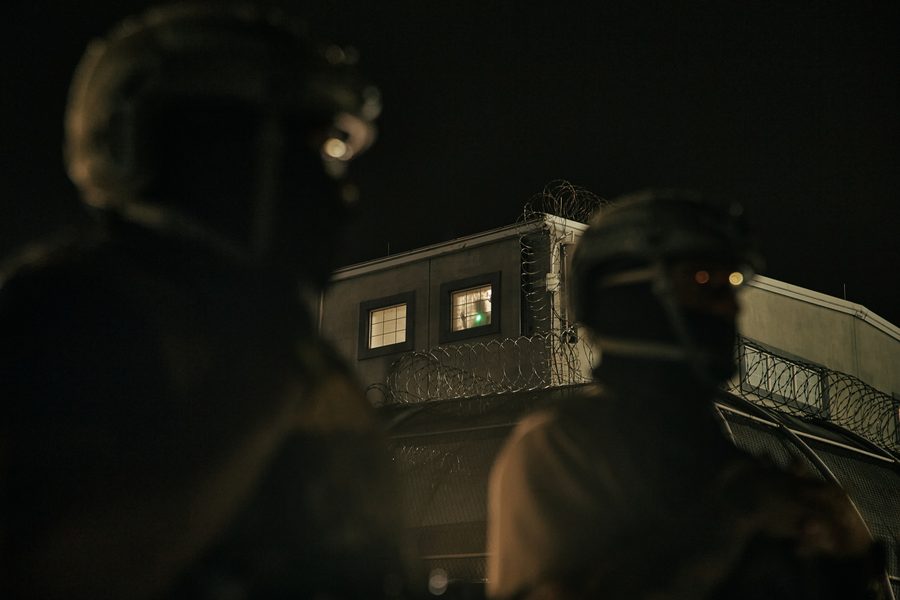
A detained immigrant stands at the window while ICE agents guard the Delaney Hall detention center in Newark, New Jersey, May 27th.
Andres Kudacki/APUnbuild the Cages
Silky Shah maps the vulnerabilities of the deportation machine.
Within Donald Trump’s first 12 months back in office, ICE occupations of cities ranging from Los Angeles to Chicago to Minneapolis clarified that immigration detention and deportation are now at the heart of the Trump project. At the same time, these devastating surges were met with extraordinary community defense, arguably containing a kernel of a struggle against authoritarianism and capitalism writ large. Immigration, in other words, is now a key front in a much larger war.
Yet the left’s collective understanding of the precise mechanisms of detention and deportation—who is being taken, and where and how this is happening—remains patchy, as does knowledge of how to interrupt those circuits. Nor do most of us have a clear sense of how to connect today’s burgeoning community defense struggles with the immigrant justice organizing of the past few decades. How did we get here, and how might we go further in challenging the most brutal aspects of the world in which we now live? I sat down with Silky Shah, executive director of Detention Watch Network and author of the 2024 book Unbuild Walls: Why Immigrant Justice Needs Abolition, to delve into these questions. This interview has been edited for length and clarity.
Amna Akbar: I am thinking about how today’s ICE surges and popular opposition came to be. I would identify four basic pieces of the puzzle. First, we have the growing capacity of police, prisons, and jails as a counterinsurgent response to the civil rights movement, the New Left, and anti-colonial victories of the 20th century. Second, there’s the rise of neoliberalism and the resulting hyperconcentration of wealth and de-democratization of society, which includes rising rents, declining wages, and attacks on worker organizing. Third, there’s the post-9/11 military-industrial complex, where forever wars abroad accelerate the targeting of Black and brown people in and outside the US, because military equipment and budgets always come back home. And finally, there’s the public’s deep skepticism of the ruling elite, in part because of the immiserated conditions in which so many live. In response, we get the rise of the Tea Party, the MAGA movement, and the Proud Boys on the right and Occupy, Black Lives Matter, and democratic socialism on the left.
Would you agree that these are the broad historical arcs that have produced the present crisis? What would you add?
Silky Shah: All of that seems right. There’s no question that these evolving conditions have fundamentally shifted things, especially since the ’60s.
What I would add is about the role of infrastructure. Starting in the ’90s, we have seen the expansion of the Border Patrol, the rise of the Prevention Through Deterrence model, and a much more militarized border. This has meant more officers and more detention facilities. Once you’ve grown this infrastructure, it makes it much harder to get rid of the laws behind it. There’s an interest in always finding people to incarcerate. In fact, and I don’t think people realize this, the vast majority of detention centers in the US are either former federal or state prisons or existing county jails. There are very few detention centers that were built to be detention centers.
Private prisons are another example of how the immigration system evolves around infrastructure. An entity like the GEO Group, which is essentially a detention conglomerate at this point—involved in every aspect of immigration enforcement, like surveillance, transportation, GPS monitoring, and so forth—is always going to be willing to adapt to what the current government wants. This is why we saw a growth in the use of private prisons for detention not just under Trump and Bush, but also under Obama and Biden.
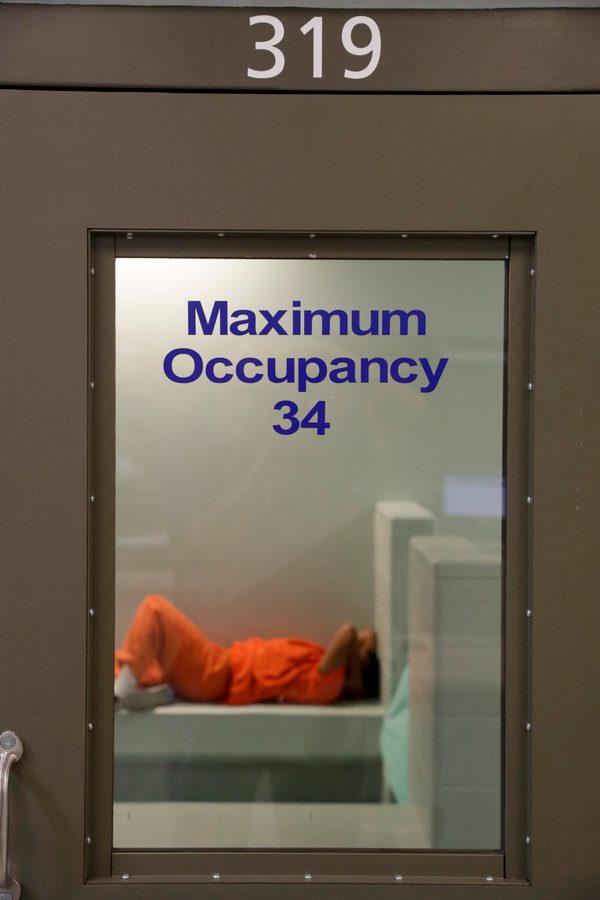
A detainee at the Adelanto ICE Processing Center in California, August 28th, 2019.
AA: Speaking of infrastructure: Let’s get into the mechanics of deportation and detention. With detentions, where are most people being held?
SS: Most people are being held in the South and Southwest. Florida, Texas, Louisiana, and California have the highest levels of detention, but there are also very large detention centers in Pennsylvania, Washington State, Michigan, and elsewhere. People are being detained in private prisons as well as in county jails, because ICE can quickly enter into those contracts. In states without large detention facilities, ICE is utilizing other spaces, like the Whipple Federal Building in Minneapolis or 26 Federal Plaza in New York City. These places used to hold people for brief stints, but in these moments of surge, immigrants end up spending longer stretches there.
Additionally, the Trump administration is detaining immigrants in federal prisons, military bases, and some state facilities that have opaque operations, like the Everglades Detention Facility in Florida, better known as “Alligator Alcatraz” (which is now set to be closed). The administration has also utilized offshore detention in places like Guantanamo, detention centers in Costa Rica, and El Salvador’s CECOT [Centro de Confinamiento del Terrorismo, or Terrorism Confinement Center, the largest prison in Latin America, which can hold 40,000 people]. Some of this is a fearmongering tactic: Only a fraction of all people detained by the US are held at such facilities, but the administration has threatened to expand this number to the tens of thousands.
“The vast majority of detention centers in the US are either former federal or state prisons or existing county jails.”
AA: How long are people being detained, and in what conditions?
SS: People are definitely spending way longer in detention than ever before. They can be in for anywhere between two weeks and several years, and the average length of stay is 50 days, which is higher than it has been in the past.
The conditions are absolutely horrifying. They’ve always been bad, but it’s so severe now. People are being crowded into these facilities: Likely over half a million people will be detained over the course of the year, with roughly 60,000 to 70,000 in detention at any given time. Then there is the fact that they’re being served rotten food, going hungry, being made to wear dirty clothes. They’re being denied medical care and put in solitary confinement. The list goes on. It’s abysmal. As of early June, 19 people have already died this year in immigration detention, and that is not a scale we’ve seen before. As a result, some people are just accepting voluntary departure from the country so they can get out of detention.
AA: People are also being denied bond, not only because immigration judges sometimes deny individual cases but also because of the way the Trump administration is attempting to render millions of people ineligible for bond.
SS: Yes, exactly.
AA: These legal maneuvers tie back to the broader infrastructural projects. I am thinking of the Trump administration’s proposal to build massive warehouses to detain immigrants. How should we understand this idea? Why was it being advanced?
SS: The warehouse proposal was unprecedented. The administration wanted to go from over 200 detention facilities to just 30 to 40 facilities that could together hold a total of around 100,000 beds. They called it a “reengineering” project, and Todd Lyons, who was the acting director of ICE until this May, said he wants ICE detention to run like Amazon warehouses. This was part of a big shift where immigration enforcement started being framed as a logistics problem: “How do we logistically remove people from society at this scale?”
Because organizing against immigration detention has often focused on state and local government contracts with ICE, the goal in trying to consolidate the detention system was to make it harder for us to oppose them. I don’t think this plan is going to work. As of late May, the government is already considering selling some of the warehouses due to opposition. More broadly, the relationship between the federal government and localities is so entrenched when it comes to immigration enforcement that I don’t see it being an easy thing to put an end to.
“Immigration enforcement started being framed as a logistics problem: ‘How do we logistically remove people from society at this scale?’”
But the administration is also taking other steps to outpace opposition. As an example, ICE is thinking about buying some private prisons even as the companies still operate them. This is because if ICE or the Department of Homeland Security (DHS)—in other words, the federal government—owns these sites, they can more easily evade state law. In Washington State, for instance, there’s been litigation around immigrants in private detention getting paid just $1 a day to do the labor that helps run the facilities, and the GEO Group has subsequently been ordered to pay minimum wage, which affects its bottom line. But if DHS instead owned the site and the GEO Group still ran it, the facility could maybe circumvent state law on minimum wages and even property taxes.

A damaged Department of Homeland Security vehicle outside Delaney Hall, May 29th.
AA: Your use of the term “consolidation” is clarifying. It highlights how the proposal to build detention warehouses mimics the tactic of the ICE bloat, surge, and occupation. Both are geared not simply at massively expanding immigrant detention, but also at building an authoritarian infrastructure with fewer and fewer openings for interruption.
Your last point about the GEO Group raises the question of profit, too. When we’re talking about mass detention or warehousing, who stands to benefit financially?
SS: ICE detention is a deeply neoliberal model, so of course the private prison industry is profiting, as are all the companies that provide services to detention facilities: food, guards, transportation. But this is not all. Many counties and states also benefit. This could be because they have contracts with the federal government and are dependent on that money coming in, or because of the jobs generated by having more detention capacity. Sheriff’s departments likewise benefit because of programs like 287(g), which makes local law enforcement eligible for additional funding if they agree to do immigration enforcement work.
“Their goal this year was to spend $38 billion on expanding detention. It’s our responsibility to insist that this can’t be a done deal.”
AA: In December, Wired reported that the government planned to pay firms to serve as bounty hunters for immigrants. And then, earlier this year, we saw bounty hunters in the Twin Cities looking for immigrants as well as protesters.
SS: Exactly. Crony capitalism. They’re throwing a lot of money around. And there’s no science around it, or any strategy besides “Let’s just put everything out there.” Their goal this year was to spend $38 billion on expanding detention. It’s our responsibility to insist that this can’t be a done deal. We don’t have to accept that this money has to be used.
AA: Let’s talk about deportations. What has changed in the past two years?
SS: Under Biden, it was mainly two groups of people being prioritized for detention and deportation: those newly arriving at the border, and those who were being transferred from jails and prisons into immigration detention because they had become caught up in the criminal legal system.
Now, things have changed significantly. Incarcerated people are still being sent into ICE detention, and at higher rates, but the border deportation numbers are much lower (in part because fewer people are trying to cross in the first place). Trump’s mass deportation strategy is instead focused on interior enforcement: nabbing people who are already in the country through street arrests in neighborhoods, schools, hospitals, and courthouses, and at ICE check-ins, which offer easy targets. The mandate now is to target as many people as possible. And the Biden-era “Alternatives to Detention” program—ankle monitors, smartwatches, smartphones, and other surveillance strategies—has facilitated this goal by helping ICE find people more quickly.
AA: Has anything changed in the mechanics of how deportations are taking place?
SS: The US deportation system has developed around the ability to detain people. So not having detention facilities makes deportation out of certain states harder; it requires putting people on planes and moving them to Louisiana or Texas, where they can be held until they are deported. This is why, when you look at places like Chicago or Minneapolis, where detention capacity is relatively low, you see fewer deportations than what could otherwise unfold during a surge.
AA: Why do some places have less detention capacity than others?
SS: Take Illinois: For years, ICE tried to build a large detention center in the state, and organizers and advocates played the most successful game of Whack-a-Mole I have ever witnessed to stop that from happening. Then, they passed a set of state bills to block private detention expansion, and another that ended county jail contracts. As a result, the State of Illinois does not have any immigration detention, and this now makes it harder for them to take large numbers of people into custody.
AA: That’s a helpful example because it shows how fights from some years ago are making a difference now, even if it’s not nearly enough. What would you say this suggests about the key sites of disruption today? What are the right targets in this phase of the struggle to end deportation and detention?
SS: We can start by looking at the ICE watch programs in Minneapolis and elsewhere, where there has been a remarkable level of solidarity from people who aren’t themselves immigrants. The number of detentions, the number of deportations, could have been so much worse if that organizing infrastructure hadn’t been in place. So that is one strategy to keep pursuing.
Then, there are a lot of the older anti-carceral strategies that need to be scaled up at this moment. At the local level—in city councils, county governments, and state legislatures—people have a lot of power to intervene. They can do so by trying to prevent local police departments from entering into a 287(g) agreement with ICE, and by getting local governments to drop their other relationships with ICE. This is particularly necessary in places like Florida, Texas, and Tennessee, where local police and state troopers are doing the work of ICE by detaining large numbers of people. (The Miami field office, for instance, had almost twice the number of ICE arrests as its St. Paul counterpart during Operation Metro Surge.)
Additionally, as I’ve noted, a key focus needs to be on stopping the expansion of detention facilities, both because it is absolutely inhumane, and because it’s a key tool for deportation. This means that organizing locally to block new facilities is a key strategy to disrupting the mass deportation agenda. There are also proactive things people can do in this regard, like passing ordinances to say the government can’t build a warehouse or an ICE facility in a given locality, or to have a moratorium on any connection between the local government and ICE. This kind of stuff is great because it can help people take a stand while also quickly cutting off the administration’s ability to deport more people.
We also need to work on the federal level to cut funding for ICE and Customs and Border Protection (CBP). And in fact, after Minneapolis, “Abolish ICE” is a serious conversation. There is a level of energy and engagement now that is a real opportunity. In January, Representative Delia Ramirez from Illinois introduced the Melt ICE Act, which aims, essentially, to get rid of ICE. ICE was created during my adult life, so I don’t think it’s out of the realm of possibility that we won’t have ICE in its current form in 2030—if we are able to normalize the idea and create the conditions for it to materialize.
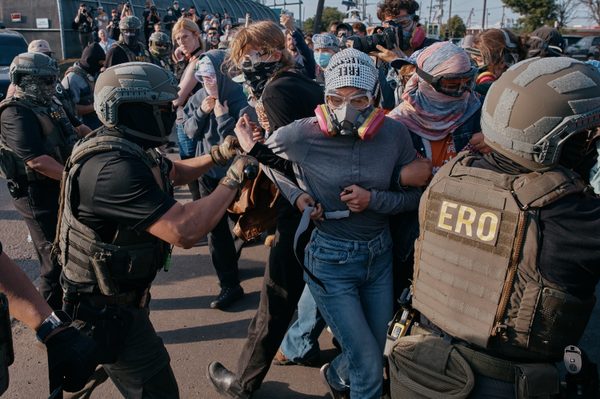
Protesters confront ICE agents outside Delaney Hall, May 27th.
“A key focus needs to be on stopping the expansion of detention facilities, both because it is absolutely inhumane, and because it’s a key tool for deportation.“
AA: When Trump got elected the first time, you told me that Detention Watch Network was not going to focus on DC because that was the time to focus on local fights. I hear you saying that now is a different moment. I just want to push you a little bit on that and hear a little bit more.
SS: If we are only fighting at the local level, then the federal government can just find other sites to expand detention. So it has to be both. During a more friendly administration, this might have meant pushing for the president and Congress to cut funding to ICE and CBP, and to reduce the number of beds in detention facilities. In fact, activist pressure led Biden to end ICE’s use of facilities in Alabama and Georgia. The Biden administration also reduced the budget for detention. I have so many critiques of that administration, but it did respond to our movement.
Now, of course, things are moving in the opposite direction. The most horrifying thing that happened this last year was the passage of the reconciliation bill—the so-called One Big Beautiful Bill Act—and the scale of money that it dedicates to expanding detention, expanding the number of ICE agents, and so forth. All of this infrastructure represents, as you said, the consolidation of Trump’s occupying army and its detention warehouses. This is about immigration, but it’s about much more than immigration, too; it’s a creeping authoritarianism with dire long-term consequences. So it’s important that we do everything we can to prevent the scale of what they’re planning to do.
This is made difficult because the Democrats themselves have moved significantly to the right on immigration. But in this post-Minneapolis moment, we’re seeing an opening to push them again, and it’s important that we do. Earlier this year, we were able to make the case that, actually, we don’t have to use all this funding and we can claw back some of it. Detention Watch Network put out a letter on this, and 1,000 organizations signed on. Very soon after that, Senator Bernie Sanders introduced an amendment that sought to take part of this immigration enforcement money and put it back into Medicaid. Forty-nine senators voted for it. At this moment, people are naturally making these connections. Our job is to spur them on.

I’m Arielle Angel, editor-at-large of Jewish Currents. Before you go, there’s something I need to ask.
We’ve seen over and over how the mainstream media falters in telling stories on our beats—whether it’s antisemitism, Israel/Palestine in American politics, Jewish identity, or the American left. At Jewish Currents we’re committed to uncompromising analysis and longform reporting on these issues and more—stories you won’t find anywhere else. In a media landscape that obscures injustice and flattens discussion, we’re changing the conversation. But we need you.
If you believe in this work, please consider making a donation—or even better, a recurring one—to ensure that we are able to keep publishing stories like this one. We can’t do it without you.
Amna A. Akbar is a professor of law at the University of Minnesota Law School. She writes about social movements, social change, criminalization, and the limits of law reform in the United States.