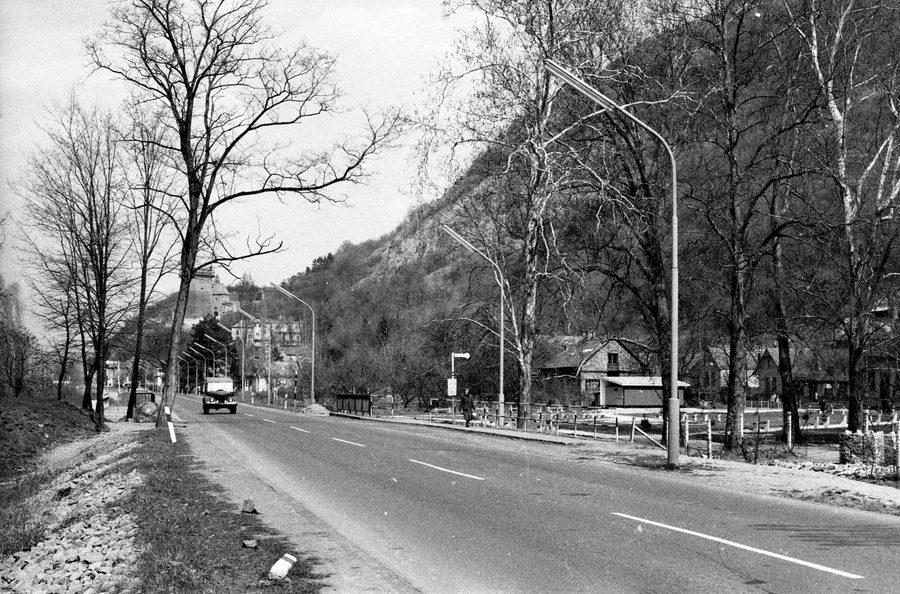
A Hungarian village street, 1956.
Dave Bagnall Collection / AlamyTwo Empty Rooms
“A real live Jewish woman! She used to live here.”
In her 1999 memoir Signora Auschwitz, survivor Edith Bruck likens living with the memory of the Holocaust to “an interminable pregnancy” in which she’s forced to carry a “monster” that can never be expelled. Her body of work reckoning with this experience constitutes, in the words of her friend Primo Levi, an “unforgettable testimony of her descent into the underworld.” Born Edith Steinschreiber in the Hungarian village of Tiszabercel in 1931, she was sent with her family to Auschwitz at the age of 13, and later transferred to a series of camps; the Nazis murdered her parents and one of her brothers. After the war, she wandered widely—first back to Hungary, then to Czechoslovakia and Israel, where she married an acquaintance with the surname Bruck to defer her military service—until 1954, when she settled in Rome and began writing in Italian. According to scholar Philip Balma, this newly adopted tongue became a “shield that would allow her to dive back into her painful past without directly reliving the suffering.” In 1959, she published the memoir Chi Ti Ama Così (Who Loves You Like This), the first of roughly two dozen works of fiction, nonfiction, and poetry to date; some scholars have called her the most prolific writer of the Holocaust in the Italian language.
While many of Bruck’s narratives plumb the horrors of the Nazi genocide itself, others explore the often absurd reality of survival—what Levi, in his preface to her 1974 short story collection Due Stanze Vuote (Two Empty Rooms), calls “an uprooting that can’t be remedied.” The titular tale, excerpted below, follows a Holocaust survivor’s postwar return to her native village. Bruck’s rendering of this moment is stunningly unsentimental; as Levi writes, “nothing here is idealized, nothing is simplified.” While the protagonist joyfully reunites with friends who feared her dead, she also confronts a chorus of sheepish acquaintances and strangers seeking absolution for their failure to help her family. The townspeople’s unsettling reactions—“Things turned out well for you, in any case,” says one; “Is the story about the death camps real?” ask others—highlight the impossibility of easy redemption or repair.
In Italy, the 94-year-old Bruck is a living legend, mentioned in the same breath as Levi, and a prominent public voice on issues relating to the Holocaust, Italian Jewry, and Israel. (Most recently, she condemned the EU for failing to intervene in the war on Gaza, attributing this inaction to historical guilt.) Yet despite her stature—and the fact that many critics and scholars consider the story “This Darkness Will Never End,” from her debut collection, to be an inspiration for Robert Benigni’s Oscar-winning film Life Is Beautiful—she is virtually unknown in the anglophone world. Indeed, only four of her many books have appeared in English, including my own translation of that first story collection, out this past spring (my translation of the collection Two Empty Rooms is currently unpublished). The ignorance of her work is part of a broader neglect of women’s stories of survival—an inattention that her devoted translators aim to help correct.
– Jeanne Bonner
The dark vehicle slowly made its way down the dusty road. The driver charged with following the young woman’s directions obeyed her—sometimes with a doubtful air, other times with distaste—as she gestured hesitantly and with confusion while describing their approach to an almost fairy tale-like village. The two men seated in the rear, Marco and Kalman, wore a particular expression, one shaded with love, protectiveness, pity, and concerted calm, as if to guide the woman to be more rational and take a more thoughtful approach, since no one knew that part of the country except her.
“So, my sweet little Judith,” the driver said, “where is your house? We don’t have much time to lose. Please tell me your last name and we’ll ask someone for directions.” He leaned out the window, searching for someone.
“Turn back,” an old farmer told them. “The house you’re looking for is that one with the new hedge.”
“So it was that one!” Judith shouted. “How could it be my house? I remember it being bigger. Everything seems diminished.”
“Everything is the way it was before,” Marco said. “It’s you who have grown. Stay strong.”
“There’s a limit even to desperation,” Judith replied. “I’ll only reach this limit today.”
She opened the passenger door then, as the car inched forward, and jumped out, immediately followed by a group of ten stunned people who were intrigued by the strange visit to the village. Wordlessly, they watched the elegant lady as she raced toward the tiny house where 20 years ago the large family of Schreiber the Jew had lived. Behind the hedge, an enormous German shepherd got ready to jump up on the visitor with the unfamiliar smell. The driver grabbed Judith firmly and steered her back into the car.
“The dog won’t let me enter the house,” Judith shouted. “The house, my house! No one’s there. The windows are shut, the glass covered in black paper like before. I want to go inside. Let me go inside for a moment!”
“No one’s home,” an old peasant woman said. “What do you want? Are the gentlemen looking for someone? Everyone’s in the fields.”
“Do you know who lived in this house 20 years ago?” Judith asked, shaken.
Fearful, the woman replied, “I don’t know anything. I don’t remember anything. I didn’t know those people.”
“Don’t you recognize me?”
“Oh!” the woman cried out as she made the sign of the cross. “You look like your mother! But you’re not your mother.” She drew back, as though she’d seen a ghost.
Turning, the old woman shouted to a group of people, “Come here! It’s one of the Schreiber girls.”
The dog quieted down, like the people, whose numbers swelled around Judith until, within a few seconds, she found herself surrounded. Country folk emerged from every house and corner. Some remained behind the hedge like back on that final foggy dawn.
Some of the children broke away from the group and ran to spread the big news. “There’s a Jewish woman from the village,” a little girl was shouting. “A real live Jewish woman! She used to live here. Her name is Judith!”
The news spread to the fields, where farmers interrupted their work to see the Schreiber girl, daughter of the poor Jewish man.
“Who are you?” asked a stout, old woman who was panting. “Oh, don’t tell me—I’ll have to guess which of the many Schreiber children you are. Oh, my saintly child, my precious one, you’re the one who would come to my house to get milk. I recognize the eyes that followed me around the barn and watched as I washed my hands, making sure when I poured out the milk that I didn’t mix in any water. Your mother, may she rest in peace, was also suspicious of me.”
Another plump woman had in the meantime elbowed her way through the small crowd. “Do you recognize me?” the woman went on, as her flushed face neared Judith’s pale one. “It’s good we can find each other alive again after all these years. So do you know who I am?”
“Yes, I think so. You’re Mrs. Koloni. I am the youngest of the Schreiber girls—the one who would come for the milk.”
“Judith!” they all yelled in unison. “It’s Judith! It’s really her. She didn’t die. She’s here. Come! It’s the Schreiber girl. Let us give you a kiss. Let us touch you, blessed daughter.”
“Light of my life, my beloved one. Do you know who I am? I’m Ilonka’s mother. She was your classmate, your best friend. Come, my child, come to our house. Come—you came back for us, no? Who else was a greater friend to you? Hurry, hurry, our house is your house, just like before. There’s nothing you can scold us for, isn’t that right, beloved child? I’m talking to you like a mother so listen to me. Come to our house—we deserve a visit more than everyone else.”
A younger woman shouted at her, “I thought you were dead!”
A path was forced open to get closer to Judith, who stood in the center of the crowd of people. By then, she was sobbing and laughing in the same breath, and even the peasant women began to cry.
“May I give you a kiss?” the young woman asked. “I’m Marta and I was a friend of your older sister. You’re still beautiful like no time has passed while I—we—compared to you, we’re old.”
A wrinkled, toothless peasant woman made her way to the front, trembling all over. “I’m Mrs. Kardos.”
“I know who you all are. I recognize many of you. You, ma’am, you’re Mrs. Nemeth,” Judith said, pointing at a woman who withdrew as though she didn’t want to be recognized. “And you’re Sandor. You—you’re Bela.”
The two men she had named shook her hand. “So you’re alive,” said one.
“As you can see.”
The other man was silent, looking down at the ground.
“Let me go, let me go,” shouted a new arrival who had tucked under her arm a bloody goose, carried by its broken neck. Her face blood-spattered, the woman asked, “Do you recognize me, child? This goose is for you. I slaughtered it for your dinner. I believe you are no longer religious and will eat with us.”
Judith was surprised that she didn’t recognize the woman offering her the goose.
“Now, listen. You can’t be angry with me!” the woman said. “I wasn’t very close to your family but I also wasn’t against you. I was wanting to have you over for dinner since I may be happier than many others to see you alive. My daughter, Eta, was friends with your sister, Eva.”
“Let me touch you,” said a voice, “it’ll bring good luck.”
“Ah yes, you’re Mrs. Kantor!” Judith shouted happily, as she kissed her. The woman was relieved, as if freed from a baseless accusation.
Judith’s head was spinning, and her eyes were burning.
“What about your mother?” another peasant woman asked. “Is it true that you’re all safe and sound in America? Grunberg’s son is in America and one of the Reis children, too. We’ve been told they are doing well for themselves. You’re all really impressive. Fire can’t even burn you and just like cats, you always land on your feet!”
“What are you saying?” exclaimed Judith sharply, with a defiant tone. Shouting, she continued, “Only one of the 11 Reis siblings survived. My parents and my brother were burnt alive! The Grunbergs never made it back and you talk about them doing well for themselves?”
“I knew it,” said another old woman tearfully. “I was very fond of them. They were my neighbors. They were my Jews.”
“Let me touch you,” said a voice, “it’ll bring good luck.”
A little girl with dark braids said, “I’m Dobai’s daughter.”
“Come here so I can hug you. Where is your mother? How is everyone? What about your father? And your brother? Did you know when he was a little boy he used to spit on me? Your mother would cry out in distress.”
Someone was heard to say, “Around here, they say you live in America. Lucky you.”
“I slaughtered a hen,” someone else in the crowd said. “I’d like to have you over for dinner.”
“Let me through,” stammered an old woman dressed all in black. “Here are four eggs for you.” She held out something wrapped in newspaper. “How hungry you were before you were taken away and I never gave you anything unless it was on loan. Wretched me. My conscience has been eating away at me ever since. Take these, and free me from my sin. I am old and I will die soon. I don’t want to stand before God with this remorse. Now I’ve been given grace and I can make amends. Accept this, please—I beg of you. All of us are poor now so at the very least, let me die in peace. Please say something—don’t look at me this way.”
“I don’t need it, Mrs. Gal,” Judith replied coolly. She had recognized the miserly woman whose husband was more respectful and sympathetic.
“You can’t refuse,” the woman persisted, wailing. “We have all sinned. All of us!”
“Of course,” Judith replied, accepting the package proffered by the unsteady hand. Then, with a kinder tone, “And what about your husband?”
“He’s over there, watching you,” the old woman replied, her face glowing. “I don’t think you’ll recognize him, poor thing.”
Judith called out to the driver and had him bring one of the two shopping bags full of gifts.
“I have some tobacco,” Judith said. “You used to smoke a pipe, isn’t that right?”
The old man was moved, and he mumbled something, his eyes sharp and alive for a moment. The villagers guffawed like children as they enjoyed the greeting between the young woman and the old man.
A woman with a limp approached Judith so she could touch her, and from behind, the others pushed closer so they could feel her with their own hands, as if her presence alone couldn’t confirm she’d survived.
Judith leaned against Marco. More than ever, she needed to feel Marco; it was no longer enough knowing he was there. She needed to touch him, to lean on him lightly but completely, in an effort to resist the astonishment she had provoked.
“You’re really alive,” said a woman who stroked her arm at length, before adding, “But your coat is made of fine fabric. You . . . and yours managed all right.”
“And what a beautiful blouse!” another voice said. “It’s made of silk. Show us how it was made, and open your coat. Oh, and your bag—it’s made of real leather.”
Another woman shouted, “I would never have thought one of Schreiber’s daughters would become a real lady.”
“When they took you away, I thought, Finally I won’t see them suffering anymore.”
“You’re simple but elegant,” said a woman wearing a clear rain slicker. “Your family always paid attention to appearances. I remember you wore a pale blue, pleated skirt and a red blouse at the end of the school year in 1942. I had to look for the same fabric for weeks because my daughter wanted to look like you. Do you recognize me? My husband was a gendarme—a person with power back then. Now I’m widowed. I never wished bad luck on you. You always made me feel great pity, and when they took you away, I thought, Finally I won’t see them suffering anymore.” She went on, “My husband wasn’t cruel, he just wanted to get ahead in work, and wearing a uniform, he felt like someone.”
“I’m not here to accuse you,” Judith stammered.
“Things turned out well for you, in any case,” she continued. “If you had stayed here, you wouldn’t have traveled the world.”
“You wouldn’t have beautiful clothes,” said another woman, jumping up.
“You’d be ignorant like us,” a third woman said.
“I see,” Judith replied meekly. “Things turned out well for me, in any case.” Then she shouted, “But how is it that everyone is alive? The old, the young, the good, the wicked, everyone? The luck is in living, not dying.”
“Thank God,” came the reply. “We only lost a few people. But the village now is all old people. The young people left for the city. They’re going to university or are working. This regime is doing something right, you have to admit.”
“But tell the truth,” they persisted, “is the story about the death camps real?”
“Ask your children,” Judith replied. “They’ve studied.”
“Not on your life,” they responded. “They don’t trust us, and they know nothing about the war. They’ve become part of the bourgeoisie like you! They criticize us and don’t give us the respect we deserve.”
“Oh my Lord,” said a woman who was running toward the crowd. “It’s a miracle! A miracle. I thought you were dead. Hold me tight. I want to know if your blood is warm!”
The woman who had just arrived was overly excited, laughing and crying chaotically. Judith looked at the people before her one by one: men and women dressed in black as if in mourning, their faces toothless and weathered. The circle widened, with young people who were Judith’s age but appeared much older. She called them by name, wanting to be sure they were in fact her old playmates. But the young ones who seemed to be 10 years older than her were standoffish even when Judith extended her hand and showed she was happy to see them. She didn’t know how to interpret their strange behavior, stiff and ashamed. She felt their calloused hands and analyzed their dazed faces, and the distance they immediately imposed so they could stand behind the hedge with vacant expressions. Perhaps they would have preferred she visit on a holiday when they would look fresher and be dressed up.
“Is the doctor still alive? And Batak, the schoolmaster?” Judith was speaking quickly to rid herself of questions, almost as though she didn’t even want responses.
“They’re alive,” said one of the country women, “and they are doing well. Batak’s son is an engineer in Debrecen. It’s a shame he’s not here. He went to university and could better converse with you. The doctor’s son is old now and a doctor, like his father.”
“But as a child, the son was also a bastard,” she replied quietly, as if disappointed they were still alive.
Stunned, a woman asked, “What are you saying?”
“Oh nothing,” Judith said, sensing they didn’t understand the reason for her bitterness. “Here’s Uncle Imre,” she shouted, suddenly radiant, and she ran to embrace him.
They held each other at length, shattered by tears.
“Don’t stand here in the middle of the street,” Uncle Imre said. “They’re all waiting for you. My home is your home, too, as always. Enough with all the talk. Let’s get going—don’t torment yourself. You’re trembling! Are you cold? Hungry? Come now, let’s go. Even if you’re grown up now, I can talk to you like a father. I was a true friend, you know, to poor Schreiber.”
“Leave her alone,” the stout, panting woman began again. “Don’t you obey him, too. Everything is just swell for him because his son is a professor. He was your classmate. He teaches Marxism or Leninism or whatever the hell they call their new religion. He kept his land on account of his son. The shotgun he uses to threaten people who approach his house is also his. My dear, some outrageous things have happened here!”
“Dinner is ready,” said a woman who lived next to Judith’s childhood home. “I’ll be offended for the rest of my life if you don’t eat at my house.”
“She would have been offended at one time if I did eat there,” Judith said to Marco in Italian.
“She even speaks foreign,” a peasant woman marveled. “Say something in a foreign tongue, won’t you? Maybe you could even sing a song. You had a beautiful voice as a child.”
“We get the radio,” said the woman in the raincoat. “We can even hear Italy!”
Judith didn’t know whether to laugh or cry.
“I have a dessert in the oven,” a second woman announced.
“They’re going to eat at my house,” the first woman said.
“And at my house after that.”
“And then at my house,” said a third woman.
Uncle Imre waited in silence until Judith was free to follow him.
“I made chicken paprika and a dessert with jam,” said Judith’s neighbor.
“We also made chicken paprika,” Uncle Imre said, “with dumplings, which Judith likes very much.”
Annoyed, the women replied, “We all made dumplings.”
A thin man arrived on a bike while they argued in the middle of the street, still prodding Judith and kissing her and undressing her.
“It’s him,” the villagers shouted.
The thin man stopped suddenly. “What do you want?” he asked suspiciously.
“It’s him, it’s him,” they repeated. “He’s the one who lives in your family’s house.”
“I’m not from here,” said the man, timidly approaching Judith. “I bought the house, ma’am. No one gave it to me. What do they want with me? I didn’t steal anything from anyone!”
“Would you let me in for a moment?” Judith asked, her face pale and tense.
“If it means something to you,” he said indifferently. “It’s a mess, though. I haven’t finished it yet. I’ve only lived in the village for two years. I’ll hold back the dog while you go inside. Please come in.”
Leaning on Marco, Judith moved toward the house, followed by 30 people, including Kalman and the driver.
In the dark, the village appeared even more desolate. To save money, the villagers didn’t turn on the oil lamps or other lights in their homes. They were used to it, sometimes even eating their dinner in the dark.
Judith stepped into the kitchen, her knees buckling. For her, it was like entering . . . a funeral chapel? A shrine? A fortress? A beloved place, with beautiful and ghastly memories? She knew every corner, every inch of the dirt floor. She knew the walls, the door, and the wooden column in the middle of the kitchen holding up a part of the roof that caved in after the house was built with the help of nomads. Inside, there was nothing but a bed, a table, and a stove.
“This is our lamp,” she shouted desperately, as if spotting an island after a shipwreck.
“All the houses are full of oil lamps,” Marco said to her. “It’s not necessarily your old one. Let’s go now, cara. Lean on me.”
“The poor dear,” the country women called out, in tears.
Judith clung to the column, as if she couldn’t or wouldn’t ever move again. She held tight to the wooden shaft, searching with her fingers for something mysterious.
“Here’s Mama,” Judith stammered. “Here’s Daddy. Here are my sisters, my brothers.” She was stroking the names carved into the wood. “My mother didn’t want us to carve our names,” she told Marco. “She always said it was bad luck, a tombstone’s inscription. Here’s the date: 1943. Exactly 20 years ago.”
“Come outside,” Marco begged her, but Judith didn’t move.
She stood, rooted to the earth, her lips murmuring something incomprehensible. Maybe she was speaking to the ghosts of the past. She was calling them and saying a prayer for them for the first time in 20 years. She’d lost it all there, not somewhere else. The grave couldn’t be anywhere else, and she wouldn’t search for it anywhere else, as if her parents were buried there beneath those meager square feet of dirt floor. She had learned between those walls how to love, how to suffer, how to rejoice, and how to fear death. Happy memories and sorrowful ones were bound together in that place. What happened afterwards was too different, too inhumane, too unbelievable to constitute the same lifetime.
She moved slowly toward the other room, the only one there besides the kitchen. It was empty. On the windows was the dark paper that they’d left behind 20 years before. From the ceiling hung a black uniform that was swinging through the air in the half-light like a hanged man. Judith covered her face with her hands.
Her eyes shut, she turned around and shouted, “Let’s go quickly.”
She began running with new strength, an iron will on her face, as if her very life were in danger and she couldn’t spend another minute in that darkened house.
Her closest childhood friend arrived by surprise and she managed to distract her, even managing to make her laugh by recalling their childhood.
“Do you remember the diarrhea from the plums?” Gisella asked her. “Just today I was making jam and I took it off the stove to run over here. Are you married? Do you have children?”
“Unfortunately, no,” Judith said. “What about you?”
“I have two. My husband works in a shoe store because we now have a shoe store. What do you think about that? We’ve made progress!”
“Gisella’s husband is a spy,” an old woman said. “He once filed a complaint about people who were going to church.”
“It’s like before,” Gisella said, paying no mind to her. “We’re still nasty and ignorant. Lucky you—you’re not condemned to live here. Don’t listen to their idle chatter—they’re evil. That’s why they pray so much! Don’t think going to church is forbidden. My girls were baptized and they go to church regularly.”
“This blouse is for your older daughter,” Judith said, interrupting her chatty friend.
“Wonderful! She’ll wear it for her communion. My Judith is a fine little lady. If you could see how tall she is!”
“Judith who?”
“I baptized them that way as a means of remembering you . . . Forgive me, you all have such beautiful names, unlike us. The village is full of Jewish names.”
“My daughter is named Judith,” Gisella said. “I named the other one Eva after your older sister. I baptized them that way as a means of remembering you . . . Forgive me, you all have such beautiful names, unlike us. The village is full of Jewish names, I mean names that you and yours would choose. I did it out of affection; my daughter reminds me of my best friend. Do you see?”
“Of course,” Judith said, absent-mindedly. “The handkerchief is for you. This other blouse is for your mother and these gloves are for Eva.”
A peasant woman reached for the gift that Judith was removing from the trunk. “I have a daughter who is the same age as Eva—her name is Flora,” she said.
Judith was so surrounded by people that she couldn’t breathe. Everyone was recalling moments that in some way involved her.
“I hid your father from the police,” one man said.
“Here’s a tie,” Judith replied.
“I didn’t say it to get something,” the man protested.
“Nor do I give it to you for that reason. It’s a memento, nothing more. There are deeds that can never be repaid.”
The voice of an old woman was heard to say, “I gave you some milk right up to the end when the others refused to sell you food.”
“Exactly,” Judith replied automatically. “I remembered you by bringing you a pair of woolen tights that you will like.”
She continued to give out gifts while at the same time receiving whole chickens fried, desserts, watermelon, pears, apples, pillow shams, and two hand sewn aprons. She emptied the trunk and refilled it with hot dishes.
The crowd was following her toward Mrs. Porosi’s house, which was attached on one side to hers. Motionless, Mrs. Porosi’s elderly father stared with glassy eyes at the unexpected visitor.
“My dear Mr. Porosi,” Judith said, leaning down to kiss the old man. “I brought you a stately tie. Do you know who I am?”
“He’s like a child now,” his daughter interjected. “Please come in. The table is already set,” adding, “Bring me two more glasses.”
They were gathering as if for a performance in the Porosis’ single room, and while the guests struggled to swallow chicken and dumplings, the others looked on in silence or told stories from Judith’s childhood.
There were pregnant women, children, and old ladies.
“Eat, blessed child,” said Mrs. Porosi as she cried profusely and blew her nose on the corner of her apron.
Kalman and the driver were eating with gusto while Marco searched his plate with a stunned look. Judith was forcing herself to swallow something so as not to offend the lady of the house.
When the wary children sat down beside her to get a slice of cake, Judith was happy to pass out everything she had piled on her plate.
“Let her eat,” Mrs. Porosi kept shouting. “They are my son Bela’s children. Do you remember him?”
“Oh really?” she said, surprised. It was only then that she thought of Mrs. Porosi’s four children whom she had been friendly with, especially the youngest two: Antal and Bela.
“This is my daughter-in-law,” she said, pointing to a stout pregnant woman.
Judith offered her a flower-patterned handkerchief. “Your husband Bela was a close friend of my brother who’s no longer alive. They were the same age.”
The woman snatched the handkerchief as if fearful Judith would forget to give her the gift as she reminisced.
“You don’t have anything for children, ma’am?” the daughter-in-law asked, reddening.
“Disgraceful,” her mother-in-law said. Shooting the woman a dirty look, she added, “Do you like the dumplings? I know Judith likes them but perhaps they don’t appeal to you gentlemen. When have you ever seen such a mountain of meat on your plate? To think, you often came over to complain that your mother never gave you more than a wing! The poor dear, she had to divide a meager hen into 20 portions. Isn’t that right, Judith? But eat up now, my dear daughter. Eat all of it and you will remember me!”
“Don’t talk about the past,” a woman interrupted. “Don’t you see how she’s dressed? She wants for nothing. They moved on, with better lives than us while we stayed poor. Not as poor but still poor. The rich aren’t as rich but they’re still rich and that’s the truth. After the war, all they did was take away and redistribute land and shuffle and reshuffle. You still have rich and poor people!”
“What kind of talk is this?” said Uncle Imre, who was still patiently waiting for Judith to follow him after dinner. He understood Judith could not offend anyone. Then he added, “Maybe I should go.”
“No, wait for me, Uncle Imre.”
“I’ll be waiting for you at home. Do you remember where we live?”
“I remember and I’ll meet you there shortly.”
“We need to leave soon,” the driver said. “It’s already night.”
“I have to visit the Dobais, Gisella, and Uncle Imre, and then we can be off.”
“My poor thing. So many stops you still need to make. You’re pale, your eyes are red,” Mrs. Porosi said. “You’re like Nemesy’s daughter. Do you remember that rich porker? You also worked his land—it wasn’t only us. And you worked it good; who would ever guess now that you touched a hoe with these snow-white hands! Now all of us have a small tract of land that we own. The rest, we work jointly for a fairly decent wage. We’ve got to admit it: The Russians have ushered in some advances. What do they say where you live about these programs?”
“There are still overlords,” yelled the pregnant daughter-in-law. The panting, chubby woman added, “I’ll tell you how things are. Do you perhaps have a handkerchief?”
“I still have some things in the bag.”
Mrs. Porosi raised her hand shyly to signal that she, too, wanted a handkerchief.
“Drink to the memory of your father who gladly drank,” the rotund woman said. “We won’t talk about politics if you don’t want to but your father was a socialist. There’s no reason to hide it now. Quite the opposite. The ones who used to think very differently now brag about it. I think, though, you Jews invented all kinds of things and this socialist communism is something you also invented.”
“Let her eat!” said Mrs. Porosi. “You mustn’t remind her of the dead and you mustn’t talk to her about politics. She is like my oldest son—she believes in social justice since she lives abroad! Things look better from afar, no?”
The old man came out of the kitchen to join the conversation. He was leaning on a knotty cane and dragged himself over with difficulty. “Seeing you will allow me to live longer,” he stammered.
“Oh stop it,” shouted his daughter. “You’ve been on your deathbed for 10 years. But you never die! Whenever he eats too much, he has me call the priest because he doesn’t feel well! His character has grown much worse and he alone keeps me busier than my four children.”
She’d become red with anger. She bent over Judith as if to confide a secret.
“If you knew,” she said under her breath, “that since they took you away, I can’t think of anything but your family’s house and you know why? It’s next to mine. I’d need only to get rid of the hedge. But believe it or not, I haven’t been able to scrape together the money to buy it yet. Don’t you think I have more of a right to live there than the others? At least I cared about your family. The new owners had lights installed and at my house, we don’t have electricity yet. And do you know why the yard is smaller? When they took you away, the neighbors moved the hedge, snatching a couple of meters on all sides. Back then, no one said anything. I took barely a meter, not even a meter. I was afraid.”
A new arrival said, “I kept merchandise for you in my house. Goods your father sold on the sly. My name is Zoli. Do you remember me?”
“Here’s a nice lighter,” said Judith. “It’s an excellent lighter—it will last the rest of your life.”
“I didn’t say—”
“It’s a memento.”
A woman wearing layers of colorful skirts said, “I want to give you a nice embroidered pillow. I never gave you anything, it’s true, and I have some of your linens. Nothing beyond your sister’s trousseau fell to us to take and I gave it to my daughter when she was about to get married. Here, I’ll give you this pillow with all my heart. Those were difficult times. If I didn’t do it, there were 10 others ready to do the same so nothing would have been left for you anyway.”
Judith took the pillow without replying to the woman with the layers of skirts. She could no longer distinguish names or faces, nor the heroes from the villains, and in the end, maybe the kindest ones were those who came by to say hello and bring her something to put their conscience at ease, to atone—with a chicken—for the years of hatred and humiliation.

I’m Arielle Angel, editor-at-large of Jewish Currents. Before you go, there’s something I need to ask.
We’ve seen over and over how the mainstream media falters in telling stories on our beats—whether it’s antisemitism, Israel/Palestine in American politics, Jewish identity, or the American left. At Jewish Currents we’re committed to uncompromising analysis and longform reporting on these issues and more—stories you won’t find anywhere else. In a media landscape that obscures injustice and flattens discussion, we’re changing the conversation. But we need you.
If you believe in this work, please consider making a donation—or even better, a recurring one—to ensure that we are able to keep publishing stories like this one. We can’t do it without you.
Edith Bruck has written more than twenty books of fiction, nonfiction, and poetry, many of which reflect her life-long commitment to Holocaust testimony, including Who Loves You Like This. Her books have been translated into many languages, including English, French, German, Dutch, Polish, Hungarian, and Hebrew. She lives in Rome.
Jeanne Bonner is a writer, editor, and literary translator. Her translation of Edith Bruck’s The Darkness Will Never End was published this spring. Her essays and reporting have appeared in The New York Times, Boston Globe, American Scholar, Longreads, Marketplace, NPR, and CNN.