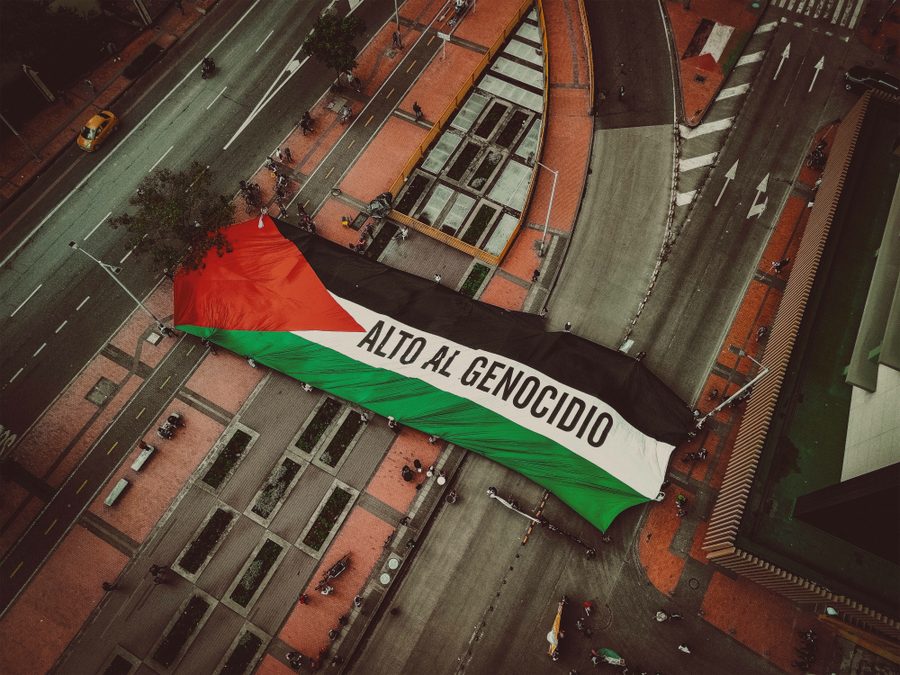
Palestine solidarity demonstration in Bogotá, 2024
Photo courtesy of Helena Müllenbach MartínezThe Making of a Coal Boycott
Inside the campaign to break the toxic relationship between Colombian mining and Israeli militarism

On November 1st, 2023, three weeks into Israel’s war on Gaza, five days after the tanks began rolling into the Strip, the day after over 150 Palestinians were buried under one residential building in Nuseirat—roughly half of the victims being children, many of whom were playing football next to the house when the bombs fell—a distant actor announced its entry into the arena: Sintracarbón, the trade union for coal workers in Colombia. It issued a statement describing what was happening as a “genocide,” and called on the Colombian government to “suspend the shipping of coal to Israel.”
Closer to the bloodshed, Leyla, a Palestinian activist hailing from Gaza and living in Amman who requested a pseudonym, was electrified by the call. She was working for Disrupt Power, a Palestinian militant research collective looking for ways to throw spanners into the killing machine. Coal, she saw, would be the ideal target. “Coal imported to Israel goes straight into its unified electrical grid. It powers the settlements in the West Bank, the artificial intelligence used to bomb Gaza, the military factories, the bases—everything running on electricity,” she told us in a June interview. When Leyla and her colleagues began gathering data, they learned that more than 60% of this coal came from Colombia. They found the ships that transported the coal and the ports where those ships docked. Then, they passed on their research to the Ramallah-based NGO Palestine Institute for Public Diplomacy (PIPD). In the spring of 2024, Amira, a PIPD activist who also requested a pseudonym, left the West Bank on a mission: to help convince the Colombian government to keep its coal away from Israel.
Since the British first occupied Palestine, coal-fueled electricity has been a critical hinge for colonial acceleration in the region. In the early 20th century, Jewish settlements gained privileged access to Palestine’s newly established electrical grid, and by 1948, Jews—the majority of whom were recent settlers—made up one third of the population but consumed 90% of the electricity. All the way into the new millennium, imported coal remained the basis of electrical power generated and dispatched across the lands conquered in 1948 as well as in 1967. In the early 21st century, gas was discovered in the waters of historic Palestine, and Israel quickly ratcheted up extraction as it sought to shift its power plants onto this source. But it was an incomplete success: On the eve of the genocide in Gaza, between a fifth and a quarter of the country’s electricity still came from the combustion of coal—the bulk extracted from lands that have been violently depopulated in Colombia. In 2023, these companies shipped nearly $447 million worth of Colombian coal to Israel, accounting for roughly 5% of the former’s coal exports and almost half of latter’s imports.
This is the reality Amira had in mind as she traveled to Bogotá in early 2024, hoping to get Colombia to end a collaboration that had destroyed many lives on both sides of the Atlantic. She would be addressing a Colombian government that, for the first time in history, was made up of forces of the left. In 2022, Gustavo Petro, a former member of the leftist guerrilla organization 19th of April Movement (M-19), was elected president of Colombia, backed by a panoply of social movements including Sintracarbón and the organized working class, Indigenous groups, and environmental organizations. Petro had campaigned on the idea of a politics of life and a program for remaking the Colombian economy, including, most audaciously, weaning it off fossil fuels. After his victory, the government quickly launched a transitional program, the most radical so far in any fossil fuel-producing country: a complete ban on new fossil fuel infrastructure. Not a single contract would be issued for opening a coal mine, drilling oil, or exploring for gas, opening the possibility that Colombia’s role in fueling the world’s fossil economy might slowly fade away.
On the eve of the genocide in Gaza, between a fifth and a quarter of Israel’s electricity came from the combustion of coal—the bulk extracted from lands that have been violently depopulated in Colombia.
One of the program’s architects was Susana Muhamad, Petro’s first minister of the environment. Muhamad is the face of climate justice and biodiversity protection in Colombia; she is also Palestinian, the granddaughter of an immigrant who fled the threat of conscription into the British army in 1925. Muhamad renewed her ties to Palestine with a 2009 visit to the West Bank. “I had dozens of cousins spread out around Ramallah who were aware of my existence. They kept asking me, ‘Why didn’t you come before?’ These family ties sort of transcended time and space,” she told us in April. It was thus to Muhamad that Amira paid a call. They sat down for a coffee, and the activist briefed the minister about her mission. Muhamad was horrified to learn about the critical role Colombian coal was playing in the ongoing genocide: “I said, ‘We have to let President Petro know about this’—and I opened the door for social movements from Palestine to transmit their message directly to the president.” Petro, who has long stood in solidarity with Palestinians, required little persuasion. In June 2024, the president announced that Colombia would halt coal sales to Israel. In August, he tweeted a terse explanation—“Colombian coal is used to make bombs to kill Palestinian children”—alongside a copy of Decree 1047, which put the export prohibition into law.
Petro’s decision to materially divest from Israel’s genocide made waves across the Atlantic. It was the greatest victory to date of the campaign for an energy embargo against Israel, if not the boycott movement as a whole. The Popular Front for the Liberation of Palestine and Hamas hailed the move, issuing communiques in praise of the Colombian president. For leftists across the globe, Petro’s actions offered a glimpse of true internationalist solidarity with Palestine; here, at last, was a model to follow. As the human rights advocate Rula Jamal wrote in Jacobin, “with Colombia being the largest coal exporter to Israel, this decision is not only a victory in symbolic terms but shows the enormous impact that a wider energy embargo could have in ending Israel’s genocide in Gaza.” In response to news of the ban, the Israeli Electric Corporation, the state’s largest supplier of electrical power, said that it was negotiating with “alternative suppliers” of energy to “further increase our room for maneuver.” But the reality remained that a choked-off Colombian supply threatened to leave Israel gasping for energy.
As it turned out, however, the extraction feeding the destruction of life and land across Colombia and Palestine would not be so swiftly interrupted. Even after Petro’s ban, Colombian mines were not closed to Israel, and ships continued to leave the ports of Colombia for those of the occupation as coal corporations found a way to evade the law. Decree 1047 would not be the last word on the export, only a preamble.
Traveling through Colombia’s “mining
corridor” in the northern region of Cesar this April, we were confronted
with huge walls blocking the mines—massive ramparts of stone and slag
that the companies have built to keep the wasteland out of sight. But in
one spot, a landslide has gouged out a viewpoint over the pit, allowing
us to take in the scene: a bowl stretching hundreds of meters into the
earth, black terraces coiling up along the sides for the trucks to drive
on. Nothing can grow, nothing can live on this land; in the words of
the Colombian scholar and activist Felipe Corral Montoya, who
accompanied us on the trip, “it is a dead desert.”
Half a century ago, residents tell us, this region was swathed in blue and green. But all of that changed with the arrival of multinational mining corporations. The largest company in the area is Drummond, headquartered in Birmingham, Alabama. It arrived in Cesar in 1993—and promptly began clearing land by force. The process involved “the deaths of innocent people, rapes, displacements. God knows how many peasants still lay buried around here,” according to a woman in the mining town of La Loma, who spoke on the condition of anonymity. Many were forced to sell their land—“they were made to practically give it away,” she explained—and would later be prevented from returning by the fait accompli of their fields having turned into coal rubble. “The coal that comes out of this ground is stained with blood,” she said. Further to the north, the residents of the region of La Guajira suffered the same fate. Here, the Wayuu—an Indigenous people who survived Spanish colonization through a combination of luck, adaptation, diplomacy, and guerrilla warfare—bore the brunt of the terror, facing waves of paramilitary atrocities and mass evictions until the region could boast the largest open-pit mine in Latin America, this one owned by the Anglo-Swiss commodities trader Glencore.
“God knows how many peasants still lay buried around here . . . The coal that comes out of this ground is stained with blood.”
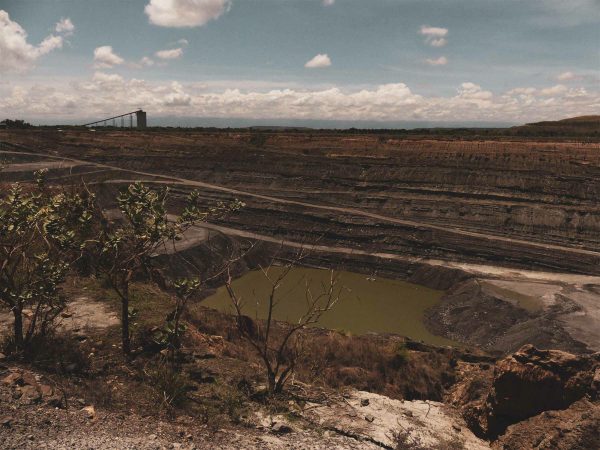
Coal mine in Cesar, April 2025
The mining giants arrived just as Colombia’s decades-long armed conflict between right-wing paramilitaries and leftist guerillas was reaching new intensity. The guerrillas’ Revolutionary Armed Forces of Colombia (FARC) and the National Liberation Army were born out of peasant revolts against land concentration in the hands of large landowners. Now, these groups took to targeting the coal industry’s infrastructure, blowing up coal trains and kidnapping managers and engineers. In response, Drummond set up a paramilitary force of its own under the umbrella of the existing far-right militia Autodefensas Unidas de Colombia (AUC). The Alabama company paid hundreds of armed men, provided them with training grounds, and coordinated with them to secure the perimeters of its coal mines. The coal railway, which carried material from mines to the port, was also enveloped in checkpoints; the private guards who manned them could shoot at anyone considered “suspicious.” The paramilitaries referred to their mission as “social cleansing,” a strategy of prompting the population to flee by means of spectacular murders and shrill threats. One gruesome instance of such violence unfolded in 1997, when armed men stormed the Santa Fe estate, shouting: “We are from the AUC and . . . we are going to stay here to carry out social cleansing.” The paramilitaries then summarily killed a 13-year-old boy, after which the residents fled. Their property was declared abandoned and sold at auction; much of it eventually ended up in the hands of Glencore.
By such means was the coal enclave of Colombia constructed. After forcing the exodus of some 300,000 people, several thousand of whom were killed, Glencore and Drummond together took hold of the northern tip of the country. Colombia had already been a paradigmatic case of ecologically unequal exchange, with biophysical matter constantly being drained from the country to feed the world market. The two companies’ conquest consolidated this pattern. Up until the ban, between 90% and 97% of the coal mined in Colombia was exported to other countries, and was much in demand at power plants from the Netherlands to Israel. As one Wayuu woman told the researcher Aviva Chomsky, “neither we nor our animals eat coal, that’s not our life.” Instead, it has ever been “the White Man [who] eats coal.”
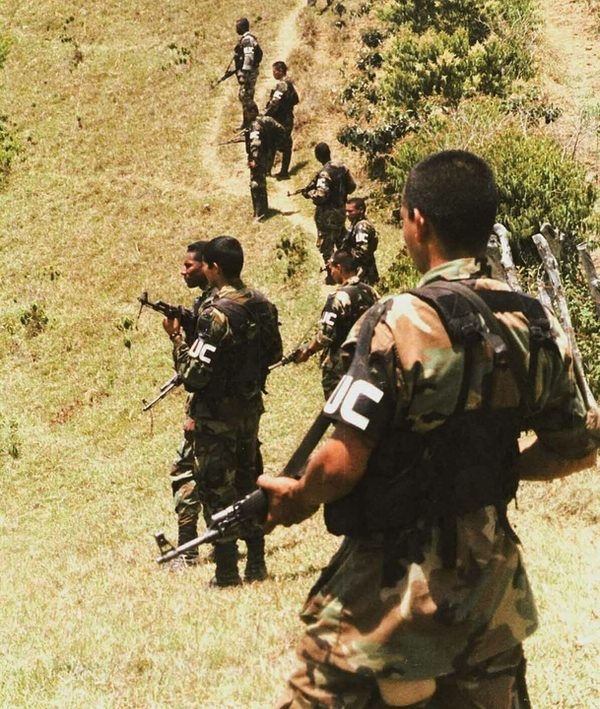
Members of the AUC conduct a military drill in the mountains of the southern region of Cauca, 2002.
In the sacrifice zones that have resulted from this takeover, a litany of woes has unfolded: collapsed agriculture; water shortages arising from the mines’ diversion of dozens of rivers; air pollution that attacks lungs, eyes, and other organs; cracked houses due to underground explosions; animals and people killed by the coal trains. Once contamination reaches intolerable levels, already displaced communities must again be “resettled,” dispossessions that feed extreme poverty in the most unequal country on the continent. Then there is the changing climate. Both Glencore and Drummond have made it onto The Guardian’s list of the 100 companies that have poured most fossil fuels on our planetary fire. “Nowadays the sun is much hotter than it used to be,” says Maria Dolores, the traditional matriarchal authority of a Wayuu community living along the coast of La Guajira. Her son Luis Carlos continues: “When the rains arrive, we are happy, because we can plant crops and the flowers sprout and our animals have water to drink. But nowadays the rains are weak and rare. The desert is closing in on us.”
Israel has deep roots in this story of destructive extraction. Throughout the Colombian armed conflict, Israeli actors helped pave the way for Drummond and Glencore, assisting and equipping the military forces of the right in an extensively documented—and, in Colombia, well-remembered—history of sordid entanglements. As Sintracarbón noted in its first call from November 2023, the coal sent into the furnaces of the genocidal machine today is “linked to the role of Israel in training military and paramilitary groups in the armed conflict our country has suffered.” Others may have bought more coal from Colombia than Israel did, but none had a similar fingerprint on the industry’s bloody takeoff.
Memories of this period inevitably feature a certain Carlos Castaño, the founder of the AUC. In the early 1980s, this young Colombian anti-communist moved to Israel for two years. He took classes in military schools as well as at the Hebrew University. In his autobiography, he described the experience in glowing terms:
I did not only learn about military training in Israel. It was there that I became convinced that it was possible to defeat the guerrillas in Colombia. I began to see how a people could defend itself from the whole world . . . In fact, I copied from the Israelis the idea of autodefensa [self-defence, through the wide distribution of] weapons; every citizen of that country is a potential soldier.
Upon his return home, Castaño rose in the ranks of the paramilitaries and, in 1997, unified them under the command of the AUC, whose members would go on to commit the lion’s share of massacres and mass displacement during the war.
Israel’s input in the armed conflict extends beyond Castaño’s early epiphanies. In the mid-1980s, FARC rebels, together with trade unionists and left-wing intellectuals, formed a political party called Unión Patriótica. The Colombian state responded by physically annihilating the party, killing more than 6,000 members—cadres, mayors, presidential candidates—over two decades. The operation under which the murders happened was designed in part by Rafael Eitan, a Mossad agent and former national security adviser to prime minister Yitzhak Rabin. (Sintracarbón referenced this link between the Israeli military and Colombian paramilitaries in its first statement calling for a boycott of coal exports to Israel.) Additionally, the AUC itself received extensive training from Yair Klein, another Israeli veteran and mercenary who also lent his services to the death squads of the Medellín drug cartel. (In 2001, the Colombian government demanded his extradition from Israel, to no avail.) Israel also supplied nearly 40% of the weapons the Colombian army and paramilitaries used to battle the guerrillas: The Hermes drone, first tested on the battlefields of Gaza, was a particular favorite, as was the Galil, an Israeli-made automatic rifle.
There has been a mirror image of these entanglements on the left. In the 1970s, the M-19 guerrilla sent its fighters to train in Palestine Liberation Organization (PLO) camps. “During our armed struggle . . . my comrades went to the Sahara and trained with the PLO,” Colombian President Gustavo Petro, a former M-19 member still unapologetic about that past, recalled to us in an April interview in the presidential palace—in an office furnished with Marxist books and adorned with a keffiyeh. “Our love for Palestine was born there.” In 1981, M-19 showed its solidarity with the PLO by attacking the Israeli embassy in Bogotá; following the Sabra and Shatila massacre in 1982, the group attacked the embassy a second time.
Others may have bought more coal from Colombia than Israel did, but none had a similar fingerprint on the industry’s bloody takeoff.
The pattern has continued into recent years, with Colombia’s right and left refracting their internal struggles through Israel and Palestine. Petro’s predecessors on the right have stayed firm in their commitment to the former. In 2013, then-president Juan Manuel Santos traveled to Jerusalem to shake hands with Israeli leader Benjamin Netanyahu and sign a free trade agreement between the two countries; he was “very proud” when Colombia was called “the Israel of Latin America,” he told Haaretz. Citing the use of Israeli military equipment, Santos—who had been minister of defense at the height of the state’s war against the guerrillas—affirmed to Israeli leaders that “with your technology and our resources, we can create enormous synergy.” The torch was carried forward by Santos’s successor Ivan Duque. In November 2021, Duque paid the usual obsequious visit to Israel, where he inspected a navy drill, praised the free trade agreement, inaugurated the first Colombian “trade and innovation office” outside the country, and conferred with Israeli officials about supposed threats on the Venezuelan border from the Lebanese militant group Hezbollah.
Now, with the left-wing, pro-Palestinian side of the armed conflict holding the reins of power, the tables appear to have turned. “They bring death and destruction wherever they go,” an ex-FARC combatant tells us in a class at a popular university in Fonseca, La Guajira, where former guerrilla fighters now channel their Marxist consciousness into projects other than armed struggle—such as the transition away from fossil fuels. The ex-fighter’s “they” was a sweeping reference to the nexus of coal companies, the US, and Israel. In contrast, another course participant emphasized, “we are on the side of those who suffer from war. We are of the people. We support Petro’s decision to stop exporting coal.”
Enforcing that ban has proved more
complicated. In August and September 2024, just after Decree 1047, coal
exports to Israel plunged to zero. In October of that year, Glencore
sent one last ship, then sold the coal mined from La Guajira to other
customers. From its assets in South Africa,
the commodities trader still transported the fuel to Israel—and one
cannot rule out the rerouting of Colombian coal from other ports—but to
all appearances, the company adhered to the ban, perhaps worn down by long-standing activist pressure.
Drummond, however, did not continue to oblige. As Petro’s ambitious programs faced resistance from bourgeois forces and the new government found itself spread thin, it was left to activists to serve as watchdogs of the coal companies’ compliance. On site in Bogotá, PIPD tasked Helena Müllenbach Martínez, a Colombian organizer and co-founder of the international Resist Glencore campaign, with monitoring the ban. Together with activists from BDS Colombia, she identified 28 Drummond ships going straight to Hadera and other Israeli ports between October 2024 and April 2025. Where Glencore and Drummond used to share the coal export to Israel, the latter now monopolized it without much ado, seeking not to attract attention to this business any more than to its erstwhile dealings with paramilitaries. A total of one million tons of Colombian coal were thus fed into the grid, roughly two-thirds of the average pre-ban amount. Almost one year after Decree 1047, Drummond’s ships had ensured that Colombia remained the main coal supplier to the occupation.
Almost one year after Decree 1047, Drummond’s ships had ensured that Colombia remained the main coal supplier to the occupation.
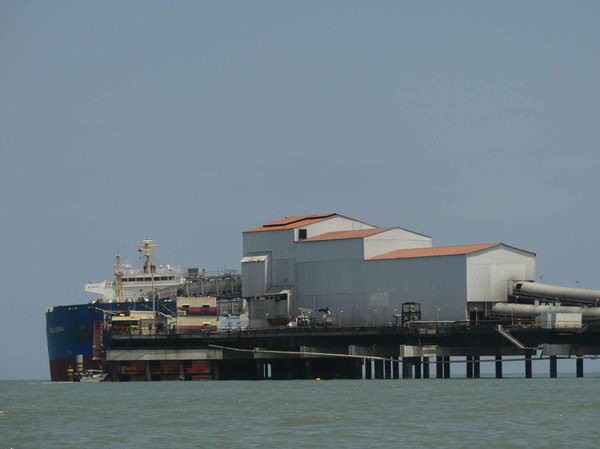
The Drummond port outside Santa Marta, 2025
Here, the company was taking advantage not only of the lack of government monitoring but of a loophole in the law itself. According to article three of Decree 1047, the export ban did not apply to contracts signed—as Drummond’s deals with Israel were—before the law came into effect in mid-2024. It was this article the Ministry of Trade cited when PIPD and the Colombian wing of BDS demanded to know why Drummond could get away with flouting the ban. “In a way, the decree contradicts itself. On the one hand, it gives precedence to human rights over private property. On the other, it treats commercial obligations as sacrosanct. So technically, Drummond might not be violating the decree,” Müllenbach Martínez explained to us in a June interview, her frustration palpable.
The motley coalition of actors who had galvanized support for the initial boycott sprung into action again. PIPD passed on the data it had collected about the decree’s subversion to the relevant ministries. On May 28th, the Wayuu Indigenous Guard—an unarmed community protection network—joined various allied groups to block coal mines across Cesar and La Guajira for a day, raising Palestinian flags and calling for a real embargo. Wayuu groups and trade unions also held a series of meetings with government officials to communicate their objections to the ban’s evasion. Sintracarbón, too, released a vehement statement repeating its call to cut off coal to the genocide—this one also signed by the oil workers’ union and the national federation for Indigenous peoples. At its headquarters in La Loma, Drummond felt the heat. The company issued a plea of innocence: “Coal exports to Israel have been done in conformity with the authorization that the National Government gave,” it claimed, pointing to its shipments having been approved by the trade ministry in line with article three.
Before this wave of protest, Petro seemed only dimly aware of this subversion of his decree. “Drummond might be cheating us,” he said in passing during our interview. But now, faced with a public campaign highlighting how Drummond made a mockery of his order, the president re-entered the fray. In mid-July, he wrapped the edifice of the presidential palace in Palestinian flags. On the 23rd of the same month, he delivered another characteristically erudite and rambling speech on the climate catastrophe, homing in on the question of the coal boycott. By now he seemed to be burning with rage. “Am I a shell here, a puppet in a theater they call politics, while real power lies elsewhere? . . . The export of coal to Israel is prohibited—it’s an order from the president of the republic.” He railed against Drummond, for first murdering workers and then flouting a democratic decision, then decried his own former minister of trade, Carlos Reyes—a liberal who “deceived” him by inserting article three into the decree—as “an accomplice to the genocide in Gaza.” He vowed to henceforth allow “not a single ton of coal” to reach Israel, and called on the workers and the Wayuu to block mines and ports if the export continued.
The day after Petro’s address, Drummond sent another vessel, Fortune, from its Colombian port, this one loaded with nearly 100,000 tons bound for Israel. Now Petro lost it. As commander-in-chief of the armed forces of Colombia, he ordered the navy to intercept any further shipments; should the company try to violate the law of the land by continuing to supply Colombian coal to Israel’s genocide, it would be met with warships. Such an announcement was unprecedented in the history of boycott initiatives, and perhaps in that of relations between states and foreign capital. Müllenbach Martínez welcomed the news. “As long as ships are within Colombian waters, he does have the legal right to send in the navy,” she said. “It’s an incredible thing for other countries to look into, that you can actually do something like this.” Since the order to the navy, PIPD has not registered a single outbound ship. The Drummond port has gone quiet, a decades-long supply to Israel coming to an abrupt halt. More cause for celebration came on August 20th, when the presidential office issued a second decree, number 0949, which canceled Decree 1047’s now-notorious article three and issued an absolute ban on coal exports to Israel. The contracts that Drummond had signed with Israel before 2024—which ran until 2036—all nullified with the stroke of a pen.
In July, Petro ordered his navy to intercept any future shipments to Israel—an announcement unprecedented in the history of boycott initiatives, and perhaps in that of relations between states and foreign capital.
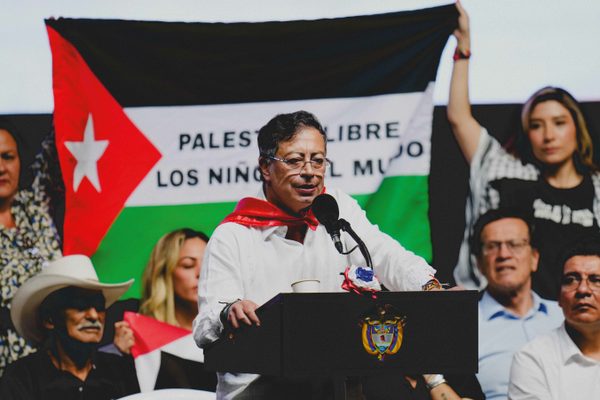
Supporters of President Gustavo Petro display a Palestinian flag as he addresses a rally in Ibague, Colombia, October 3rd, 2025.
But this law is likely to be just another act in a protracted struggle. After Decree 1047, Glencore and Drummond sued the Colombian government 17 times, for millions of dollars in each case, within the framework of free-trade agreements. Now, “there will be even more court cases, because Drummond was counting on another decade of sales and now the contracts have been canceled,” Müllenbach Martínez said. Even more critically, in 2026, Colombia will elect a new president. Polls have indicated that the right or far right is likely to reconquer the palace. A top contender is Vicky Dávila, a media personality aspiring to be the Colombian Jair Bolsonaro or Javier Milei who has attacked Muhamad for being a Palestinian foreigner and Petro for being a terrorist sympathizer. Barely had the ink dried on the presidential paper before conservative parliamentarians and presidential candidates demanded that the Colombian supreme court abrogate Decree 0949. In the assessment of Müllenbach Martínez, “this new decree can be eliminated in 24 hours if they win.”
A Pyrrhic victory it might still be, but the model of the Colombian boycott initiative has been inspiring to many in the movements for Palestine and the climate. “A lot of countries in the Global South were meant to do much more for Palestine, to disrupt the genocidal machine economically. But so far, and we’re in September 2025, it’s only Colombia doing it,” says Mohammed Usrof, a Gazan living in Qatar who has become the face of Palestinian youth at the United Nations Climate Change Conference’s COP summits in recent years. Usrof, who has lost 70 family members to the massacres in Khan Younis, invests considerable hope in the lessons of the Colombian boycott, and he is not alone. Efforts to keep the experiment alive have spread. In the run-up to COP30 in Brazil, the campaign for an energy embargo is focusing on that country, which is nominally committed to both mitigating climate change and ending the genocide but is still a major exporter of oil to Israel. Oil workers’ unions have called on President Luiz Inácio Lula da Silva to follow in the footsteps of Petro. South Africa, with its mixture of judicial vanguardism and uninterrupted coal exports, has become another front for similar protests. Leyla, the activist from Disrupt Power, says that the Colombian ban is ripe for export to such places. It lays out the process—“a trade union which set the ball in motion, and after that, solidarity movements could be mobilized and policymakers lobbied”—and shows that “an energy embargo from below can actually win.”
More abstractly, the episode can be seen as an object lesson in the clash between two dialectics. On the one hand: a dialectics of destruction. Coal from Colombia has energized occupation and genocide in Palestine; Israeli militarism has contributed to displacement and destruction in Colombia; and both together are fueling the ultimate breakdown of the climate. Within this dialectic, as seen from the northern shores of Colombia, the current genocide in Gaza appears like a culmination: The physical annihilation of Palestine is the concentrated exhaust from a world system geared toward the destruction of the many for the benefit of the few. Petro emphasized as much in his July 23rd speech: “What are they doing in Gaza? Showing us how the power of carbon can wipe us all out if we rebel. Mister Carbon is the power of the world . . . We have to destroy Mister Carbon, or else he will destroy us all.”
On the other hand, then, a dialectics of resistance. The coal boycott has come about through a remarkable reciprocity between social movements in Colombia and Palestine and—uniquely—the executive power of the left. Once in the cabinet and the presidential office, Muhamad and Petro were proudly responsive to pressure from extra-parliamentary campaigns, and egged the activists on in turn. The exceptionality of this situation is hard to exaggerate, and the fight to keep it in place is ceaseless when a bourgeois state apparatus works to maintain business as usual and a revanchist right stands ready, preparing to regain full power. Movements have reached for the emergency brake on the coal train; whether they can bring it to a halt remains to be seen.

I’m Arielle Angel, editor-at-large of Jewish Currents. Before you go, there’s something I need to ask.
We’ve seen over and over how the mainstream media falters in telling stories on our beats—whether it’s antisemitism, Israel/Palestine in American politics, Jewish identity, or the American left. At Jewish Currents we’re committed to uncompromising analysis and longform reporting on these issues and more—stories you won’t find anywhere else. In a media landscape that obscures injustice and flattens discussion, we’re changing the conversation. But we need you.
If you believe in this work, please consider making a donation—or even better, a recurring one—to ensure that we are able to keep publishing stories like this one. We can’t do it without you.
Andreas Malm is an associate professor of human ecology at Lund University, Sweden. His latest book, with Wim Carton, is The Long Heat: Climate Politics When It’s Too Late, forthcoming from Verso in October.
Maxy Guedes is a French independent journalist and reporter.