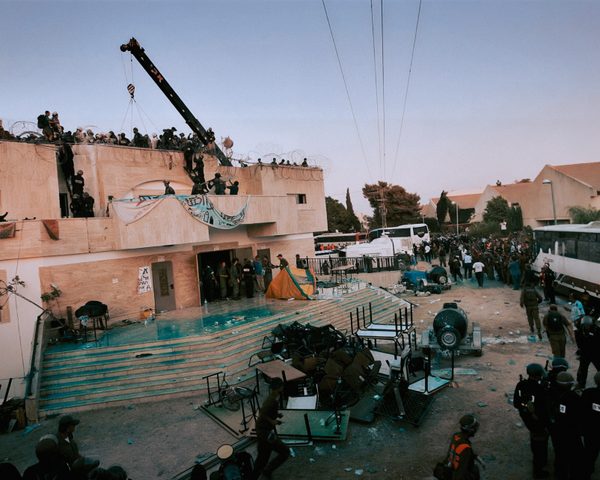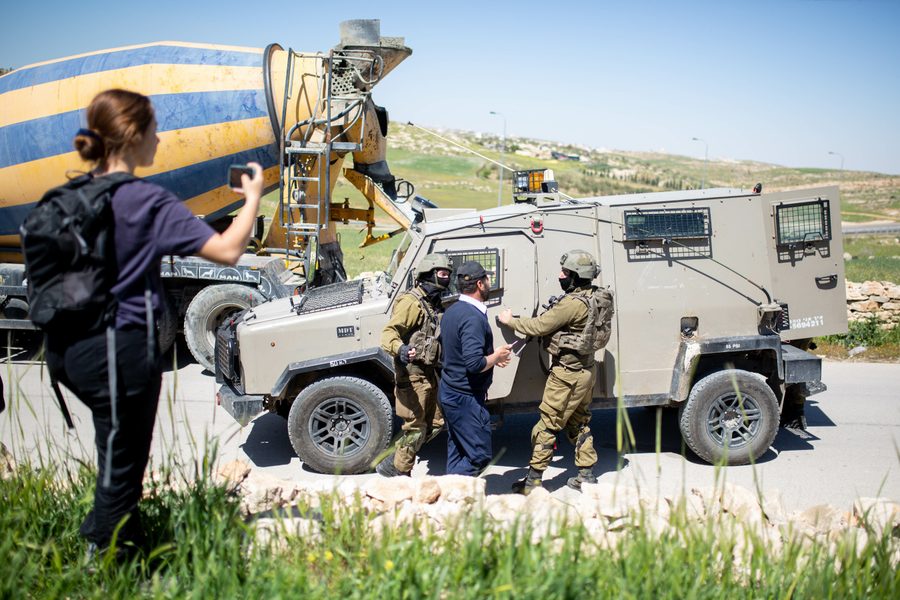
A solidarity activist films a confrontation between the Israeli military and a Palestinian resident in the West Bank.
Emily GlickHow Should Activists Relate to Risk?
An investigation through Jewish text, in the wake of escalating violence in the West Bank against Palestinians and their allies
Chevruta is a column that aims to address the ethical and spiritual problems confronting the left. For each installment of the column—named for the traditional method of Jewish study, in which a pair of students analyzes a religious text together—Jewish Currents will match leftist thinkers and organizers with a rabbi or Torah scholar. The activists will bring an urgent question that arises in their own work; the Torah scholar will lead them in exploring their question through Jewish text. By routing contemporary political questions through traditional religious sources, we hope to discover new and unexpected avenues for inquiry into today’s most pressing problems. You can find an audio version of this conversation here, and a stand-alone source sheet for group study here.
In September 2024, an Israeli sniper shot and killed Turkish American human rights activist Ayşenur Ezgi Eygi outside of Nablus in the northern West Bank. Her murder was a devastating example of a sharp uptick in military and settler violence against both Palestinian residents and the international and Israeli activists who work with them. For years, solidarity activists such as Eygi have responded to the violent reality in the West Bank by physically accompanying Palestininans in the hopes that their “protective presence” will serve as a buffer to prevent attacks. This strategy has been employed by groups like All That’s Left, Jordan Valley Activists, Center for Jewish Nonviolence, International Solidarity Movement, and others, and has received heightened attention thanks to the Oscar-winning documentary No Other Land, which features Palestinians resisting colonialism in the villages of Masafer Yatta, and Israelis engaging in protective presence with them.
For those engaged in solidarity work in the West Bank, this moment of increased violence has amplified ever-present moral questions: What is my responsibility to intervene when someone else is in danger? How much risk must I take upon myself to try and protect my Palestinian comrades? And to what extent must I recruit others to join me in taking that risk? In this chevruta, I explore these quandaries with Jewish Currents assistant editor Maya Rosen. As a long-time protective presence activist, Maya is regularly weighing the danger that she and the activists she recruits will take on in the course of their work: How can she adequately prepare people without scaring them off? And how can she communicate the rewards of the work alongside the risks?
We consider this dilemma through the lens of three texts, the first of which is a short Talmudic passage that establishes the commandment to intervene to save other people’s lives even at personal risk. Next, we discuss a 1941 legal responsum from the Kovno Ghetto exploring whether a person is obligated to risk one’s life by interceding with Nazi collaborators to negotiate the return of kidnapped Jews. Finally, we work through another short Talmudic passage about conversion to Judaism, which proves a surprising source for considering the ethics of recruiting other people to a dangerous but worthy mission. I hope that our discussion will help others who are wrestling with the attempt to share the burden of risk, and that, by offering a way to understand and respect limitations, it will help readers find pathways to greater collective courage.
— Aryeh Bernstein
Aryeh Bernstein: Maya, could you tell us about what brings you to this conversation and the questions you’ve been brooding over?
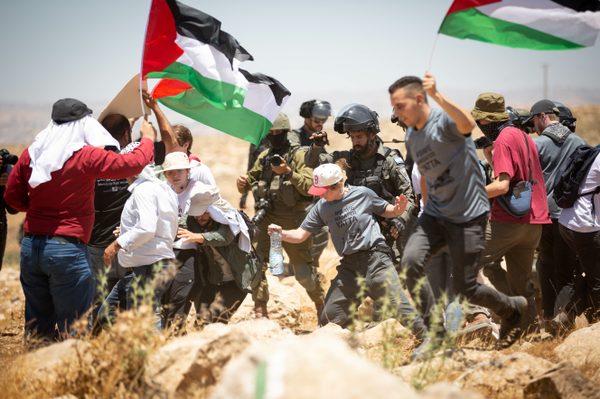
Maya Rosen: I’ve lived in Jerusalem for the past eight years, and in that time, I’ve gotten involved in organizing with Palestinian communities in the West Bank. Often we do what’s called “protective presence,” in which solidarity activists will go to communities that are requesting our presence if there’s a concern about settler violence or attacks. That might mean going with residents while they shepherd their sheep or harvest their olives. It might mean walking children to school who have to pass by a violent outpost. The hope is that our being there reduces violence, or, at a minimum, allows us to collect documentation, which can then be used in future legal proceedings and in getting the word out to people abroad.
Aryeh: I remember at the end of October 2023, word spread on social media as well as through some news outlets that settlers were threatening an all-out pogrom in the Masafer Yatta communities in the South Hebron Hills, and I remember texting with you and a couple of other comrades of ours, knowing that you would probably be thinking about going out for protective presence and not feeling confident that you could be safe. At the time, I felt I had to write to you just tell you that I love you and that I believe in you. I’m glad that the worst we expected that night didn’t happen, but I’ve thought about that night a lot: What can we do, and what risks do we need to take on?
Maya: I’d love to discuss this with you. I know that if we do our job right, it means that we escalate, and if we escalate, it’s going to get more violent here, and people will get hurt. And that’s a really hard thing to recognize. Yes, I want our movement to grow, and yes, I want us to be effective, and no, I don’t want anyone to get hurt. But in moments, it feels like that’s an inevitable consequence. So I struggle with how much risk I should take on and the limits and boundaries of that. And the longer I’ve been in this work, the more I’m in a role where I’m facilitating new people coming into the work—where I’m organizing a protest or overnight shifts in a village where there might be a demolition. And in those cases, I wrestle with what my responsibility is to those recruits in terms of making sure that they’re safe, and sharing all the information that I can.
Aryeh: I remember a little over two years ago, the first time we had a version of this conversation, you told me that when you began doing this work, you recruited people to do protective presence trips—often American or European nationals, Jews who were in Israel—and you would say, your EU passport, your American passport, protects you. Even then you were having doubts about whether you could say that to anybody anymore.
Maya: I think that’s part of why Ayşenur Ezgi Eygi’s death really rattled me. Obviously, there’s the brutality and the horror of it, but also, she was an American, and it fully punctures that myth that there’s some sort of protection offered by that positionality. I sometimes take a bit of—I guess false—pride in knowing how to assess risk in the field and knowing how to act as safely as possible in very tense, violent situations, how to position myself and how to be able to extricate myself when things get more tense. Trusting my instincts in the field is a skill I feel I’ve developed over the years. And part of what was really scary about Eygi’s death is that she was standing off to the side, on a hilltop overlooking a protest. She wasn’t in the thick of it.
Aryeh: Different from Rachel Corrie.
Maya: Very different from Rachel Corrie, whose death—while she was heroically blocking a bulldozer with her body—was also obviously horrendous. But Eygi was an onlooker and was killed by a sniper. And if it’s true that just by standing in the West Bank, you can be shot by a sniper who you can’t even see, that really shatters everything that I know about what it means to “stay safe” in these circumstances.
Whenever I’m on a bus of people coming down for a protest, I give a standard PSA where I say: “The West Bank is unpredictable. And even though today we think the risk level is going to be X or Y, it could always change at any moment. And we can’t guarantee anything.” So it’s not like I feel I’m taking people blind into the field. But even if I tell them that it could be dangerous, my experience means I have a greater ability to assess risk. So there’s a limit to how effective my warning is. Is there a point at which my verbal warning is insufficient and I actually should stop bringing people? Or is the need of the hour so intense that it’s actually important despite that?
I’ve drawn a lot of inspiration from learning about the struggle for civil rights in the United States and the struggle against Apartheid in South Africa. And I’m especially aware that more allies died in those struggles than in the struggle against the occupation here. This only heightens my feeling that if this escalates, if we’re going to win, it’s going to get more violent, and the number of those murdered or seriously injured will increase. It’s a really scary thought. How do you bring people into the movement while also making sure that they’re aware of that? How do you make sure they still want to join the movement, since we need to grow?
Aryeh: Right. What is informed consent in such a context? Do new people have the capacity to understand what that means? Let’s explore these questions.
The first text is a passage in the Babylonian Talmud, Tractate Sanhedrin, page 73a, which explores the basic question of whether one has to take on danger in order to reduce danger to others.
Maya reads.
From where do we derive that one who sees another drowning in a river or being dragged away by an animal or being attacked by bandits is obligated to save them? Scripture states, “You shall not stand idly over the blood of your fellow.”
Aryeh: What’s your reaction to the text? What does it bring up for you?
Maya: It seems to start from a core assumption that you do need to attempt to save people who are in danger, and that the rabbis are attempting to find a biblical text that’s going to ground that conclusion. You could have imagined the reverse: The rabbis could have taken a biblical verse and then said, “Okay, what are we required to do given that text?” But it seems that the text is being driven by a core moral assumption that’s outside of the text, rather than a prescriptive “do what the text tells you.”
It does seem that these are all risky situations in their own way: that the animal could turn on you and attack you, too. Same with the bandits. That the raging river is carrying someone away. For me, I’m not a strong enough swimmer that that wouldn’t entail some risk.
Aryeh: Do you think you have an obligation to jump into the river if you don’t know how to swim?
Maya: My assumption would be no, because then you’re not going to help the person. You’re just going to have two people who have drowned instead of one.
Aryeh: We also have responsibilities to preserve life—“u’shmartem et nafshoteichem,” you should protect your lives, your health.[1] So there already might be limitations on this obligation, when it could be helpful to others but too risky for yourself.
Maya: Right. And I’m wondering whether there are gradations of that: If there’s a 10% chance you could save them, but a 90% chance you both drown, then is it worth it? And how far do those numbers have to shift for it to be the right thing, or even the obligatory thing, to do? It still leaves us with all these questions: It’s clear that if somebody is bleeding in front of you, you need to help them in some way. But what about if you hear that this is happening in a different town? If it’s not in front of your face? Do you have to go seek it out?
Aryeh: Maybe it’s impossible to reach a clear calculus. I found a very chilling legal responsum from 1941 by Rabbi Ephraim Oshry, who was the rabbi of the Kovno Ghetto, one of the last rabbinic greats in that era to survive the Holocaust. He wrote rabbinic responsa in the Kovno Ghetto and throughout the Holocaust period and buried them in scraps, and found them after the war. They’re published in a very chilling collection of responsa called She’elot U’Teshuvot Mima’amakim (Responsa from the Depths).
He’s asked a question in that volume: The Nazis had appointed some Lithuanian hooligans to do some of their dirty work—harassing, rounding up, and killing Jews—and some of these hooligans kidnapped some yeshiva students. Somebody approached Rav Oshry to talk to another rabbi who happened to know these hooligans. The moral question being: Should this second rav go and intercede on their behalf to save the yeshiva students? Must he do that? May he do it? Are you allowed to put yourself in such danger, when you’re also obligated to protect your own safety?
Rav Oshry comes to the conclusion that the rabbi wasn’t obligated to, but it was a kind of “midat hasidut,” an act of piety, to do so. This rabbi was not prohibited from doing so, and he wasn’t necessarily obligated to do so, but it was an righteous act. (Incidentally, he did so and was successful, but was later killed in one of the concentration camps.)
Maya: There’s something about the ruling he gives—that it’s neither mandatory nor prohibited—that, on the one hand, feels intuitively right. But it also feels less helpful. I still don’t know what I’m supposed to do!
Aryeh: I know! I think it might be simultaneously very empowering to feel that these rabbinic sources aren’t so narrow and don’t have the hubris of always having the answers. And also sometimes, especially in situations of life and death, we need guidance.
I did want to pivot to one other passage that I think sheds light on another aspect of your question. When you were talking about the burden you feel, it sounded like you had even more concern for the well-being of people whom you’ve recruited to do this work. There’s a passage that, on its face, is not about our topic, but I think might resonate with it. This is a passage in the Babylonian Talmud, Tractate Yevamot 47a-b, and it’s about what we—the rabbinic class—should say if somebody comes forward to convert to Judaism. The core of this source is from 2nd-century Palestine, under Roman occupation. It was not a great time for the Jews, especially for the rabbis. If you think about the Yom Kippur liturgy—the martyrology, and the stories of the ten holy rabbis and the trials and tribulations they went through under Roman occupation[2]—that’s all present in the background. So let’s jump in and see what this surprising text might teach us.
Maya reads.
Our rabbis taught: A convert who comes to convert at the present time, they say to him, “What did you see, such that you came to convert? Don’t you know that the Jewish people at the present time are anguished, suppressed, despised, and harassed, and suffering comes upon them?” If they say, “I know and I’m unworthy,” they are accepted immediately.
Aryeh: How do you relate to that? Somebody says, “I really want to be Jewish.” In the day and age of the text, the first thing you tell them isn’t, “That’s great, welcome.” The first thing you tell them is, “Don’t you know? Haven’t you heard? It’s bad for us.”
Maya: Maybe that’s just a sanity check: Why would you want to join a group that’s going to make your life worse by any normal metric? If you convert, you’re going to be subject to attacks. This is not a winning team at the moment.
Aryeh: How does this script sound different to you than the one you give on buses before leaving for a protective presence trip?
Maya: My first inclination is it actually feels somewhat similar: It does mention the danger, but there’s also a limit. You could imagine a speech given to converts that is actually like, “Okay, well, let me tell you about the pogroms we faced. There was this incident where this gentile bandit came and attacked us. And there was this time when the…”—whatever it may be. There’s no detail or texture given, no accounting for what it actually looks like or feels like to be despised and attacked, how it affects you and your children and your livelihood. So in that sense, it does feel somewhat similar to my bus speech. I say, “This is really dangerous and things are unpredictable,” but I don’t say, “And you know, last night there was an attack in this village, and the week before, this person got beat up.” That feels like it would actually constitute fear mongering in a way that’s unproductive. I don’t want to exaggerate the risk. Because while it’s true that the danger is very serious, the vast majority of the time that I’m in the West Bank, I’m fine. And even more than that—often it’s a really lovely day, which is something that doesn’t fit the narrative. I visit really good friends who live in these villages, and we sit and drink tea and play with the kids; not every moment is an emergency moment, even though the broader situation is dire. And so I also don’t want to prime people to only be able to view these places through the lens of catastrophe.
Aryeh: I think that’s a great segue into the continuation of the passage, about the laws that are mentioned specifically to the would-be convert. To give a bit of context, what we’re about to see is a list of the Torah’s social welfare laws—specifically agricultural laws that stipulate that when you’re harvesting, if you drop certain plants, you can’t go back and pick them up. They’re for poor people to come and harvest for themselves. Same with the forgotten sheaves in the corner of one’s field.
Maya reads.
And they inform them of some of the light mitzvot and some of the weighty mitzvot. And they inform them of the sins of gleanings, forgotten sheaves in the corner of one’s field, and the poor person’s tithe. And they inform them of the punishment for the mitzvot. They say to them, “Be aware that before you came to this status, had you eaten forbidden fat, you would not be punished by karet.”
Aryeh: Certain very weighty prohibitions in the Torah have the punishment of “karet,” which we assume to mean that you are cosmically cut off from the Jewish people in the World to Come, or something like that.
Maya reads.
“Had you profaned Shabbat, you would not be punished by stoning. But now, once you become Jewish, if you have eaten forbidden fat, you are punished by karet. If you have profaned Shabbat, you are punished by stoning.” And just as they inform them of the punishment for mitzvot, so do they inform them of the reward granted for them. They say to them, “Be aware that the World to Come is made only for the righteous, and be aware that the Jewish people at the present time are able to receive neither an abundance of good nor an abundance of calamities.” And they do not proliferate upon them, nor are they exacting with them.
Aryeh: This last part seems to be a theological reflection about whether reward and punishment can come in this world.
Maya: Because our true reward and punishment is going to come in the World to Come?
Aryeh: Yeah, exactly. I think with “proliferate,” it means, “Don’t overwhelm them with too much detail about the mitzvot and their consequences, and don’t be too exclusionary.” Don’t say things like, “I don’t know if you’re good enough, if you know enough.” But still, you have to make sure they know this context.
I’m hearing within this text some of what you were saying. You start with making sure that they understand that it’s a hard road, and you have to know the responsibility involved. And also you want to share the positive things too. Maya, you were talking about worldly rewards, the relationships, the sense of purpose. You have to make that a significant part of the story.
But why do you think it starts with the grim part: “Don’t you know the Jewish people at the present time are anguished, suppressed, despised, and harassed, and suffering comes upon them”?
Maya: I guess that’s the responsibility piece. You know, I don’t want to be the one convincing people to do something beyond what they’re comfortable with. But I’m conflicted as I say that; I also want to fight against this liberal cult of safety—like, as soon as you say the word “safety,” it’s automatically a reason not to do something. I feel torn between a sincere desire for caution and a desire to reject that paradigm, wanting people to be in a mentality where they feel, “of course, we have to take on risk.”
Aryeh: Because the residents of Masafer Yatta are experiencing so much risk, or the residents of indigenous communities who are being bulldozed by pipelines, or whoever it may be.
Maya: Right, they don’t have a choice in the matter.
Aryeh: And their survival depends on people who don’t live with as much risk taking on some of it. And the more of us that do it, the less risk there is for any one person or group. But still, the text starts with: “But you have to make sure people understand the risk.” What makes the speech on the bus different is it’s not just saying, “You should know the Jewish people in the present time are anguished, suppressed, despised, harassed, and suffering comes upon them.” You’re simultaneously trying to get more people to take seriously “lo taamod al dam re’echa,” don’t stand idly by the blood of your fellows, and that it’s actually a great merit to fulfill that mitzvah.
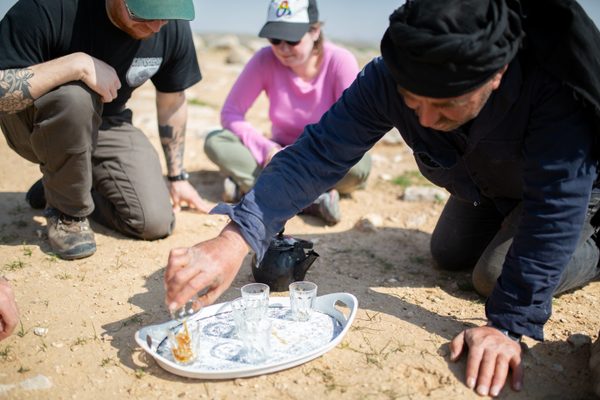
Maya: There is a piece of that that really resonates with me: that despite all the difficulties of this work, I feel so grateful to be able to do it. It gives my life shape and purpose. And beyond that, it has brought me into relationship and community with some of the people who are dearest to me in the world. In so many versions of this world and my life and the reality we live in, I wouldn’t have met these communities, and I’m so grateful that I have.
I want to create a movement culture where there is the ability to make an active choice about risk. But I don’t think it’s a healthy movement culture that glorifies the idea that the way to be the most successful activist is to always take the maximum possible risk. In order to sustain ourselves in the work and to sustain our movements, we have to be able to say, “Today, I’m going to visit these communities, but I’m actually kind of under the weather, or I have a really big test tomorrow, and I’m not in a position where I can get arrested.”
Aryeh: And so then there are other roles. Can you do a jail support shift? Can you stay back at home, but make a pot of soup for people to come back to so they can be nourished when they return?
Maya: Yes, and I think that our movements need to have a lot of roles. This kind of work on the ground is not right for everyone, and it’s not right for anyone all the time.
Aryeh: I want to run a reading of this passage by you that translates it to our context. A striking thing about the conversation with the convert is it’s a one-on-one. It raises the question: Do you want people getting on that bus if they haven’t had a one-on-one with an organizer yet, where somebody with a little more experience can get a sense of what’s motivating them and where they’re coming from? So when somebody comes to sign up for risky, protective presence work, the first thing to do is have a one-on-one and ask what their story is. After you hear from them, make sure that they understand the negative consequences—the danger—and that they’re not being unrealistic. Then, once they’re in, you give them a training—a nonviolent direct action training, a community organizing training—inform them of some of the light mitzvot, some of the weighty mitzvot, not every nook and cranny; they’re not going to be experts, but make sure that they have the basics. Make sure that they know that integral to our movement is the commitment to sharing resources, making sure that we keep us safe. Nobody’s left behind—“the sins of gleanings, forgotten sheaves, corners of one’s fields, poor person’s tithe.” We make sure they know how they can access help when they need it, and they understand their responsibility to help others. We make sure they have a sense of what it means to be part of this, what the consequences could be, and also the reward and the rich sense of purpose and relationships that come with it. You don’t go over the top, and you don’t try to keep people out. You try to welcome people in, but you make sure that people have that context.
Maya: That resonates a lot. I really like the way you translated “the sins of gleanings, forgotten sheaves, the corners of one’s field, and the poor person’s tithe”—the recognition that part of bringing people into this work also means investing in the structures that will provide them with care while doing it.
Aryeh: And imparting their role in sustaining those structures of care for others, too.
Maya: Totally. I sometimes think of these aspects as separate: the work and the support structures. But it’s crucial to integrate them in some way, so that when people join, we really do have support to offer, and they are recruited into a role in sustaining it. You can’t just join a protective presence shift and go back to your own life; you’re actually embedded now in a network of people who are actively looking out for each other.
It feels tied to the rabbinic idea of “simcha shel mitzvah,” literally “the joy of mitzvot,” that commandedness and obligation requires something of us, and that, in and of itself, is also what can bring joy.
Aryeh: That’s a profound confluence between the wisdom of movement organizers and rabbinic scholars: that commandedness and responsibility is a whole terrain of joy.
Maya: Amen.
Devarim 4:15
According to rabbinic tradition, ten prominent rabbis were martyred by the Romans in the period following the destruction of the Second Temple, including Rabbi Akiva and Rabbi Shimon ben Gamliel. They are memorialized in the poem “Eleh Ezkarah” (“These I Will Remember”), which is recited on Yom Kippur and describes the executions in harrowing detail.

I’m Peter Beinart, editor-at-large of Jewish Currents. Before you go, I need to ask something of you.
In recent years, I’ve watched as mainstream Jewish institutions and media have chosen ethnonationalism over liberal democracy and mass slaughter over the pursuit of a just peace. Jewish Currents offers something different. It’s a magazine built on intellectual curiosity and respect for the dignity of all people.
But a project like this doesn’t sustain itself, and we can’t do it without your help. If you share my belief in the importance of this mission, please consider making a donation—or even better, a recurring one. We need you with us.

Rabbi Aryeh Bernstein directs the Chicago Avodah Justice Fellowship and is a senior editor of Jewschool.com, a member of the Tzedek Lab, and the author of “The Torah Case for Reparations.” Aryeh was ordained by Yashrut Institute.

Maya Rosen is an assistant editor at Jewish Currents.