Newsletter
Jul
14
2026
Good afternoon from the Jewish Currents news desk, where the sky turned yellow around midday.
This week at Jewish Currents, we’re getting ready to send the next issue of the magazine to the printers. Subscribe today to get a copy. (Enter SNAILMAIL30 at checkout for a 30% discount on a new subscription.)
In today’s newsletter, Alex Kane reports on Democratic primary for US Senate in Michigan, where Abdul El-Sayed is looking to extend the insurgent left’s extraordinary winning streak. It won’t be easy.
But first: I’m Josh Nathan-Kazis, and here’s what we’re talking about today at the Jewish Currents news desk.
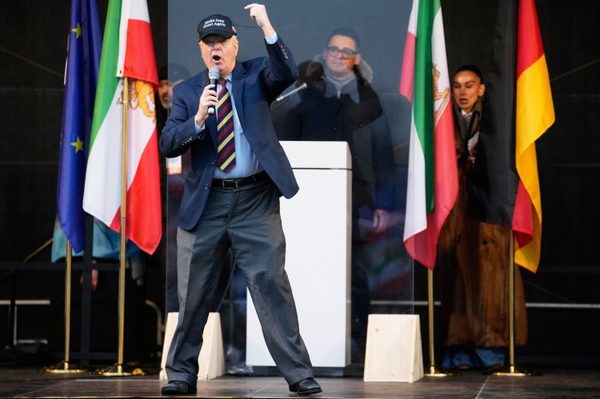
Senator Lindsey Graham, who died over the weekend, wearing a “MAKE IRAN GREAT AGAIN” cap at a pro-war rally in Germany in February.
Ebrahim Noroozi/AP
FOREVER WAR MONGER: Senator Lindsey Graham is dead, but the war he worked so assiduously to start lives on. On Friday, President Donald Trump declared the ceasefire between the US and Iran to be “OVER!”—and on Saturday, the day Graham died, the US said it attacked 140 targets inside Iran. US strikes continued on Sunday and Monday, when the Trump administration also announced it would resume blockading the Strait of Hormuz.
Graham was the loudest voice in Trump’s ear pushing him to take up Israeli prime minister Benjamin Netanyahu’s invitation to embark on a joint war against Iran. In the weeks before the first assault, he traveled to Israel to meet with Israeli intelligence, according to the Wall Street Journal. (“They’ll tell me things our own government won’t tell me,” he told the paper.) He was thrilled at having convinced Trump to finally start the war that Israel and its US allies have wanted since the 1990s.
Now Graham is dead, and the rest of us are left to live with the mess he made. The ceasefire is over, Iran is shooting at tankers and US bases, the US is shooting at Iranian military sites, oil prices are rising, and it’s looking more and more like Lindsey Graham got us into one last forever war before checking out.
KHANNA’S RUN-IN: Rep. Ro Khanna, the progressive California Congressman expected to make a long-shot bid for the Democratic presidential nomination in 2028, went to the occupied West Bank last week. On his visit to the former site of Khirbet Zanuta, a Bedouin village abandoned two years ago following a series of violent settler attacks, armed settlers accosted him. According to a New York Times report, Israeli soldiers didn’t intervene to help Khanna but “chatted” with the settlers after arriving on the scene and continued to block the road so the Congressman couldn’t pass.
The pro-Israel propaganda machine has spent the past few days working to bury the incident under layers of obfuscation and misdirection. But there was nothing unusual about what happened at Khirbet Zanuta; it was the sort of thing that happens every day on the Palestinian side of the Green Line. Settlers deployed violence with impunity, and the Israeli military backed them up. Khanna saw it with his own eyes, and other Democratic presidential hopefuls will see it, too. “Centrist Democratic and Republican presidential candidates have long used Israel as a campaign trail stop to burnish their foreign policy credentials and pick up pro-Israel support,” my colleague Alex Kane told me this morning. “Now the progressive counterpart is coming into focus: a trip to the South Hebron Hills. Khanna’s a harbinger of what will be a trend for any candidate looking for support in the left lane of the primary.”
JEFFRIES’S TIGHTROPE: Congress is set to vote today on a two-sentence amendment introduced by Thomas Massie, the heterodox Republican congressman from Kentucky, that would strip $3.3 billion in aid to Israel from a major military spending bill. Rep. Hakeem Jeffries, who leads the House Democrats, said Tuesday he’ll oppose the amendment. But in a letter to colleagues that cited the equivocal position taken on the amendment by the liberal Zionist group J Street, Jeffries signaled he won’t push other Democrats to vote with him. “There are good faith reasons that will result in Members voting in a variety of different ways,” Jeffries wrote.
As Democratic voters shift heavily against US aid to Israel, Jeffries finds himself in a tricky spot. “Leader Jeffries is trying to balance the intransigence of the party’s donor class with the demands of its base,” said Josh Paul of the lobby group A New Policy. “The two are irreconcilable.” The question for Jeffries is whether he can hold his spot at the head of the caucus if Democrats take the House next fall. Some insurgent progressives who have won primaries in recent weeks are already threatening to withhold their support. “By not whipping against the amendment, he avoids imposing his will on progressives in a way that would alienate them as he seeks to become Speaker next January if Democrats retake the majority,” my colleague Alex told me.
J Street appears set to play an important role in the brewing intra-party struggle. The group said in a statement Tuesday that it opposes Rep. Massie’s amendment, which it called “poorly drafted,” but that it would support members who vote yes to “signal their opposition” to unconditional military aid to Israel. Jeffries cited J Street in the second sentence of his Tuesday letter to colleagues, a “sign that J Street really is now where Democratic House leadership looks,” one longtime Hill-watcher told me. That seems likely to be Jeffries’s play over the next few months: Look to J Street to help him carve a path between pro-Palestine progressives and pro-Israel donors.
POLITICAL STABILITY: Since 1988, no Israeli government has lasted its full four-year term. Ruling coalitions are big and sloppy in the Israeli parliamentary system and have a habit of collapsing. At times the government has seemed to change with the seasons: There were three Knesset elections between April 2019 and March 2020. Yet the current government, Israel’s 37th, has persisted. The elections now scheduled for late October will be held on the last date permissible under Israeli law. The only Israeli government to serve its full term in nearly 40 years is the one that oversaw and carried out the genocide in Gaza.
A coalition of Benjamin Netanyahu’s Likud, Bezalel Smotrich’s Religious Zionist Party, Itamar Ben-Gvir’s Otzma Yehudit, plus a number of right-wing and Haredi parties, Israel’s government survived repeated upheavals. These include the protests over its effort to rework the Israeli judicial system in 2023; the ongoing fractures over efforts to draft Haredi yeshiva students into the military; and the plan to kneecap the office of the Israeli attorney general. The coalition held on to power even after the security failures of October 7th, when the state’s borders were overrun and more than a thousand Israeli civilians and soldiers were killed.
Israel, among the most fractious of democracies, has lived through a period of political stability unequaled in four decades while its military has flattened the open-air prison it maintains along its southern border and massacred its residents. The lives of Palestinians do not matter in Israeli politics. It’s not a hopeful sign for whatever comes after the elections in October.
UNKOSHER SLOP: The rabbi Danya Ruttenberg explained on Monday how a Jewish person might make the case for an exemption from an employer’s demands to use AI by claiming a religious accommodation under federal civil rights law. On her website Life is a Sacred Text, Ruttenberg offered a list of potential justifications for such a claim, including that it’s forbidden under Jewish law to benefit from theft and that Jews are commanded to preserve the earth. Her advisory is part of a broader dialogue over the use of religious accommodations to offer workers some agency as employers demand we offload our thinking to the clankers. Earlier this year, a Unitarian Universalist software engineer drew some attention for obtaining a religious exemption from working with AI, and there’s been some discussion that more workers may be seeking exemptions in the wake of Pope Leo’s recent encyclical. Ruttenberg’s intervention brings the conversation into the Jewish sphere, and raises new questions about how the liberal rabbinate will think through the threat artificial intelligence poses to our jobs, our brains, our world, and our souls.
The pro-Israel Jewish establishment, meanwhile, is thinking through the threat of artificial intelligence in the only way it knows how: By worrying whether or not it’s antisemitic. On Monday, Project Halo, a newsletter distributed by the Jewish Federations of North America to workers at local federations across the US, put out an edition about the “double-edged sword” of AI. “It supercharges antisemitism by making it easier, faster and cheaper to produce and spread hate,” the big thinkers at the JFNA wrote. “At the same time, AI increasingly serves as a powerful tool to counter Jew-hatred.” The JFNA ultimately seems optimistic about the coming reign of our new digital overlords. They write that AI can be “increasingly part of the solution to fight antisemitism” while reassuring local federation staffers that AI “is neither inherently good nor evil.” Glad they’re on top of it.
SUING THE DRAGONS: Mahmoud Khalil, the Palestinian organizer kidnapped by ICE last year, filed a blunderbuss of a federal lawsuit on Tuesday against an extraordinary list of defendants who, he says, “sought to terrorize and make an example” of him and others “to intimidate and silence the growing movement for Palestinian rights and political freedom.” The lawsuit argues that the defendants, including top Trump administration ghoul Stephen Miller, the website Canary Mission, the Heritage Foundation, and many others, are liable under an 1871 law known as the Ku Klux Klan Act, which allows civil rights lawsuits to be brought against government officials and private individuals in federal courts. The 131-page lawsuit alleges a “conspiratorial plan,” developed inside the Heritage Foundation and carried out by the Trump administration in cooperation with groups like Canary Mission and Betar, to repress the civil rights of Palestinians and their supporters.
“I will not stop fighting until everyone who willingly contributed to my missing the birth of my son, and to taking 104 days of my life from me, answers for what they’ve done,” Khalil said at a press conference outside the federal courthouse in Manhattan. Khalil is being represented by the Center for Constitutional Rights and the firm Beldock Levine & Hoffman.
The Jewish Currents news desk is directed by Josh Nathan-Kazis, with reporting from Alex Kane, Maya Rosen, and Mari Cohen, and editing by Lizzy Ratner. Want to get in touch? Email me at jnk@jewishcurrents.org, or message me on Signal @jnk.56. If you were forwarded this email, subscribe here so you don’t miss the next one.
Insurgent Democrats Want to Extend Their Hot Streak in Michigan. It Won’t Be Easy
By Alex Kane
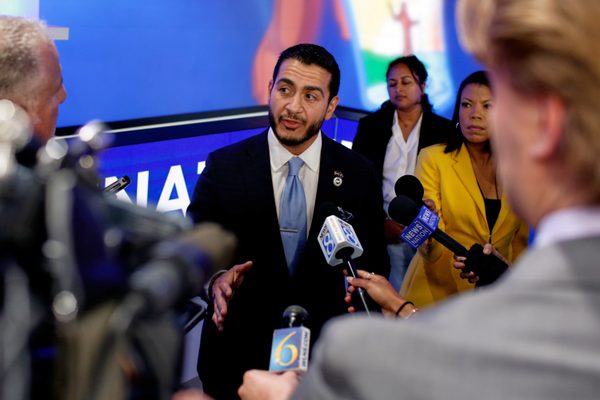
US Senate candidate Abdul El-Sayed faces Rep. Haley Stevens in next month’s Democratic primary in Michigan.
Kristen Norman/AP
The Democratic Party’s insurgent left is looking to extend its recent winning streak to Michigan, where the Bernie Sanders-backed public health official Abdul El-Sayed is facing off against one of AIPAC’s top allies in Congress, Rep. Haley Stevens, in a Democratic primary for an open Senate seat.
It may be a bumpy ride.
Progressives hope that the platform of Medicare for All and opposition to Israeli impunity that worked this summer in safe Democratic House districts in New York City, New Jersey, and Colorado can win in a purple state. The primary, which will take place early next month, will shape the general election contest this fall that may determine control of the Senate. But Michigan, a swing state where resentments still simmer over the Democrats’ split in the 2024 primary over the Gaza genocide, poses a serious challenge to progressives’ efforts to remake the Democratic party.
El-Sayed’s coalition of young voters will face off against Stevens’s base of older voters and Black voters, who are generally friendlier to establishment-backed candidates. As the Stevens campaign leans heavily into the argument that she’ll fare the best against a Republican opponent in the general election this fall, AIPAC’s super PAC is courting Black voters with ads featuring clips of former President Obama praising Stevens’s work on the 2009 auto bailout. Meanwhile, some local Black Democrats have attacked El-Sayed over his support for the Uncommitted movement, which clashed first with Joe Biden and then with Kamala Harris during the 2024 presidential campaign over the Biden administration’s response to the genocide in Gaza.
Progressives, however, remain bullish. They say Michigan, which has above-average union density, could be the rare purple state where a left-wing populist has a shot at a Senate seat. “People see a swing state and they think, ‘We must all rush to the mushy middle.’ But that’s wrong,” said Andy Levin, the former congressman and union organizer whom Stevens defeated in 2022 with the help of $8 million in AIPAC spending. “Michigan often swings between the populist left and right. Strong, clear messages work here. It’s the place where George Wallace, Jesse Jackson and Bernie Sanders won Democratic primaries, and then Trump beat Hillary in the general.”
