Newsletter
Jun
11
2026
Good afternoon from the Jewish Currents news desk, where no one got much sleep last night. In today’s newsletter, Alex Kane takes a close look at the hot Democratic congressional primary in uptown Manhattan and the Bronx, where Darializa Avila Chevalier is testing whether an anti-AIPAC message can win in a heavily working-class district.
I’m Josh Nathan-Kazis, and here’s what we’re talking about today at the Jewish Currents news desk.

Rep. Alexandria Ocasio-Cortez on Capitol Hill on Thursday, the day after the Knicks won an unbelievable game of playoff basketball.
Tom Williams/CQ Roll Call via AP
SWISS CHEESE CEASEFIRE: Iranian officials worry that the ceasefire they struck with the US in April is starting to look like Israel’s empty ceasefires in Gaza and Lebanon, Trita Parsi, the executive vice president of the Quincy Institute, told me this morning. They’re “Swiss cheese ceasefires,” Parsi said. “A ceasefire in which the United States can continue to attack Iran, but anything that Iran does in return will be seen as escalatory. As a result, Tehran seems willing to escalate now in order to break free from the current situation.”
That appears to be at least part of the calculus behind the strikes and counter-strikes of the past few days. The two countries remain short of a return to all-out war, but President Trump on Thursday morning warned that the US “will be hitting Iran . . . VERY HARD TONIGHT” and seizing Iranian oil infrastructure. That sort of dramatic threat sounds a lot like Trump’s bombast in early April, when he said that “a whole civilization will die”—immediately before he agreed to a ceasefire deal largely on Iran’s terms, as Parsi noted at the time. Now, the US and Iran are negotiating a memorandum of understanding to serve as a framework for a final deal to end the war. “The Iranians believe that the current memorandum falls severely short,” Parsi said. “They are supposed to give up their main leverage, which is the control of the Strait [of Hormuz], but the US is not willing to give anything equivalent upfront, particularly the unfreezing of Iranian assets.” That may be changing: Trump said this afternoon that he was stepping back from this morning’s threat since negotiations with Iranian officials were moving forward. His track record suggests US negotiators could cave soon.
JOKES: During the Jewish journalism awards ceremony at the American Jewish Press Association’s (AJPA) annual conference last week, Ami Eden, the CEO and executive editor of the nonprofit that owns the JTA, delivered a comedy routine that included an extended riff on a Gazan journalist’s testimony to New York Times opinion columnist Nicholas Kristoff that he was raped by a dog while in Israeli detention in 2024. “Everyone is saying, ‘How could the Times publish such a crazy claim? You don’t have to be a dog expert to know that it isn’t even possible,’” Eden said. “The awkward part is that deep down, each and every one of those people is thinking the same thing: ‘But if anyone could figure out how to get a dog to do that, it would be the Israelis.’” Later, Eden joked that if the claims were true, Israeli national security minister Itamar Ben-Gvir would be “out campaigning with a t-shirt and a picture of himself and the dog, ‘Bark-Up Nation,’” a reference to the “Start-up Nation” cliché. (Eden delivered his routine on June 4th, the same day that pro-Israel social media influencer Lizzy Savetsky and the comedian Elon Gold drew backlash for joking about Palestinian prisoners being raped by dogs on the Tribeca Festival red carpet.)
Eden runs 70 Faces Media, which operates most of the leading US Jewish news brands, including JTA, the New York Jewish Week, and Hey Alma, and is the incoming president of the AJPA, a membership organization for US Jewish media outlets. He declined to comment on his jokes, which we hear elicited no laughs.
DEPORTATION: An immigration judge last week issued a new deportation order against Mohsen Mahdawi, the Columbia University graduate student who was held in ICE detention for two weeks last year over his pro-Palestine activism. The ACLU, which is representing Mahdawi, said that he is appealing a Board of Immigration Appeals decision underlying the new deportation order, and is meanwhile protected from deportation while a separate case he filed challenging his initial detention progresses in federal court. Mahdawi, who has a green card, was first seized by ICE when he turned up for a scheduled interview as part of his naturalization process. An organizer of the student protests at Columbia in 2024, Mahdawi was co-founder of a Palestinian student group at the university with Mahmoud Khalil, who spent three months in ICE detention last year. “The administration is abusing immigration law to silence me for speaking the truth about Palestinian suffering and genocide,” Mahdawi said in a statement provided by the ACLU. “When a government weaponizes immigration to punish speech, millions of immigrants and citizens feel that blow.”
PHANTOM BOYCOTT: An Anti-Defamation League subsidiary called JLens put out a report Wednesday that purported to demonstrate that if New York City’s public employee pension funds acceded to the demands of Palestinians to divest from companies that sustain Israeli apartheid, it “could reduce total pension assets by approximately $37.55 billion between 2025 and 2035.” Taxpayers, JLens said, would have to make up for any resultant shortfalls. It’s a sophisticated effort, and part of the pro-Israel Jewish establishment’s broad campaign to undermine the Palestinian-led nonviolent boycott movement. But JLens appears to have arrived at that $37.6 billion figure by significantly overstating the number of companies targeted for divestment by the BDS movement.
JLens’s report says it based its calculations on a list of 47 large US-listed public companies “targeted” by the BDS movement. To create its list, the report says JLens reviewed online lists of divestment targets from a handful of pro-BDS groups. But Dov Baum, director of corporate accountability at the American Friends Service Committee (AFSC), says the list JLens built vastly overstates the demands the BDS movement has made on institutional investors. Baum says JLens’s list includes many companies that are not actually on the BDS divestment shortlist, which is maintained by AFSC and endorsed by the leadership of the BDS movement. “They are vacuuming up any name of any company that Palestine solidarity activists have ever targeted for any issue and calling that a divestment list,” Baum said. The companies that the movement actually targets for divestment campaigns, Baum says, are only those that are “considered unmovable at this time, companies that have direct complicity in severe violations and at the same time are not responsive to public concerns on the matter.”
Asked about the decision to include companies not on the BDS divestment shortlist, a JLens spokesperson said that no such shortlist exists. “There is no single, unified ‘BDS divestment short list,’” the spokesperson said via email. “As the report documents, generally the organizations that drive these campaigns operate without a shared methodology or central coordination, which can produce significant variation in which companies they target and how.” Despite the ADL’s claims, the BDS movement generally does coordinate its major divestment campaigns through the BDS National Committee, a Palestinian civil society coalition.
Some of the companies on JLens’s list are on AFSC’S BDS divestment short list, like the construction equipment manufacturer Caterpillar. But others are not, including many of the large tech companies that are responsible for much of the US stock market’s growth over the past decade. The JLens list includes Alphabet, Amazon.com, Oracle, Intel, Meta, Microsoft, and NVIDIA, none of which are on the divestment shortlist. JLens arrived at its $37.6 billion projection by testing how a portfolio that excluded its list of notionally boycotted stocks would have performed over the past decade, relative to portfolio that didn’t. By slipping the tech stocks onto its list, JLens was putting a big thumb on the scale. The BDS movement wasn’t asking institutional investors to omit these stocks, but JLens’s anti-BDS fearmongering only works if they were.
RIGHT HAND OF GOD: Lauryn Hill, on Wyclef Jean’s 1997 album “The Carnival,” prophesied that the Knicks would “build you up just to lose the championship.” Last night at halftime, with the Knicks trailing by 27 points, it appeared as though Hill’s reference to the team’s 1994 finals loss to the Rockets would once again manifest disaster for New York, as it had in 1999. At the end of the third quarter, though, with the Knicks down 75 to 90, a new and different prophecy was unveiled: “Getting air stretching our legs prepping for the greatest comeback in nba finals history,” Jewish Currents program coordinator Noa Azulai texted a friend. Then it came true.
The Jewish Currents news desk is directed by Josh Nathan-Kazis, with reporting from Alex Kane, Maya Rosen, and Mari Cohen, and editing by Arielle Angel. Want to get in touch? Email me at jnk@jewishcurrents.org, or message me on Signal @jnk.56. If you were forwarded this email, subscribe here so you don’t miss the next one.
In Uptown Manhattan, a Test of Anti-AIPAC Politics in a Working-Class Hispanic Stronghold
By Alex Kane
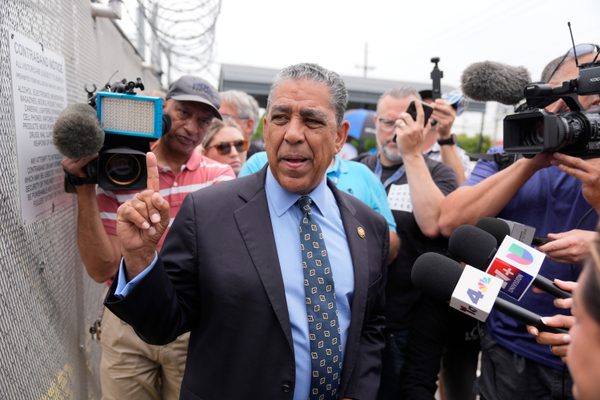
Rep. Adriano Espaillat late last month outside Delaney Hall, an ICE detention center in New Jersey.
Seth Wenig/AP
In uptown Manhattan this month, Darializa Avila Chevalier, a Democratic Socialists of America-backed insurgent, is testing whether the anti-AIPAC politics that have driven Democratic primary victories in progressive bastions around the country in recent months can play in a working class, largely Black and Latino district.
Avila Chevalier’s message to voters in New York’s 13th Congressional district is that Rep. Adriano Espaillat, the incumbent congressman, is beholden to AIPAC, and supports sending money to Israel that should be spent at home. That’s similar to the case made by recent Democratic primary winner Adam Hamawy in New Jersey, who ran on a pro-Palestine platform in an affluent district where nearly half of residents are college educated.
In an uphill battle to expand the electoral playing field for the pro-Palestine left, Avila Chevalier is testing whether the strategy can win in a district where, despite recent waves of gentrification, the proportion of residents living under the poverty line is double the rate of the city overall. The race is tight, according to a poll commissioned by Justice Democrats, a progressive PAC that backs Avila Chevalier. The survey showed Espaillat down four points, with 22% of voters undecided.
Avila Chevalier’s political identity is entwined with the pro-Palestine cause. She joined Columbia University’s Students for Justice in Palestine chapter in 2014 after a trip to the occupied West Bank, and in 2024 returned to Columbia’s campus to help organize the student encampment there. One day after the October 7th attacks, she attended a pro-Palestinian rally in Times Square that was condemned by many Democratic politicians because of some protesters’ praise of armed resistance.
Some political experts say that foreign policy issues alone won’t be decisive in this race. While Democratic voters of all races have soured on Israel, it’s an open question as to how much that will matter in NY-13 later this month. “Parts of this district have a pro-Palestine voting base, but it’s not a traditional stronghold of the left in New York City,” said Beth Miller, the political director of the anti-Zionist group Jewish Voice for Peace Action.
