Never Again for All, or for No One
A PR snafu at the LA Holocaust Museum reveals the impossibility of drawing boundaries around an anti-genocide rallying cry.
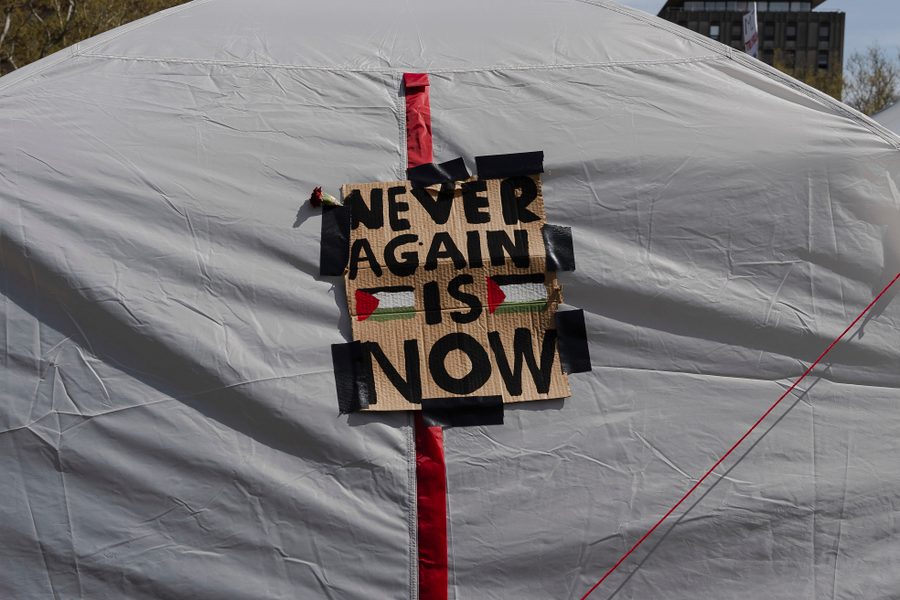
A “Never Again” sign at the MIT encampment in 2024
On September 4th, the Holocaust Museum LA posted an Instagram graphic depicting interlocked arms of various skin tones, with one arm bearing a concentration camp tattoo. The text accompanying the picture read “‘Never Again’ Can’t Only Mean Never Again For Jews.” Other slides continued this universalist message: “Jews Must Not Let the Trauma of our Past Silence our Conscience. Standing with Humanity does Not Betray Our People. It Honors Them. To Be Jewish is to Remember And to Act.”
Anodyne as these sentences may sound, they were enough to set off a firestorm in the post’s comments section. Some praised the museum for what they believed was a statement against Israel’s violence in Gaza; others were outraged, calling the message “beyond disgraceful.” “Our ancestors are rolling in their graves,” one commenter wrote. On her popular @rootsmetals account, the pro-Israel influencer Debbie Lechtman called the sentiment an “All Lives Mattering of the phrase ‘never again.’” Right-wing advocacy group StopAntisemitism even tried to capitalize on the controversy, commenting, “Donors seeing this – please DM us. We’re happy to help redirect your giving our way, an organization that focuses solely on the Jewish people and fighting the bigotry we face.”
Two days later, the museum intervened, taking down the post and issuing an apology—this time with comments turned off. The graphic had been “part of a pre-planned social media campaign intended to promote inclusivity and community,” the new Instagram post stated, lamenting that it was “easily open to misinterpretation by some as a political statement reflecting the ongoing situation in the Middle East. That was not our intent.” In other words, the post was a call for inclusivity, but there was exactly one case, one group of people, it was not meant to include: the people of Gaza.
This fundamental irony reflects more than a PR stumble; it exposes a deeper crisis in liberal discourse. These days, most moral claims issued from a liberal institutional voice contain an extra clause, whether or not it is stated explicitly: “except for Gaza.” Indeed, Palestine has long been the exception to the rule of inclusivity in liberal society. Palestinians are continually denied their claim to the very rights hailed as “universal” for everyone else: the right of return, the right to self-determination, the right to food and medical care. Even advocacy for those rights is uniquely excluded from rights to free expression—including by those who are otherwise vocal about free speech—a phenomenon so routine that it has earned its own label: the “Palestine exception.” As its apology clarifies, the Holocaust Museum LA’s original post had tried to push this logic one step further, turning Palestine into an exception in speech itself, wherein “never again” means “never again for anyone,” but “anyone” really means “anyone but Palestinians.”
The problem the museum ran into, however, is that language resists being fixed within the bounds of chauvinism; even when born of exclusionary intent, words take on lives that exceed it. The history of the phrase “never again” itself attests to this fact. The slogan has circulated in multiple contexts, and may have its roots in Weimar-era anti-war and antifascist movements, but its most enduring lineage comes from Israeli poet Yizkah Lamden’s poem “Masada,” a 1920s Zionist work which celebrates the choice of the Sicarii Jews to commit mass suicide rather than be captured by the Roman army. This spirit of Jewish militarism later captivated right-wing ultra-nationalist Meir Kahane, who popularized the phrase in his 1971 manifesto and used it to justify acts of terrorism against Palestinians to fortify the Jewish ethnostate. The Jewish Defense League, a far-right terrorist group founded by Kahane, adopted “never again” as one of its mottos (the other being “every Jew a .22”).
It is Kahane, not any antifascist group, who is credited for introducing “never again” to the popular lexicon—upon Kahane’s death in 1990, then-president of the American Jewish Committee Sholom D. Comoy remarked that “despite our considerable differences, Meir Kahane must always be remembered for the slogan ‘Never Again,’ which for so many became the battle cry of post-Holocaust Jewry.” Yet his claim on the words has become tenuous in the years since its popularization: the phrase now commonly serves as a distinctly universalist call for justice. Benjamin Netanyahu himself evoked it in reference to the Rwandan genocide, Jewish immigrant rights group Never Again Action took it up as their namesake, and it was used as a general call for nonviolence by gun control advocates in the wake of the Parkland shooting. Kahane’s own words could not be confined to the boundaries he’d imagined; they were too pithy and broadly applicable to stay fastened solely to the prevention of another genocide of Jews. Like the museum’s statement, “never again” was “easily open to misinterpretation.”
This slippage in meaning isn’t a unique case of politics outgrowing a speaker’s intentions, but a reflection of the fundamental structure of language itself. As philosophers since Plato have noted, language does not and cannot stay confined to one object or situation; to speak of something is, to some extent, to speak of it in general. Even a sentence as simple as “the sky is blue” already depends on a broader concept—blueness—that goes beyond the sky itself. Understanding the sentence therefore entails recognizing the sky as part of a larger category, creating an inherent comparison between it and all other blue things. So too when we call something a genocide; the word itself would be meaningless if it did not categorize historical events within a general framework of atrocity. Philosopher Jacques Derrida called this essential feature of language “iterability”: for a word or phrase to be meaningful at all, it must be able to be grafted onto new contexts. As he writes in “Signature Event Context,” any piece of language “can break with every given context, engendering an infinity of new contexts.” This is how “never again” was able to travel from Kahane’s manifesto to an anti-Zionist rallying cry used by Jewish Voice for Peace. To understand a phrase is to be able to replicate and reinterpret it, so to understand the meaning of “never again” is to immediately call to mind other instances of genocidal violence—Rwanda, Bosnia, Darfur, and, inevitably, Gaza.
As fewer and fewer Americans support Israel’s onslaught, and as more and more scholars and human rights groups deem Israel to be committing genocide, it becomes increasingly impossible to exclude Gaza from universalist moral claims—which is precisely why so many Instagram users, especially those most outraged by the post, unquestioningly assumed the museum’s vague statement to be about Gaza. This leaves only one option for institutions to quell iterability and prevent accusations of hypocrisy: silence. Instead of risking an unintended statement about Palestine, they may decide not to speak. In their retraction, the Holocaust Museum LA chose this silence. Rather than risk the application of “never again” to Gaza, they renounced their utterance of “never again.” Rather than exhorting Jews not to “let the trauma of our past silence our conscience,” they chose to fall silent themselves.
This is the endpoint of the insistence that Gaza can never be compared with the Holocaust. Because language allows comparison, we must be silent. And so the choice is stark: Either we speak of the Holocaust and our commitment to “never again,” opening ourselves to the unavoidable comparisons, or else we become unable to speak of the Holocaust except in tautologies. To honor “never again” requires risking universality; to deny that risk is, in the end, to forget.

I’m Peter Beinart, editor-at-large of Jewish Currents. Before you go, I need to ask something of you.
In recent years, I’ve watched as mainstream Jewish institutions and media have chosen ethnonationalism over liberal democracy and mass slaughter over the pursuit of a just peace. Jewish Currents offers something different. It’s a magazine built on intellectual curiosity and respect for the dignity of all people.
But a project like this doesn’t sustain itself, and we can’t do it without your help. If you share my belief in the importance of this mission, please consider making a donation—or even better, a recurring one. We need you with us.

Sean Pergola is the operations coordinator at Jewish Currents.