Newsletter
Apr
22
2026
Good afternoon from the Jewish Currents news desk. Today, Maya Rosen reports from the West Bank village of Umm al-Khair, where children are gathering by the razor wire blocking their path to school. And, we speak with Jodie Ginsberg, CEO of the Committee to Protect Journalists, about the wrongful detention of the American journalist Ahmed Shihab-Eldin, who has been held in Kuwait for 51 days.
The Jewish Currents news desk is directed by Josh Nathan-Kazis. Tips, responses, ideas, complaints, leaks? Email Josh at jnk@jewishcurrents.org. If you were forwarded this email, subscribe here so you don’t miss the next one.
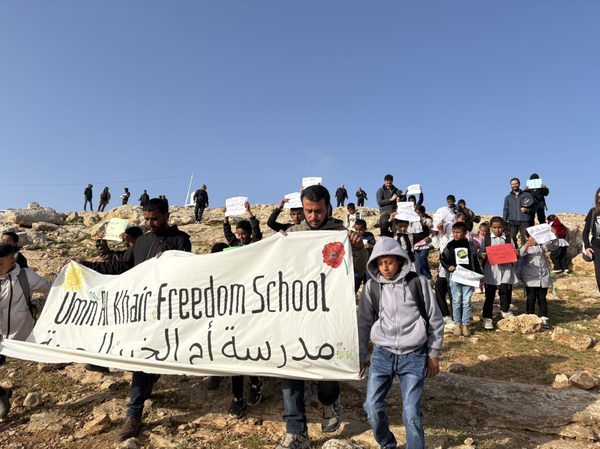
Tariq Hathaleen (center) and his students march toward the razor-wire fence cutting Umm al-Khair off from its school.
Maya Rosen
In a Palestinian Village Cut off from Its Schoolhouse, Children Ask for Education
Maya Rosen
Tariq Hathaleen, an English teacher from the village of Umm al-Khair in the southern West Bank, stood in a field a kilometer from the village school on Sunday morning, facing a crowd of some 50 children. “Good morning,” he said, getting their attention. “Good morning, teacher,” they responded together in Arabic-accented English.
A week before, on April 13th, Tariq’s students tried to return to class for the first time since the start of the US-Israeli war on Iran six weeks earlier, only to find that residents of the adjacent settlement of Carmel had laid razor wire across the path to their school, as Jewish Currents reported at the time. Adults from the village called the Israeli police, but Israeli soldiers arrived instead and shot tear gas toward the children.
A week after the confrontation, the path was still blocked. So, on Sunday, Tariq and others gathered by the new razor-wire fence to establish “the Umm al-Khair Freedom School”—a protest against the fence and political education rolled into one.
Even before the six-week closure, children in Umm al-Khair had only gone to school three days per week, for about four hours a day; Israel’s withholding of Palestinian Authority tax revenue has left the PA unable to pay teacher salaries and other expenses. “Education in Palestine has become basically nothing,” said Hanady Hathaleen, a village resident and mother of a student at the school, who is studying for a master’s degree in child development. (The residents of Umm al-Khair are members of an extended Bedouin family that was displaced from southern Israel in 1948, and all share a surname.)
In the field on Sunday, Tariq taught the Umm al-Khair children about the idea of a right to education, and the history of groups who have been denied that right. What the occupation “seeks is a generation that fails, a generation that cannot read, cannot write, and cannot communicate its cause to human rights institutions,” a representative of the Palestinian Education Ministry, Ayed Jundi, told the students.
The children sang songs with a music teacher, including one that they had adapted to describe their village: “Umm al-Khair is our home / Oh joy of all our eyes.” Their song ended with a verse about Hanady’s husband, Awdah Hathaleen, the 31-year-old village resident and English teacher at the school who was shot and killed by a settler in July. “Awdah is a star in our night / [His] love is always with us,” the song concludes. Awdah and Hanady’s five-year-old son, who started kindergarten at the school in the fall, was among the children teargassed the previous week.
Tariq taught the students the English phrase “open the road,” which came in handy when three balaclava-clad soldiers, along with the head of security of Carmel and a representative of the South Hebron Hills settler regional council, appeared on the other side of the razor-wire fence, guns slung over their shoulders, chatting amongst themselves and filming the children. Umm al-Khair and Carmel are just meters apart, separated by a chain link fence; Carmel’s suburban houses loom over the makeshift one-room tin homes of the village. The settlers and villagers are well-known to each other: When Khalil Hathaleen, head of the village council and father of two daughters in the school, shouted across the fence to the Carmel security chief and the regional council representative, he addressed them both by their first names. “You are responsible for everything happening here,” he yelled.
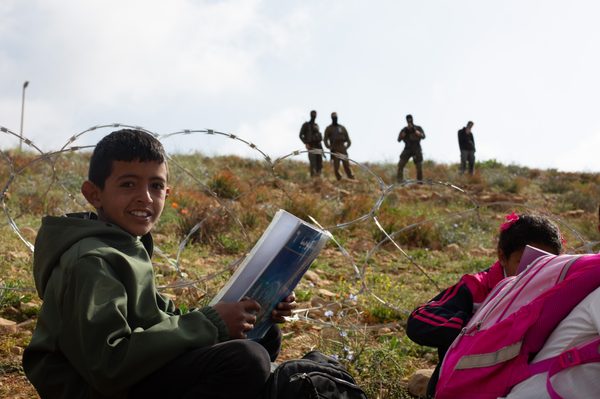
Sahm Hathaleen, 11, pulls out his schoolbooks as Israeli soldiers look on.
Jacob Lazarus
Although the Israeli military has proposed an alternate path for the children around the razor wire, the new path is much longer, and would require the children to walk near the caravans of a new settler outpost that extends the Carmel settlement. It’s a replay of what’s been done elsewhere in Masafer Yatta, the group of Palestinian villages in the South Hebron Hills to which Umm al-Khair belongs. In the early 2000s, the nearby village of Tuba was cut off from the road linking it to the village of Tuwani, where the nearest school is located, when the settlement of Maon expanded to connect to an outpost. For nearly 25 years, the children of Tuba have had to choose between walking ten kilometers each way to reach the school, or waiting for military escort, which is often hours late; children have faced serious violence on both routes.
Carmel has seized some 70% of Umm al-Khair’s land since the settlement was founded in the early 1980s, including most recently by erecting caravans in the center of the village. Even though the path to the school is older than Carmel, and is marked on both Israeli military and Palestinian maps as a school access road, it seems that the settlement’s plans now involve spreading from the caravans in Umm al-Khair’s center into the area of the school path. The night after settlers put razor wire across the path, they returned to arrange rocks into the shape of a Star of David, writing the word “Carmel” in rocks below it.
“The main idea of the road closure is to take this land from the Palestinians,” Eid Hathaleen, a resident of the village and father of three daughters at the school, said. “This is one of the tools they are using to squeeze us out.”
The blocking of the road at Umm al-Khair comes amid a broader assault on education across the West Bank, Gaza, and East Jerusalem. Multiple schools, including in Masafer Yatta, have been demolished in recent years, and, as of June 2025, 84 schools in the West Bank face demolition orders. Settler attacks, military raids, and movement restrictions make it hard for students and teachers alike to reach schools.
After several hours at the Freedom School, as the children packed up their backpacks to go, they pinned homemade signs to the razor wire, swiveling them around so that their messages asking for school access and education faced the soldiers and settlers on the other side. The next morning, the students were back at the razor-wire fence, with plans to continue their daily pilgrimage. “We will fight until the end to reopen this path,” Tariq told Jewish Currents. “It’s not only about reopening the path; it’s about the basic right to education for every child in this world.”
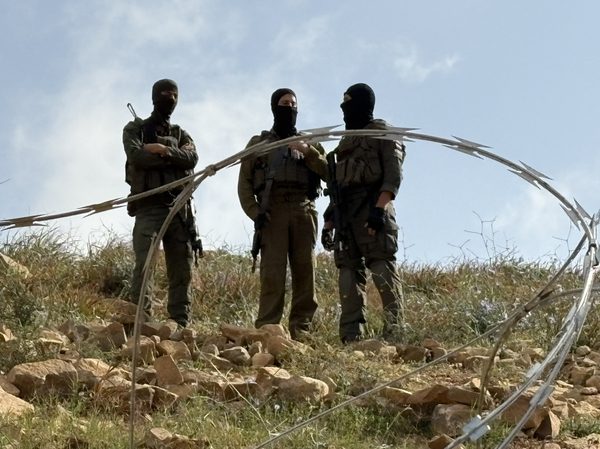
Masked Israeli soldiers linger near the razor-wire fence blocking the road to the village school.
Maya Rosen
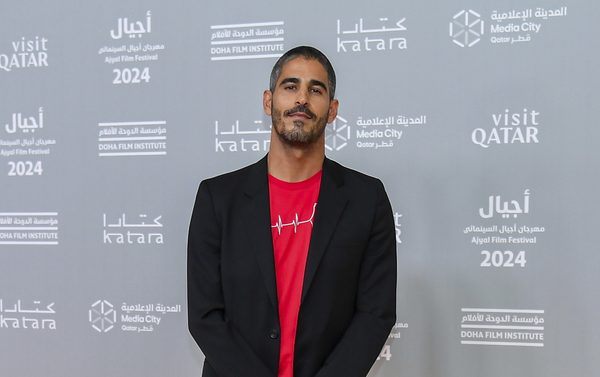
Ahmed Shihab-Eldin in 2024 in Doha, Qatar.
Noushad Thekkayil/AP
What Can Be Done to Help Ahmed Shihab-Eldin, the American Journalist Detained in Kuwait
Last week, the Committee to Protect Journalists (CPJ) revealed that Ahmed Shihab-Eldin, an award-winning American journalist, had been detained in the Gulf nation of Kuwait since March 3rd, when he was arrested while visiting family.
CPJ says that Shihab-Eldin was detained for reposting images related to the US–Iran war, and that the charges he appears to be facing could carry a ten year prison sentence. On Wednesday morning, attorneys acting for his sisters put out a statement saying that they are “extremely concerned for Ahmed’s safety and well-being.”
Shihab-Eldin, who as of Wednesday has been in detention for 51 days, is a familiar face: He was a host on HuffPost Live and on Al Jazeera English, and has worked for the New York Times and PBS Frontline, in addition to maintaining an active online presence. His arbitrary arrest comes amid a broader civil liberties crackdown in Kuwait. The Gulf Center for Human Rights (GHCR) reports that authorities there have arrested “dozens” of citizens for posting opinions online during the ongoing Iran war. “These arrests are part of a systematic pattern of repression adopted by the authorities, which has transformed Kuwait, once relatively free in terms of public freedoms compared to its neighbors, into a police state,” GCHR said last month.
Shihab-Eldin is a dual citizen of the US and Kuwait. Under a US law called the Levinson Act, cases of US citizens who have been wrongfully detained overseas are handled by the Special Presidential Envoy for Hostage Affairs, who has extraordinary powers to assist detainees and their families. Though the State Department has said that it is aware of Shihab-Eldin’s case, it has yet to officially declare him wrongfully detained. “Kuwait is supposedly the United States’ ally, yet this American citizen remains behind bars,” one of the attorneys, Caoilfhionn Gallagher, said in a statement. “It is long past time for him to be released so he can come home to his family in the USA.”
More than 17,000 people have signed a CPJ petition calling for Shihab-Eldin’s release. On Monday, the news desk spoke with the CPJ’s CEO, Jodie Ginsberg, about efforts to free him.
Josh Nathan-Kazis: What can be done to help Ahmed Shihab-Eldin?
Jodie Ginsberg: The United States has always taken a very robust approach toward the protection of its citizens, including through the introduction of the Levinson Act, which provides a clear mechanism for the US to support individuals who have been wrongfully detained.
We believe that Ahmed Shihab-Eldin meets the criteria under the Levinson Act to be designated as wrongfully detained, and we think that is an important step to speeding up his release. It means that the family can get more support, that the government can engage in more direct negotiations with the government that has wrongfully detained the American citizen. It also means [the US government] can penalize any country that is deemed to have wrongfully detained a US citizen.
JNK: What are the steps to securing that designation for Ahmed?
JG: All US citizens are entitled to consular support, so we understand that this is now being handled at consular level. In the case of Evan Gershkovich [the Wall Street Journal reporter wrongfully detained in Russia from March 2023 through August 2024], it took about a week for that designation to come through. In the case of Alsu Kurmasheva [the Radio Free Europe/Radio Liberty reporter wrongfully detained in Russia from October 2023 to August 2024], she received the designation just before she was actually released. We are not able to say with any certainty how long it might take. We continue to push, and have done so publicly.
Obviously, there’s always two parties in any wrongful detention: There’s the country of which an individual is a citizen, and there’s the country that has detained them. And so it will partly depend on the US giving this attention and resources, and partly also the responsiveness of Kuwait.
JNK: Is there anything the public can do to be helpful to Ahmed?
JG: The best thing those who support Ahmed can do at the moment is to keep up public awareness of his situation, to keep in the public’s mind that a US citizen and a highly respected journalist has been detained. The thing that people can do that’s in everybody’s power is to remind these governments that people care about these individuals, that they are being watched. That’s why we continue to push people to sign the petition, and speak out on behalf of Ahmed.
