Newsletter
Jul
16
2026
Good afternoon from the Jewish Currents news desk, where the sky is the color of the president’s bronzer, the lettuce is poison, the ticks are making us allergic to toothpaste, Captain Sully has Alzheimer’s, and the whales are sinking fire boats. At least England lost.
Today we’ve got a scoop from Will Alden about a conflict brewing over a decision by a major Jewish left conference to extend an invitation to MAGA provocateur Curt Mills. The invite has led one other speaker to drop out and is reigniting debates over how the left should engage with the anti-war Trumpist right.
And, I spoke with the novelist Dinaw Mengestu about his decision to resign as president of PEN America after the organization issued a report last week on the alleged “isolation and exclusion” of Jewish and Israeli writers in the publishing industry.
But first: I’m Josh Nathan-Kazis, and here’s what we’re talking about today at the Jewish Currents news desk.
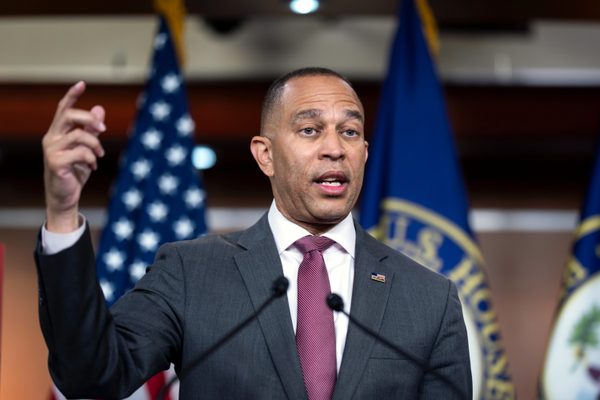
Nearly half the Democrats in the House voted on Wednesday for an amendment opposing aid to Israel that their leader, Rep. Hakeem Jeffries, voted against.
J. Scott Applewhite/AP
MOUSE THAT ROARS: On Wednesday, hours after nearly half of the Democrats in the House voted for an amendment that would strip $3.3 billion in US military aid from Israel, Jewish Voice for Peace Action’s Beth Miller issued a warning: “Every Democrat who voted to continue funding genocide is on a primary list for 2028.” Three or four years ago, a threat from JVP meant as much to a centrist Democrat as a squeak from a mouse in the hallways of the Rayburn House Office Building. Now that JVP and its democratic socialist allies seem to be slaying another pro-AIPAC incumbent every other week, the idea of landing on Miller’s list is no joke for lots of Democrats.
The vote failed yesterday, and the underlying bill passed. But the Democratic caucus is clearly scrambling to signal that it understands that its base doesn’t want to buy more weapons for Israel. Even former House Speaker Nancy Pelosi—who, my colleague Alex Kane reminds me, told a pro-Israel audience in 2018 that “if this Capitol crumbled to the ground, the one thing that would remain” is aid to Israel—voted for the amendment. It’s a victory for the pro-Palestine left.
The liberal Zionist J Street, meanwhile, has tied itself to the embattled old guard, most notably Rep. Hakeem Jeffries, the minority leader, who voted against the amendment. Jeffries, as I wrote on Tuesday, appears to be looking to J Street to help him weave a path between the pro-Palestine progressives and the pro-Israel donors. The group opposed the amendment but, after the vote, seemed to try to grab credit. “The outcome of today’s vote sends a strong message,” J Street president Jeremy Ben-Ami said in a statement. “The majority of House Democrats demonstrated that there is now broad agreement within the Democratic caucus that it is time for a fundamentally different American approach to the U.S.-Israel relationship and the region.” Jeffries and J Street want to define that new approach, but Jeffries’s hold on the Democratic caucus looks weak, and J Street seems like it’s missed its moment.
SOBERING: The former Labor Knesset member Eli Goldschmidt on Thursday announced he is launching a new Israeli political party that will back the continuation of Benjamin Netanyanu’s rule. The party, called Yisrael Mitpakachat in Hebrew, is targeting Israeli liberals who have moved right since October 7th. “The verb le’hitpakeach is a homophone that can mean both ‘to open one’s eyes’ (it appears in the Bible when Adam and Eve realize that they are naked) and also ‘to sober up,’” Jewish Currents associate editor Maya Rosen tells me. “In the post-October 7th context, it refers to those formerly of the left who have ‘come around’ to understanding that security is king. And it’s a real cultural phenomenon.”
WHAT THE HELL: Here’s some more villainy from Itamar Ben-Gvir, the Israeli national security minister. Israel National News reports that, at Ben-Gvir’s request, Israel’s minister of environmental protection on Thursday changed her ministry’s rules for the ownership of crocodiles to allow them to be kept for commercial purposes. This will enable the Israeli Prison Service, which Ben-Gvir runs, to “launch a pilot program to keep crocodiles on their premises,” per the outlet. Ben-Gvir has previously discussed plans to build a prison surrounded by a crocodile-filled moat, cribbing from Florida Gov. Ron DeSantis’s similarly ghoulish Alligator Alcatraz, which may or may not have permanently closed after less than a year.
The Wall Street Journal reported on Wednesday that a dozen Palestinians released from Ben-Gvir’s prisons told the paper that they were physically abused while incarcerated, and two men said they were sexually assaulted. Now Israel wants crocodiles to guard the walls of its torture chambers.
The Jewish Currents news desk is directed by Josh Nathan-Kazis, with reporting from Alex Kane, Maya Rosen, and Mari Cohen, and editing by Lizzy Ratner. Want to get in touch? Email me at jnk@jewishcurrents.org, or message me on Signal @jnk.56. If you were forwarded this email, subscribe here so you don’t miss the next one.
MAGA Firebrand Curt Mills Will Speak at a Major Jewish Left Conference. Some Say He Doesn’t Belong.
By Will Alden

Curt Mills, pictured at his home, is editor of The American Conservative, an ally of Tucker Carlson, and a leader of MAGA’s anti-interventionist wing.
KT Kanazawich
A major conference of Jewish left leaders has booked the anti-interventionist MAGA provocateur Curt Mills as a speaker for next year’s event, causing at least one participant to back out in protest, and highlighting a dilemma facing the anti-Zionist left over how it relates to right-wing critics of Israel.
Mills, the editor of The American Conservative (TAC) magazine, who was recently profiled in Jewish Currents as the intellectual leader of MAGA’s emergent anti-Israel wing, has accepted an invitation to appear at the 2027 Conference on the Jewish Left, held at Boston University. He’s also been invited to table for TAC at the event. Mills’s panel will focus “on changing US foreign policy toward Israel,” according to a June email obtained by Jewish Currents and sent by the panel’s organizer, Jeremy Menchik, a BU professor who heads the research center where the conference is housed. Mills will be featured as a “potential coalition partner for the Jewish left,” Menchik said in an interview.
But Mills’s inclusion has led another planned speaker, Rabbi Andrue Kahn, executive director of the anti-nationalist American Council for Judaism, to pledge to withdraw from the lineup if the right-wing journalist remains on the program.
“I won’t be in a conference with someone who holds the values of this man,” Kahn told Jewish Currents, citing Mills’s anti-immigrant views and the “abhorrent” material published in TAC under his editorship, including a stridently anti-trans essay and another that traffics in breezy racism and antisemitism. “The magazine calls for things that specifically create harm for people I work with and care for, and for the world I’m trying to build,” Kahn said, adding that Mills’s appearance at the conference could alienate important allies.
Menchik’s insistence on including Mills has also inflamed some of the other organizers of the conference and is causing turmoil in Jewish left circles. At the core of the debate is the question of whether and how the left should engage with MAGA figures who appear to share certain of its foreign policy goals, even as the Trump administration attacks the rights of immigrants, trans people, and other vulnerable communities at home.
A Few Quick Questions for Dinaw Mengestu on His Resignation as President of PEN America
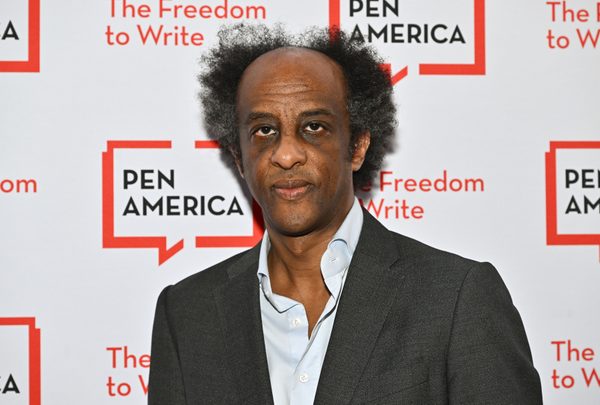
The novelist Dinaw Mengestu, pictured in May, resigned last week as the president of the writers’ group PEN America.
Evan Agostini/Invision/AP
PEN America, the literary organization, published a bafflingly bad report last week on the “rising isolation and exclusion” of Jewish and Israeli writers. Based entirely on anecdote, the report, titled “A Silent Moratorium,” conflated allegations of antisemitism against American Jewish authors with a claim that US presses won’t publish Israeli fiction. “Apparently, the authors of the PEN article spent ‘months’ on their piece,” the Wellesley College Jewish studies professor Josh Lambert wrote Wednesday on his Substack, More Life. “That’s hilarious, and appalling, when you look closely at what they’ve published.” Lambert wrote that he found eight works of Hebrew fiction published in translation by US publishers in 2024 and 2025 in just 20 minutes of searching. “Maybe, before you publish a piece that is called ‘A Silent Moratorium,’ you could, like, search for evidence that the phenomenon you’re describing is actually, like, happening?” Lambert wrote.
PEN America’s president, the novelist Dinaw Mengestu, resigned the day the group published the report. Mengestu, a professor at Bard College, had served on the board of PEN America for roughly a decade before he was elected president in December. His election came at the tail end of a nearly two-year-long writers’ boycott of PEN America over its approach to Palestinian writers, Israel, and the war in Gaza. Mengestu’s decision to step down has set off a round of predictable discourse framing the resignation as itself an affront to free speech.
I spoke to Mengestu on Wednesday about his decision to resign. After we spoke, PEN America’s co-CEOs, Summer Lopez and Clarisse Rosaz Shariyf, put out a statement defending “A Silent Moratorium” and the organization’s track record of protecting pro-Palestinian speech. “When Texas and Arkansas passed laws requiring government contractors to sign pledges disavowing any boycott of Israel before they could get paid, we spoke out against both,” they said. “Since October 2023, we’ve put out dozens of statements specifically addressing the suppression of pro-Palestinian speech in this country.” This interview has been edited for length and clarity.
Josh Nathan-Kazis: You’ve spent a decade as a board member and then president at PEN America. Tell me why you think the organization is important.
Dinaw Mengestu: PEN’s value is as an advocate for literature, to create a community of writers, and to put the value of that work out into the world. That component is inextricable from what [PEN] does for defending free expression in language. We understand that to protect the work of individual writers is a way to protect the rights that all of us are dependent upon in order to have a free and equitable society. What we’re trying to do is create not just laws or protect laws but a culture in which people can share and express their ideas.
JNK: Why did you resign?
DM: I resigned because this report continues a practice that I thought we were going to stop. [I thought] we were going to become an organization that advocated equally for writers. The report is written explicitly to be used to delegitimize not only BDS but also to help support anti-BDS legislation. They know that. I’ve had that conversation with them before the report was released. [Anti-BDS legislation] is probably the most restrictive free expression threat in our country right now, and we have said practically nothing.
Not only do we say nothing and release this document, but we released a document that pretends to be about documenting experiences of discrimination, but it is not doing that. It is trying so hard to serve as support for anybody who wants to try to advance anti-BDS legislation. You can see it in the way the narrative is framed. Why are we talking about Jewish and Israeli writers? The experiences of Israeli writers has nothing to do [with it]. If you are an Israeli writer, you have an entire publishing industry that supports you. Why is that our concern? We are not obliged to put books into translation. We only publish 3% of books in this country in translation anyway. The idea that somehow we can document that and pretend or claim that that is a result of discrimination is just illogical.
JNK: What surprised me about the report was that there was so little data offered to back up its claims. The segment you’re alluding to, where they claim that Israeli fiction is not being published in the US in translation, acknowledges that “only a handful of Israeli authors are published in the U.S. each year” anyhow. The report wasn’t presented in a way that suggested a rigorous analysis.
DM: Because there is no rigorous analysis. You can look back at a report we did in 2022 on discrimination in publishing. That report is rigorous. It is 60, 70 pages long. It is full of facts. It is full of research. It is a real substantive body of work.
You would actually have to measure this over the course of a number of years. You would have to be able to compare at least two, three years to determine if there is any change in translation rights [from Hebrew]. But [the report] does work if you are trying to put forward a claim that BDS is actually not protected speech but is commercial activity that can be regulated by the state. [You] just need somebody to come out and say, ‘Yeah, last year I would have had 5 books published, but this year I have zero.’ That is enough to try to help move BDS from being First Amendment speech to being commercial activity.
If people are experiencing that kind of discrimination in publishing, which is the heart of PEN America’s work, we should care more than just providing anecdotal evidence. We should really try to document and show exactly how this happened. To do it so haphazardly is an offense. If this report were about discrimination against Black writers and this is what they did, I would be fucking enraged.
JNK: So do you think they should have done sort of a more rigorous job, or do you think a more rigorous job would have risked empowering anti-BDS legislation?
DM: No, I think a more rigorous job wouldn’t have actually empowered anti-BDS legislation at all, because a more rigorous job would have actually been about discrimination. If you are not publishing a writer because they’re Jewish, that is just racism. There’s no other terminology. You can’t use BDS as a cover for that. Documenting racism and pushing back against racism is entirely within the mandate of the organization. So we should have certainly done that. That is not what we did.
JNK: You wrote on Instagram this week that you were “permanently” leaving PEN America and will “help make something better.” I wonder if you could say more about what you meant.
DM: I’ve got more than 2000 different writers who have sent messages or reached out who would be very happy to have an organization that they felt like they actually believed in and that they could actually trust. I believed in what PEN could do, what it could be, and I understand some of the very good work that PEN America has done. But it can’t be at the expense of a collective defense of all of our rights. As soon as you begin to decide that some rights of some people are worth more than others, it’s not tenable or feasible. Rather than just walking away and turning our backs on the organization, I would rather work with other writers to do something better.
