A Leftist’s Guide to Tariffs
Despite purporting to “bring back jobs,” Trump’s trade war continues the capitalist offensive of the free trade regime.
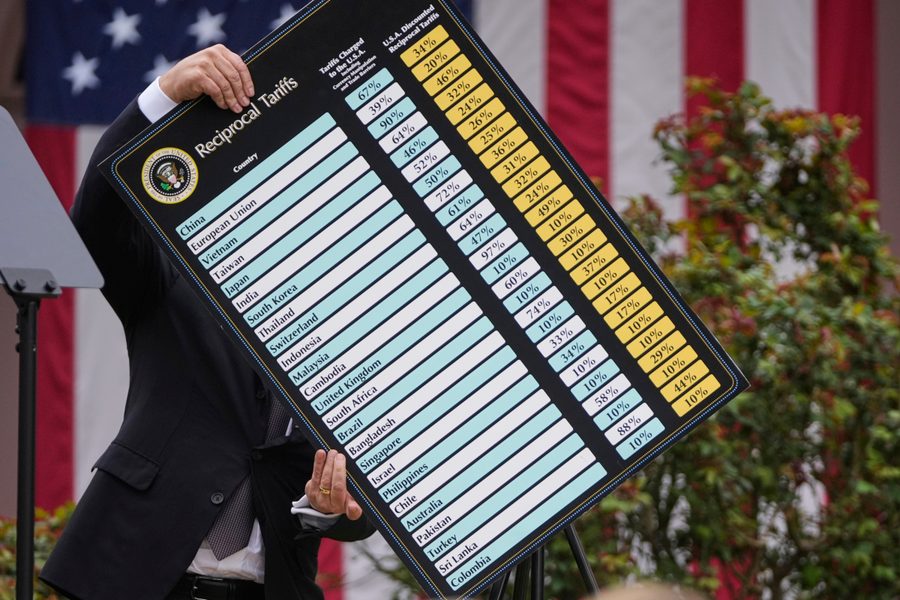
Commerce Secretary Howard Lutnick holds a tariff chart at the White House, Wednesday, April 2nd, 2025.
It’s been a dizzying few months for US economic policy. Again and again, President Donald Trump has announced and backtracked on tariffs. On March 4th, he proclaimed an immediate 25% tariff on imports from Mexico and Canada, only to say the next day that US automakers would be exempt for a month to give them time to adjust. In the subsequent weeks, Trump continued this flip-flopping, announcing or backtracking tariffs on goods ranging from soybeans to aluminum and steel. Then, on April 2nd, Trump unveiled a series of “reciprocal” tariffs on every country in the world. Set to take effect in three days, the tariffs would begin at a common baseline of 10%, but would rise to up to 50% on April 9th for countries that were net exporters to the US.
Trump’s announcement caused widespread alarm: On April 8th, Reuters reported that the S&P 500 had just witnessed “its steepest four days of losses since the index was created in the 1950s.” In light of the panicked markets—as well as the retaliatory tariffs that multiple countries quickly promised to impose on the US—Trump declared a “90-day pause” on the higher tariffs just a few hours after they began on April 9th, essentially reverting to the 10% baseline. But there was one exception: China. That country would now face a 124% tariff, which was bumped up to 145% the next day. China responded in kind, confirming that Trump has instigated a full-blown trade war that risks at least a recession and at most, a decline of the primacy of the dollar in global trade. But through it all, Trump has retained his commitment to tariffs, insisting such a policy is necessary to return manufacturing jobs to the US.
For the left, which has long been critical of how the current global economic order has failed workers by promoting low wages and the offshoring of jobs, these developments present a fork in the road. Some US labor leaders have commended Trump’s tariffs, with United Auto Workers’ Shawn Fain calling them a “long-overdue shift away from a harmful economic framework that has devastated the working class and driven a race to the bottom across borders,” and Teamsters’ Sean O’Brien telling reporters that tariffs could bring back “good-paying, middle-class jobs.” But others on the left, while sharing Fain and O’Brien’s concerns for the plight of American workers, have denounced Trump’s tariffs, joining foreign labor leaders in calling for labor coordination across borders rather than a trade war that pits workers against each other. To help parse these left debates, this explainer offers an overview of tariffs, delving into what they are, how they have historically helped and harmed workers, how Trump is using them, and whether his version is indeed a solution to the ills wrought by free trade economic policy over the past few decades.
What are tariffs, and how have they historically been used?
A tariff is a tax collected on imports. The company bringing in the imported goods pays the tax, which becomes an added cost of doing business in the country. This serves to disincentivize imports, and can be a way for governments to promote domestic production.
In the US, tariffs have historically been supported by industrialists looking to evade foreign competition and promote their own newly established enterprises. Between the early 1800s and 1930s, for instance, industrialists demanded tariffs on incoming goods to compete with Britain, early America’s main industrial competitor. As a result of their lobbying, throughout the 20th century the US had some of the highest tariffs in the world. Such protectionism helped new industries like American iron and steel transform into powerful global players by the end of the 20th century.
While it is most often industrialists who benefit from tariffs, sometimes politicians and even workers join pro-tariff coalitions. This is because of what the late anthropologist David Graeber referred to as the ideology of corporatism: the idea that workers and bosses have common interests. Corporatists, per Graeber, sell the idea that “there is no class contradiction” and “we’re all in it together.” In the case of tariffs, this worldview manifests in the belief that by bolstering domestic industries, tariffs automatically empower domestic workers—providing them with jobs, increasing their wages, and improving their standard of living. In reality, however, the distributional effects of tariffs depend on class power. While 20th-century US tariffs helped industrial barons like Andrew Carnegie, they rarely helped their workers, who continued to labor in dangerous conditions for dismal wages. It was only when labor collectives and unions pushed for wage fairness and for health and safety regulations that steelworkers benefitted.
Globally, too, tariffs have had an uneven impact. Specifically, tariffs imposed by the West have long served as tools of imperial control over colonized countries and have occasioned what anti-colonial Marxists have called the “development of underdevelopment.” The British empire, for instance, used tariffs to prevent colonized countries’ manufacturers from selling goods to England, even as cheap raw materials extracted from those colonies were used in most “domestic” British products. In the mid-20th century, ex-colonies tried to recover from the immiseration they had suffered under this colonial system through “import substitution”—essentially coupling high tariffs on Western goods with subsidies and incentives for their own domestic production. But Western countries could not abide these restrictions, and by the 1970s, US-led institutions like the World Bank and the International Monetary Fund coerced ex-colonies to “liberalize” their economies, opening them up to a “free” (West-led) trade system that would send their industries into a downward spiral. The economist Ha-Joon Chang has termed this late-20th-century practice “kicking away the ladder of development,” with Western countries prescribing a “free trade” economic formula for others that they did not use when developing their own industries.
How do Trump’s tariffs compare to historical uses of the tool?
Tariffs are often selectively applied to individual countries, sectors, or even specific products, reflecting a studied approach to propping up a domestic industry. In contrast, Trump has approached tariffs as a blunt weapon, beginning with a universal tariff “on all imports.” Practically, this means that instead of promoting a US car maker like Ford by taxing its foreign competitors like Honda or Hyundai, Trump has also taxed all the inputs Ford itself needs to make its own cars—effectively raising the costs of production for everyone rather than promoting American manufacturing.
The blanket approach to tariffs, as well as the frequent waffling on implementation, has prompted chaos, but has also clarified Trump’s actual goals. For example, by the end of March, Apple—which maintains the vast majority of its supply chain outside the US—sought to circumvent imminent tariffs by airlifting some $2 billion worth of iPhones into the US, chartering additional cargo flights, and even lobbying airport officials to clear customs faster. Soon after inaugurating this panic, the administration issued a set of tariff “exceptions” for smartphones, laptops, and other select technological goods from China. Apple’s shares, having fallen originally, temporarily rallied, and Trump was quick to take credit, boasting: “I speak to Tim Cook. I helped Tim Cook, recently, and that whole business.”
This series of events laid bare Trump’s strategy: impose aggressive tariffs, push companies and countries to the brink of ruin, then offer individualized negotiations where business and state leaders can curry favor. “It’s like [Trump’s] a medieval priest selling indulgences,” the leftist economic analyst Doug Henwood told Jewish Currents, referring to Trump’s quest to call the shots on a case-by-case basis rather than produce a clear procedure others can plan around. Indeed, within a few days of announcing the “reciprocal” tariffs, Trump’s press secretary boasted that 70 countries had reached out looking to negotiate individual deals for exceptions on specific products or a country-wide carve out.
Trump’s tariff “transactionalism” has not worked out. So far, no bilateral trade deals have materialized. (News of a tentative deal on auto imports broke on April 29th, but few details had been reported by press time.) Dismayed by Trump’s “break first, negotiate later” approach, many countries have started actively planning an economic world order without the US. Treasury yields have been rising—a metric that indicates a loss of confidence in the dollar as there are fewer buyers for American debt. Trump has responded by floating the idea of lowering tariffs on China soon, but it may be too late to backpedal. Whether the tariffs stay or go, trading partners’ loss of confidence in the US is now a serious problem. In practical terms, it indicates that Americans are likely to pay more for goods, thanks not just to the tariffs but also the declining value of the dollar.
What has been Trump’s stated justification for these tariffs?
Trump claims his tariffs will solve two problems: the US trade deficit, and the loss of domestic manufacturing jobs. Both these phenomena emerged together in the 1970s. At that time, US capitalists were facing limits on their profits due to very high income taxes (92% on the upper bracket through the 1960s), rising union power, and newly competitive Asian firms. In response, they became interested in bolstering profits by becoming “more competitive,” i.e. gaining access to cheaper labor abroad in addition to cheapening labor in the US. As a result, successive US administrations began negotiating trade agreements like Ronald Reagan’s 1988 agreement with Canada and later, Bill Clinton’s 1992 North American Free Trade Agreement (NAFTA), applauded by the Heritage Foundation as “Reagan’s vision realized.” Signed with bipartisan support, NAFTA enabled companies to escape the US regulatory environment and its minimum wage, union rights, and environmental regulations. Now, companies could set up plants across North America with reduced import duties and fines. The creation of the World Trade Organization in 1995 furthered this momentum by creating similar free trade conditions amongst 166 member countries.
The rise of these trade agreements has globalized most supply chains, with the manufacturing of both parts and final consumer products now taking place internationally. Thanks to this shift, the US has been buying more from abroad than it sells—a trade deficit. Since the 1970s, the size of that deficit ballooned, going from about 1% of the GDP in 1980 to 3% of the GDP ($620 billion) in 2019 and 3.9% ($1.2 trillion) in 2024. Trump has been decrying this since the 1980s, saying other countries “rip us off by dumping their goods into our country,” and are “laughing at us.” It’s not clear, however, how this deficit itself in itself is a “ripoff” for everyday Americans, who are in fact receiving the goods they purchase from abroad.
The real problem has not been the need to buy goods from abroad, but the decline of livelihoods due to the deregulatory economic environment. In the past few decades, the bipartisan free trade regime has led to the offshoring of over 700,000 jobs from the US as capital sought to drive down its costs of production. Domestic wages for the jobs that remained have also stagnated amid an assault on pro-labor regulations and the social safety net in the US itself—while unions have lost leverage because of companies gaining the option to move jobs abroad rather than having to stay and negotiate. Through these measures, US capitalists have significantly restored their profitability.
How does Trump’s apparent opposition to the free trade consensus compare to longtime leftist critiques of the neoliberal economy? Will his tariffs serve leftists’ goals?
Large parts of the left have opposed the deregulatory spiral of the past five decades. During the onset of Clinton’s NAFTA in the 1990s, Bernie Sanders visited Mexico and met the Mexican workers who had replaced American workers, many working for subhuman wages and living in precarious housing surrounded by environmental toxins. At the time, Sanders warned that agreements like NAFTA were antithetical to the wellbeing of all workers, whether in the US or Mexico, and said that only a regime of “fair trade, not free trade” could solve this—a system that would entail having strong worker protections that accompanied trade across North America. Such insights were often repeated in the coming years, from anti-NAFTA protests in Mexico to the streets of Seattle in 1999. But regulations that constrain bosses and benefit workers, whether domestic or foreign, have rarely been on offer from either political party in the US. As Henwood told Jewish Currents, “we never developed a progressive internationalism based on fairer trade, and now we are paying the price” in the form of Trump cynically exploiting the issue to his own ends.
Indeed, for all his concern for onshoring jobs, Trump has done nothing to address the core reason the jobs disappeared in the first place: capitalists’ unwillingness to pay US wages and adhere to US law. Instead of curbing capital’s power to flee regulation, Trump has only bolstered it by assaulting the National Labor Relations Board, deregulating environmental laws, removing caps on financial accumulation, and more. In this permissive deregulatory context, tariffs alone cannot compel businesses to bring “good” US jobs back. Instead, research by economists like Isabella Weber finds that companies will try to adjust to “cost shocks” like tariffs by charging consumers more, by squeezing more out of their workers, and by automating. This pattern appears to be holding. Already, the auto company Stellantis has used the tariffs as a reason to pay shareholders more and cut jobs. Meanwhile, Subaru has recently announced a plan to shut a US plant, and other Asian car makers have suggested they plan on doing the same. The net result may be more job losses than gains.
What should a left vision for restoring the US economy look like, if not support for tariffs?
Given the likely effects of Trump’s tariffs, distinguishing pro-worker rhetoric from pro-worker policy is a good first step in making sense of the president’s policy. A second but no less important step is to recognize the historical continuities between Democrats and Republicans, and between free trade and tariff regimes. For instance, the political scientist Thea Riofrancos told Jewish Currents that successive US administrations have seen the mineral lithium, used to make both consumer electronics as well as missile defense systems, as essential to US national security, but have approached the task of securing lithium differently. In his first term, Riofrancos said, Trump used executive orders to “expedite the regulatory processes for mining critical minerals in the US.” Then, Biden “picked up where Trump left off,” adding provisions to boost US-led lithium mining to his landmark Inflation Reduction Act, and framing it as a move to support green energy production despite the fact that lithium mining pollutes water supplies. Now, Trump has returned to the issue with his tariffs, targeting China—which controls 80% of the lithium supply chain—in a bid to bully it into allowing the US access to its lithium supply chain.
This example illustrates how US leaders across parties have, whether using free trade or tariffs, ultimately adopted a (corporate) America-first paradigm that puts military and mining priorities far ahead of workers’ concerns. Henwood pointed out that the main difference between the two parties has been the method, with Trump “returning to a 19th-century model” where, in addition to seeking control through trade negotiations, brute force is also on the table. Riofrancos agreed, noting that while Biden was pressuring Greenland, a major lithium producer, to sell its mining assets to US companies rather than Chinese ones, Trump has directly threatened Greenland’s sovereignty itself. The approaches differ, but neither is about offering dignified livelihoods—just as neither the free trade paradigm, nor the tariffs that supposedly correct for it, are automatically linked to good jobs.
For the left, the insight here is that securing “good jobs” will require much more than tariffs. In the lithium example, it ought to involve opposing green capitalism and the defense industry’s calls for lithium in the first place, instead advocating for jobs that do not require militarism or extractivism. (Public healthcare and education, two sectors that create far more domestic jobs and equitable growth than corporatist bosses have permitted us to realize, are good candidates for such agitation.) More broadly, good jobs in the US will require curbing corporations’ ability to offshore production as a way to avoid domestic labor law. And on a global scale, ensuring good jobs will entail supporting the emergence of an internationalist progressivism through policies like a global minimum wage and universal workers rights. As the economic anthropologist Jason Hickel has pointed out, “such reforms are unlikely to be handed down from above.” Instead, as Hickel says, they will require a political struggle “similar in scope to the anti-colonial movement of the 20th century.”

I’m Arielle Angel, editor-at-large of Jewish Currents. Before you go, there’s something I need to ask.
We’ve seen over and over how the mainstream media falters in telling stories on our beats—whether it’s antisemitism, Israel/Palestine in American politics, Jewish identity, or the American left. At Jewish Currents we’re committed to uncompromising analysis and longform reporting on these issues and more—stories you won’t find anywhere else. In a media landscape that obscures injustice and flattens discussion, we’re changing the conversation. But we need you.
If you believe in this work, please consider making a donation—or even better, a recurring one—to ensure that we are able to keep publishing stories like this one. We can’t do it without you.
Sheetal Chhabria is Associate Professor of History at Connecticut College and the author of Making the Modern Slum: The Power of Capital in Colonial Bombay.