Newsletter
Feb
27
2026
Good morning from the newsletter they’ll wrap the fish in at Fairway after the revolution comes. Here’s the latest from the Jewish Currents news desk.
Josh Nathan-Kazis on the split between anti-occupation Jewish groups over how to oppose US military aid to Israel, and a West Bank dispatch from Maya Rosen, who spoke with a man whose West Bank village has been depopulated due to settler attacks. Plus: Mainstream Jewish groups are arguing for synagogue protest rules in New York that go beyond what a proposed bill seems to actually do, Alex Kane reports.
The Jewish Currents news desk is directed by Josh Nathan-Kazis. Tips, responses, ideas, complaints, leaks? Email Josh at jnk@jewishcurrents.org. If you were forwarded this email, subscribe here so you don’t miss the next one.
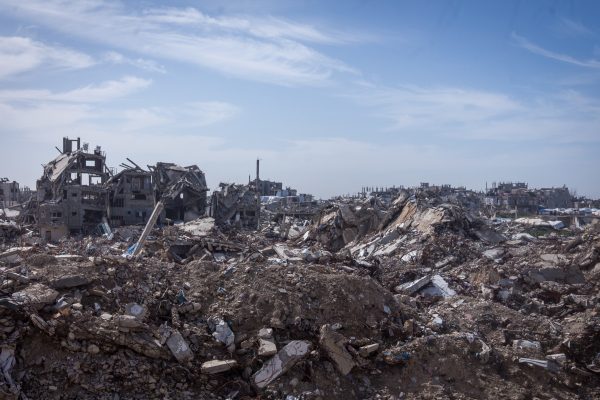
The Jabalia refugee camp in Gaza this month. A large US-made bomb dropped there in 2023 destroyed an entire apartment block, killing over 100 people.
Hassan Salem/Sipa USA via AP
As Americans Sour on Aid to Israel, Jewish Anti-Occupation Groups Split on Strategy
Josh Nathan-Kazis
A new House bill introduced this week that would set conditions on Israel’s use of US weapons is setting off a fight over political strategy between left and liberal Jewish anti-occupation groups, as activists clash over how to take advantage of growing public opposition to US military aid to Israel.
Since May of last year, more than a quarter of House Democrats have signed on as cosponsors of the Block the Bombs Act, which would ban the US from sending 2,000-pound bunker busters and certain other munitions to Israel. That bill has the support of the anti-Zionist group JVP Action, along with a number of Arab and Palestinian-led organizations, including the IMEU Policy Project and the US Campaign for Palestinian Rights Action.
J Street, the leading liberal Zionist advocacy group, doesn’t oppose Block the Bombs. But late Monday, it backed a new House bill, introduced by Illinois Democrat Sean Casten, called the Ceasefire Compliance Act, which would set conditions for restricting Israel from using all US weapons in the West Bank and Gaza.
J Street says that the Ceasefire Compliance Act doesn’t conflict with efforts to organize behind the Block the Bombs Act. “This is not in any way taking away from support for Block the Bombs,” J Street president Jeremy Ben-Ami told Jewish Currents on Tuesday. “I think it’s additive.”
JVP and its allies, however, are condemning the J Street-supported bill as a weaker measure that risks spoiling Block the Bomb’s momentum. “A bill like this effectively acts as an off ramp for members of Congress who are feeling pressure to take concrete steps to actually block weapons from going to Israel,” says JVP Action’s political director, Beth Miller. The Casten bill seems designed to appeal to national security-minded moderate Democrats: Its language emphasizes Israel’s security needs, and its conditional bans on the use of US weapons would only apply in the West Bank and Gaza. It would place no limits on the Israeli use of US weapons against Iran, or any of Israel’s other regional rivals. The Block the Bombs Act, by contrast, would entirely stop the US from giving Israel the weapons named in the bill.
The fight over these bills is in some sense symbolic: Neither of them will pass in the current Republican-led House, and neither have any hope of becoming law under the current administration. But the two bills illuminate the strategic disagreement between the liberal Zionists on one side, and the anti-Zionists on the other, over how to best take advantage of a political moment in which a majority of Americans, and a large majority of Democrats, oppose sending more aid to Israel.
Underlying the strategic conflict between JVP and J Street is strong opposition from Palestinian activists to the J Street-backed Casten bill. Casten’s House district on the outskirts of Chicago includes one of the largest Palestinian communities in the US, but Casten’s relationship with Palestinian American leaders appears to be strained. “He has never engaged local Palestinians on the issue,” said Faith Powell, a consultant with the Justice Coalition, a Palestinian American-led political organization based in Chicago that has endorsed Casten’s opponent in the upcoming Democratic primary.
Abdelnasser Rashid, a Palestinian American State Representative in Illinois whose district overlaps with Casten’s, told Jewish Currents that he saw Casten’s bill as undermining the Block the Bombs effort. “I am not aware of a single conversation that Congressman Casten has had with his constituents, including his Palestinian constituents,” about the bill, said Rashid. “I believe that the intent of this bill is to provide an alternative to Block the Bombs. We see through it and we reject it.”
The IMEU Policy Project, a leading Palestinian advocacy group in Washington, also told Jewish Currents that it does not endorse Casten’s bill. “Rather than detracting from existing substantive legislation, we encourage Members of Congress to cosponsor the Block the Bombs Act, which has real momentum and the backing of a broad, grassroots coalition,” the group said.
A spokesperson for Casten said that the congressman had consulted with “a diverse range of stakeholders” while drafting the bill, including Palestinian and Muslim-led groups, and Palestinians living in the West Bank. But Casten’s press release announcing the bill cited support from two progressive Jewish groups, J Street and New Jewish Narrative, and no Palestinian or Arab organizations. (The release also named two DC-based advocacy groups, Foreign Policy for America and Refugees International, as endorsers of the bill.)
Ben-Ami told me that J Street prefers the Ceasefire Compliance Act to Block the Bombs, because the former bill is designed to influence Israel’s behavior, rather than block specific weapons. The bill would predicate Israel’s ability to use American weapons in the West Bank and Gaza on their compliance with certain conditions, like refraining from annexing the West Bank and abiding by the terms of the October Gaza ceasefire. It sets up a process to determine whether Israel is meeting those conditions and, failing that, a monitoring group to determine whether Israel has actually stopped using US weapons in the West Bank and Gaza.
But Ben-Ami also said that Casten’s bill gives more Democrats a chance to signal support for conditioning aid to Israel. J Street endorses roughly 50 of the 62 Democrats who have signed on as cosponsors of Block the Bombs, but has roughly 70 other endorsees in the House who have not. “I think most of those 70 would like to be able to express in some way that they think there have to be limits and restrictions and conditions on our aid,” Ben-Ami says.
The bill currently has 25 cosponsors, including many who also cosponsored Block the Bombs. “I would urge groups that are very invested in Block the Bombs not to view this as zero sum, but to view this as a win, win,” says Ben-Ami. “If at the end of this Congress, we have a majority of the Democratic caucus on these two bills combined, then we will have established that the balance of the Democratic Party is in favor of ending the blank check to Israel.”
New Jewish Narrative, created in 2024 as a merger of two older liberal Zionist groups, has endorsed both the bills. “There are people who haven’t been on Block the Bombs who will get on this; that’s frankly probably the point of this bill,” says Hadar Susskind, New Jewish Narrative’s president and CEO. “My preference would be they would get on Block the Bombs. But if there are people who aren’t going to do that who will get on this, that’s also a net positive.”
For some groups to J Street’s left, though, the Casten bill represents a betrayal. JVP and its allies have been using Block the Bombs as a wedge and a litmus test for candidates in Democratic House primaries now ongoing across the country. Brad Lander, the former New York City Comptroller running for Congress in Brooklyn, endorsed Block the Bombs in The Nation early this month; his opponent, incumbent Rep. Dan Goldman, has not. (Lander’s campaign told Jewish Currents Wednesday that he would also support the Casten bill; Goldman’s campaign did not respond when asked if Goldman supports either bill.) In a heated Democratic Congressional primary in Illinois, one leading candidate, Daniel Biss, has said he would support Block the Bombs, while another, Laura Fine, has said she would not. Casten himself is facing a primary challenge in his Illinois district from a candidate, Joey Ruzevich, who supports Block the Bombs.
“What should be happening is that we should be pressuring all members of Congress onto the Block the Bombs Act, or similar mechanisms,” says JVP Action’s Miller. “When I look at [the Casten] bill, I understand it to be something that is undermining the momentum of the Block the Bombs act.”
Even some who generally support the Casten bill have criticized its lack of support from Palestinian Americans. A New Policy, a lobbying group focused on US policy towards Israel/Palestine co-founded by Josh Paul, who resigned from the US State Department in 2023 over military aid to Israel, supports both bills, though it recommends some tweaks to the Casten bill. “It is important for members of Congress who want to work on these issues, and in this space, to realize that justice is something that must be built in collaboration with the Palestinian American community, rather than without them,” Paul said.
Contact Josh Nathan-Kazis at jnk@jewishcurrents.org.
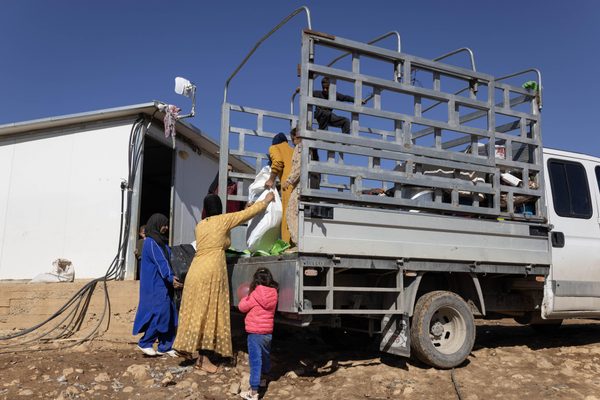
A family packs to flee Ras Ein al-Auja amid settler attacks in January.
Oren Ziv
West Bank Dispatch: “Everything is Destroyed”
Last month, the 135 families living in the West Bank Palestinian Bedouin village of Ras Ein al-Auja, known as Ras al-Ein, were forced to flee following years of unrelenting attacks by neighboring Israeli settlers, who had set up an outpost in the middle of the village. Ras al-Ein had been one of the only remaining communities in the area. Settlers have forcibly depopulated surrounding villages over the last two years using arson attacks, property theft, intimidation, and other physical violence committed as part of Israel’s mass ethnic cleansing campaign of Area C, the portion of the West Bank under full Israeli control.
To reflect on the expulsion of the Ras al-Ein community, Jewish Currents assistant editor Maya Rosen spoke with Naif Ghawanmeh, a 50-year-old father of ten who was among those forced to flee the village, about his family’s history of displacement and the prospect of return. Ghawanmeh is a farmer and a shepherd, but he has had to sell most of his flock because the settlers have made grazing impossible.
Naif Ghawanmeh: We have lived in Ras al-Ein since 1982, for nearly 45 years. I grew up there. We were forced to move after the 1948 war, and after the 1967 war. This is our third displacement. We have no other land. Our land is in 1948 [on the Israeli side of the Green Line].
We were the very last ones to leave Ras al-Ein. We were there alone. There were many settlers, with many flocks, walking around the village every day. We are now staying in an area between Auja and Jericho, but I don’t know for how long. We will wait here, and we will see. My whole life is there. I grew up there. I have ten children; they were all born there. I’m in this new place, but my mind is there, in Ras al-Ein. My wife is always asking, When are we returning?
I need to build my life anew. Everything is destroyed.
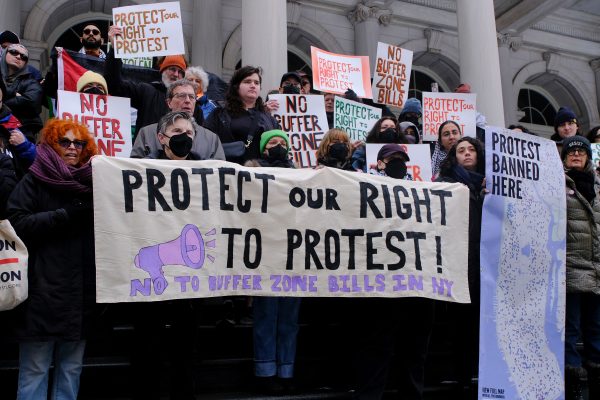
Protesters gathered at a New York City Council hearing on legislation that could restrict rallies outside of places of worship, February 25th, 2026.
Katie Godowski/MediaPunch/IPX
Would Buffer Zone Bills Give Police More Power? Mainstream Jewish Groups Say Yes, NYPD Says No
Alex Kane
At a lengthy New York City Council committee hearing on Wednesday on bills to regulate protests outside of synagogues and educational institutions, mainstream Jewish groups and the NYPD did not seem to be talking about the same bill.
Jewish groups said the legislation would give increased power to the police to limit synagogue protests. The NYPD, however, said the bill does not give the police more power than it already has under existing law.
The bill, part of a package of proposals framed by Council Speaker Julie Menin as addressing bias in the city, has had the strong support of organized Jewish groups in New York. But the version of the legislation currently under consideration departs starkly from the one Menin originally proposed, and at the Wednesday hearing, mainstream Jewish groups appeared to be arguing in favor of bills that no longer said what they wanted them to say.
The first draft of the bill directed the NYPD to maintain barriers in response to “interference” or “intimidation” outside religious sites, and allowed the police to establish those barriers up to 100 feet from houses of worship. But the NYPD itself expressed concerns to Menin over the initial draft, and she has made significant amendments as a result. The 100-foot mandates no longer appear in the bill’s text, or in the text of a related bill that creates buffer zones outside of educational facilities.
On Wednesday, a slew of representatives from mainstream Jewish communal groups—including the UJA-Federation of New York, the Anti-Defamation League (ADL), and the Jewish Community Relations Council—spoke in support of the bills at the Council hearing. Yisroel Kahan, the ADL’s Orthodox liaison, cast Menin’s bill as one that “aims to create a security buffer zone for houses of worship,” while Ariel Savransky, the 92nd Street Y’s director of government and community relations, said the bill provides “additional protection to organizations at risk.”
Under questioning from Brooklyn City Councilmember Kayla Santosuosso, however, police department attorney Michael Gerber said the bills did not mandate buffer zones nor increase police power to create them. “Any time you have a fixed rule across the board, that is certainly going to raise constitutional questions,” Gerber said, appearing to acknowledge the department’s concerns with the plan proposed in earlier versions of the law. Responding to a question from City Councilmember Shahana Hanif, Gerber also noted that antisemitic speech outside houses of worship is generally protected by the First Amendment.
Instead, Gerber cast the amended bill as merely a tool allowing the NYPD to be transparent with the public about how they would handle protests outside religious institutions, and said that the bill does not give the police powers over protest activity that they didn’t already have.
Some council members questioned why the bill was necessary if it didn’t change anything about how the police would handle protests. “It appears the intent of this bill is duplicative of existing law,” said Councilmember Crystal Hudson. In response, Speaker Menin said the intent of the bill was to make sure that a protest like the November one outside Park East synagogue—in which demonstrators outside an event supporting immigration to Israel and the West Bank chanted “take another settler out”—would “never happen again.” She did not offer specifics on how the bill would do this, but spoke instead to a feeling of urgency among Jews. “Any suggestion that the bills aren’t needed is just minimizing what the impact has been to the Jewish community,” she said.
Civil liberties advocates continue to oppose the bills. In testimony on Wednesday, Justin Harrison, the senior policy counsel at the New York Civil Liberties Union, warned that the bills in question would increase police power to arbitrarily create and enforce limits to the detriment of protesters’ constitutional rights.
“Both proposals encourage viewpoint and content-based enforcement against disfavored speakers and messages, in that they offer the NYPD wide latitude to decide when, where, and under what conditions they should set up buffer zones, an exercise typically reserved for the courts, which are very limited in their ability to allow any infringement on the right to protest,” said Harrison.
Jennvine Wong, a supervising attorney at the Legal Aid Society’s Cop Accountability Project, argued that the bill could undermine a 2023 settlement reached with the NYPD in response to a lawsuit alleging that they violated the constitutional rights of those protesting police brutality after the murder of George Floyd. “That settlement required NYPD to minimize police presence at protests and demonstrations to ensure compliance with the First Amendment,” said Wong. “[Creating buffer zones] would necessarily increase police presence and risk greater surveillance of people of color.”
Even amid the confusion over what the legislation actually means, Menin’s amendments seem to have convinced more council members to sign on. Her original bill only had nine sponsors. The amended bill has 32 sponsors—six more than the majority needed for it to eventually pass.
If the bill passes, it will be up to Mayor Zohran Mamdani to sign it into law. That would place Mamdani between the Speaker—whose cooperation he needs to pass his legislative agenda—and parts of his base, which strongly oppose the bill. On Wednesday, Mamdani noted that the bill had been significantly changed from its original version, but did not commit to a position on the legislation.
Contact Alex Kane at alex@jewishcurrents.org.
