Newsletter
Apr
17
2026
Good afternoon from the Jewish Currents news desk, where I’m still smarting from my humbling defeat at this week’s intramural Jewish Currents bowling face-off.
Today, Alex Kane writes on the new political terrain for left-wing candidates on arms to Israel. Plus: A hopeful update on this week’s Senate vote on US weapons sales, and a quick question for Asaf Yakir on what the downfall of Viktor Orbán means for Netanyahu.
The Jewish Currents news desk is directed by Josh Nathan-Kazis. Tips, responses, ideas, complaints, leaks? Email Josh at jnk@jewishcurrents.org. If you were forwarded this email, subscribe here so you don’t miss the next one.
This may have been the week that AIPAC’s grip over Democratic politics slipped.
When I wrote on Tuesday about efforts to push Senate Democrats to block two specific arms transfers to Israel, I quoted Jewish Voice for Peace Action political director Beth Miller saying that she was hoping for around 30 senators to vote in favor, up from 27 who voted for a similar resolution last summer.
After Sen. Bernie Sanders forced the votes late Wednesday, the outcome blew that prediction out of the water: 40 Senators voted to oppose a large sale of Caterpillar’s D9 bulldozers, which the Israeli military has used for decades to demolish Palestinian homes and infrastructure, and 36 voted to oppose a large sale to Israel of thousand-pound bombs.
It was a sharp break for the Democratic party. Votes in favor came from the very core of the Democratic foreign policy establishment, from senators like Cory Booker of New Jersey and Adam Schiff of California, whose political careers have been defined and enabled by their close ties to AIPAC. (Just two years ago, AIPAC’s super PAC spent $5 million boosting Schiff’s first senate campaign.) “The politics of this have moved more in the last two-and-a-half years than in the previous 25,” says Hadar Susskind, president and CEO of the progressive Jewish group New Jewish Narrative, which backed the resolutions. “It also shows you that the fear factor of AIPAC is gone.”
Part of that weakening of the lobby group’s influence is a result of its own blunders, which were on bright display in New Jersey on Thursday night, when Analilia Mejia, a left-wing critic of Israel, waltzed to victory in a special Congressional race two months after AIPAC dropped $2.3 million torpedoing the primary campaign of her pro-Israel progressive opponent.
But it’s mostly that Israel’s recent belligerence in Gaza, the West Bank, Lebanon, and Iran has changed the terms of the foreign policy debate so much that the even the implicit threat of the $91 million that AIPAC’s super PAC has on hand isn’t enough to keep Senate Democrats in line.
– Josh Nathan-Kazis
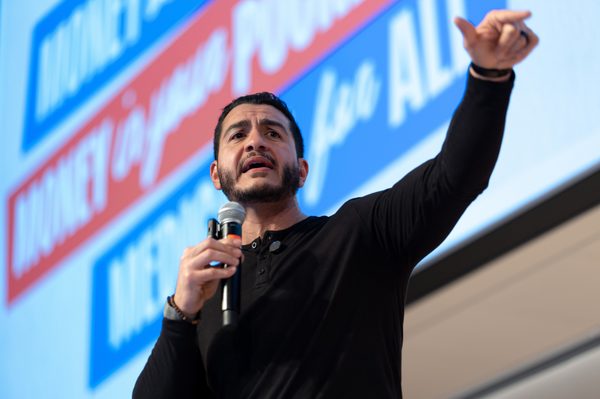
Abdul El-Sayed, a leading contender in the Senate Democratic primary in Michigan, opposes all arms sales to Israel.
Julia Demaree Nikhinson/AP
In Democratic Primaries, Leading Candidates Oppose Selling Iron Dome Interceptors to Israel
Alex Kane
For progressive Democrats, the de facto position on US military ties to Israel in recent years has been to oppose US military aid, except in the case of notionally defensive missile interceptor systems like Iron Dome. This spring, that’s started to break down: One of the two leading contenders in the Senate Democratic primary in Michigan, the physician Abdul El-Sayed, says that he opposes not just military aid, but all US arms sales to Israel, including Iron Dome. He’s one of a large crop of left-wing candidates who are serious contenders in ongoing Democratic primaries and are pushing for the US to stop selling any weapons to Israel.
The US government sells weapons to Israel, and other allies, that it procures from US weapons manufacturers. Today, Israel pays for much of that weaponry with the billions in military aid it receives from US taxpayers. Opposition to using US aid to pay for notionally defensive weapons like Iron Dome has been fringe in the Democratic Party. But Rep. Alexandria Ocasio-Cortez publicly adopted that position two weeks ago, sending a jolt through progressive politics and reorienting the broader US foreign policy debate around Israel. Now, progressives are increasingly saying they oppose US military aid, but want to allow Israel to continue to buy defensive weapons like Iron Dome from the US government with its own money.
Democratic Reps. Rashida Tlaib and Rep. Ilhan Omar have long gone a step further, pushing to end not just US military aid to Israel, but all US arms sales to the Israeli military. But their lonely position may soon have more backing in Congress.
A spokesperson for Abdul El-Sayed told Jewish Currents that “he does not believe the United States should sell weapons to Israel.” New York Assemblymember Claire Valdez, who has out-fundraised all other candidates running for the open seat in New York’s 7th Congressional district, published a foreign policy platform last week urging an end to all weapons sales and military aid. Saikat Chakrabarti, the former Ocasio-Cortez aide who is running for Congress in San Francisco and polling a close second to his main opponent, has repeatedly called for a total arms embargo, and in the wake of Israel’s deadly April 8th attacks in Lebanon, which killed over 300 people, said the US should impose sanctions on the country. And Adam Hamawy, a US Army veteran who volunteered as a doctor during Israel’s genocide in Gaza and the top fundraiser in a congressional race for in New Jersey’s 12th district, opposes US government sales of anti-missile systems to Israel. Chakrabarti’s and El-Sayed’s primary opponents both say the US should continue funding Iron Dome.
Yousef Munayyer, head of the Palestine/Israel program at the Arab Center Washington DC, argued that US financing of Iron Dome has allowed Israel to act belligerently, without fear of significant blowback. “It’s not like the Israelis are simply knocking down missiles and then staying put. It has created a cover for Israeli expansionism,” he said. “It’s important as a matter of American policy to send a clear message to the Israeli government and public that if you want to choose this path of constant war, that should be on your dime.” That argument that Iron Dome cannot be considered “defensive” has been adopted by Hamawy, the New Jersey congressional candidate. In an interview with Jewish Currents, he said the US should not pay for or sell anti-missile systems to Israel, and that Iron Dome has reduced Israel’s incentive to negotiate with Palestinians. “It insulates Israel from the consequences of its genocidal policies,” said Hamawy. “I just don’t believe it’s truly defensive in that matter because there’s no reason for them to negotiate.”
The debate over US funding of Israel’s anti-missile systems has real bearing on policy. Every year, Congress votes on whether the US should continue to give Israel its annual $500 million to spend on anti-missile systems, which were jointly developed by Israel and the US. In 2021 and 2025, Congress voted overwhelmingly to replenish Israel’s depleted anti-missile systems; only a handful of progressives, including Tlaib and Omar, opposed the funding at the time.
Ocasio-Cortez, a potential 2028 presidential candidate and a leader of the left flank of the Democratic Party, is a bellwether of just how much the debate over Iron Dome has moved. In 2024, Ocasio-Cortez and 18 of her progressive colleagues issued a joint statement explaining that they were “against supplying more offensive weapons that could result in more killings of civilians,” while in favor of “strengthening the Iron Dome and other defense systems.” This month, amid the US-Israeli war on Iran, and as she approached the New York City chapter of the Democratic Socialists of America for an endorsement, she reversed her position. “The Israeli government is well able to fund the Iron Dome system,” she said in a statement. “I will not support Congress sending more taxpayer dollars and military aid to a government that consistently ignores international law and US law.”
A host of other Democrats, such as Reps. Ro Khanna and former City Comptroller and Congressional candidate Brad Lander—both of whom previously said they supported Iron Dome—followed suit, saying Israel should buy the arms themselves. J Street, the liberal Zionist lobby group that has long pushed for US financing of Iron Dome, said last week that they no longer held that position. “Israel is capable of paying for its own military equipment, including supplies for its missile defense systems,” J Street head Jeremy Ben-Ami said in a statement sent to Jewish Currents.
“It used to be completely taboo to even think about touching Iron Dome funding,” said Amira Hassan, political director of the pro-Palestinian, anti-AIPAC electoral group Peace, Accountability, and Leadership PAC. “It’s significant that that taboo is being lifted.” But Hassan says it’s not enough to stop at subsidizing Israel while allowing them to buy weapons. “There should be no weapons going to a nation committing a genocide,” she said.
At the same time, some progressives are questioning whether it’s smart politics to push politicians for an end to Iron Dome sales. “Convincing lawmakers to oppose the transfer of every weapon and gadget that Israel is using in its illegal assaults around the region is a challenging enough project as it is,” said Dylan Williams, vice president for government affairs at the progressive foreign policy think tank Center for International Policy. “Muddying the waters by centering the debate around sales of Iron Dome interceptors is exactly what our opponents want to do. Why would we do that work for them?”
For now, ending US subsidies for, let alone sales of, Israel’s anti-missile systems remains a minority position in the party. Support for an end to the transfer of offensive weapons continues to grow. “Those with political ambitions are trying to calibrate the sweet spot to be seen as progressive but not radical, and in line with the base but not totally out of touch with the party establishment,” said Munayyer.
But Munayyer predicted that Ocasio-Cortez’s position would become more commonplace. “The entire American relationship with Israel is up for discussion now in a way that it never was before. It wouldn’t surprise me if her position becomes the norm,” he said.
Contact Alex Kane at alex@jewishcurrents.org.

Hungarian Prime Minister Viktor Orbán and Israeli Prime Minister Benjamin Netanyahu last summer.
Denes Erdos/AP
A Quick Question for Asaf Yakir on What the Downfall of Viktor Orbán Means for Netanyahu
The electoral defeat last Sunday of Viktor Orbán, the Hungarian prime minister who eroded Hungary’s democratic institutions, free press, and civil society over 16 years in power, raises questions about the political future of Israel’s Benjamin Netanyahu.
Orbán and Netanyahu are close allies, and Hungary under Orbán has been the key European backer of Israel and of Netanyahu, blocking targeted European Union sanctions, refusing to comply with an International Criminal Court (ICC) arrest warrant for Netanyahu, and starting the process of leaving the ICC entirely.
What’s more, Orbán’s model, which he’s dubbed “illiberal democracy,” is the closest analog to Netanyahu’s vision for Israeli society on the international stage. Does Orbán’s defeat at the hands of the conservative Peter Magyar suggest that Netanyahu himself is at risk? To help understand the impact of the fall of Orbán in Israel, we spoke to Asaf Yakir, a postdoctoral researcher at the University of Padua who has written on right-wing populism in Israel and Hungary. He is a member of the Standing Together movement and co-host of the Wake Up Call podcast.
Josh Nathan-Kazis: Asaf, what does Orbán’s defeat at the polls last weekend mean for Netanyahu?
Asaf Yakir: Viktor Orbán’s electoral defeat is bad news for Netanyahu. Netanyahu’s alliances with other nationalist and populist leaders have long been a pillar of his legitimacy. Orbán was one of the last world leaders still willing to host and support him. If Europe decides to impose the sanctions Orbán has blocked, it may be the first real diplomatic consequences of Israel’s genocide in Gaza.
At the same time, Netanyahu’s media mouthpieces and political allies are already spinning Orbán’s defeat as proof that “illiberal democracy” is indeed a democracy, justifying their own attempts to implement the Hungarian model of reforms within Israel.
The mainstream opposition in Israel seems revitalized by Orbán’s defeat, vowing to remove Netanyahu from office in the coming elections. But his rivals will probably not be able to replicate the Hungarian opposition’s success. Their ability to repeat Magyar’s achievements is hindered by their failure to present an alternative vision to the Netanyahu-led war crimes and regional expansion. Consequently, they cannot rely on the left or on Palestinian citizens of Israel to support them. Most polls indicate that without such cooperation, the Israeli opposition will not form the next government.
