Newsletter
Mar
6
2026
Here’s the latest from the Jewish Currents news desk: Peter Beinart writes that Iran poses no existential threat to Israel, never mind the US. And, Alex Kane on AIPAC-backed candidates defecting on Iran. Plus: An interview with Iran expert Ellie Geranmayeh on what the Iran war will leave behind.
The Jewish Currents news desk is directed by Josh Nathan-Kazis. Tips, responses, ideas, complaints, leaks? Email Josh at jnk@jewishcurrents.org. If you were forwarded this email, subscribe here so you don’t miss the next one.
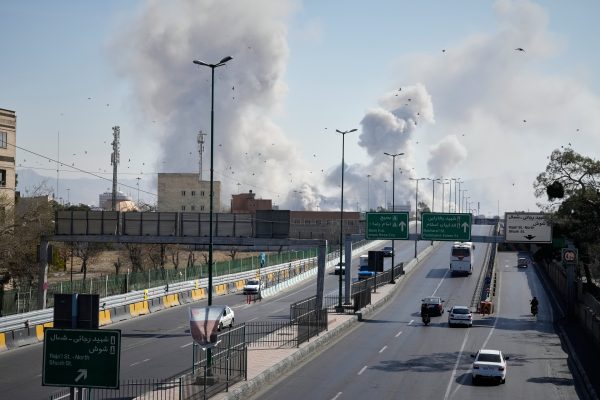
Smoke rises over Tehran on Thursday amid US-Israeli airstrikes on Iran.
Vahid Salemi/AP
Iran Is Not an Existential Threat
Peter Beinart
When he announced America’s attack on Iran, Donald Trump declared that the Islamic Republic’s “menacing activities directly endanger the United States, our troops, our bases overseas and our allies.” Top Democrats responded by criticizing Trump for neither consulting Congress nor explaining what the war aimed to achieve. But they accepted his premise that Iran poses a grave danger. Democratic Senate Leader Chuck Schumer endorsed “confronting Iran’s malign regional activities” and “nuclear ambitions.” House Democratic Leader Hakeem Jeffries warned of “the threat” Iran “poses to our allies like Israel.”
But Iran doesn’t pose a significant threat to Israel, let alone the United States. Even at its strongest, Tehran has merely challenged Israel’s dominance of the Middle East, not its survival. Yet the claim that Iran existentially threatens the Jewish state is rarely disputed in mainstream American debate, even by politicians who oppose war.
The argument that Iran endangers Israel usually starts by citing Tehran’s rhetoric. As Israeli ambassador to the US Danny Danon told CNN this week, “When they chant death to Israel, we believe them.”
But Israel’s leaders haven’t always believed them. In 1985, when the Islamic Republic was still young, its embassy in Pakistan invited children to write stories and draw pictures on the topic “Israel must be erased from the Earth.” That same year, Israel sold Iran 100 anti-tank missiles. Israel spent much of the 1980s arming Iran in its war against Iraq, which the Jewish state saw as a much graver threat. Even Iran’s role in establishing Hezbollah, the armed group that grew out of Israel’s 1982 invasion of Lebanon, didn’t stop the flow of weapons from Tel Aviv to Tehran. Nor did Iran’s missile program, which Trump administration officials now cite to justify war. When Iran acquired its first ballistic missile in 1985, in an effort to counter Iraq, Israel supplemented the Islamic Republic’s arsenal with shorter-range missiles of its own. Haaretz has even reported that some of the anti-tank missiles later fired by Hezbollah at Israeli forces were likely sold by Israel to Iran in the 1980s. In the words of Tel Aviv University’s David Menashri, one of Israel’s foremost authorities on Iran, as quoted by foreign policy analyst Trita Parsi in his book A Single Role of the Dice, “Throughout the 1980s, no one in Israel said anything about an Iranian threat—the word wasn’t even uttered.”
It wasn’t until the 1990s that Israeli and American leaders began describing Iran as a threat to the Jewish state. But this change in rhetoric didn’t occur because Iran’s attitude toward Israel changed. It occurred because Iraq, Israel’s chief bogeyman, had been brought to its knees. With Saddam Hussein hobbled by the 1991 Gulf War and then a decade of brutal US sanctions, the Islamic Republic took its place as Israel’s foremost regional competitor. “Nothing special happened with Iran,” retired Israeli Brigadier General Shlomo Brom told Parsi, “but because Iraq was removed [as a danger], Iran started to play a greater role in the threat perception of Israel.”
To be sure, Iran did grow stronger in the ’90s as a result of Iraq’s decline. It also began backing Hamas and Islamic Jihad, which opposed the Palestine Liberation Organization’s recognition of Israel. And in the early 1990s, Iran restarted its nuclear energy program, which had begun under the Shah. It was this cocktail—Iran’s hostile rhetoric, its nuclear program, and its support for armed anti-Zionist groups—that birthed the current conventional wisdom that Iran represents an existential threat to Israel.
But this claim has never been borne out by Iranian behavior. Despite its antipathy toward Zionism, and its efforts to resist Israeli and American power, the Iranian regime has shown no willingness to imperil itself by trying to destroy Israel. To the contrary, it has repeatedly sought to defuse conflict with both Jerusalem and Washington, if only because it recognizes their vastly superior power. In May 2003, after the Bush administration’s invasions of Afghanistan and Iraq, Iran sent the US government a secret message: If the US lifted sanctions, ceased trying to overthrow the Islamic Republic, and accepted Tehran’s right to peaceful nuclear energy, Iran would end its support for Hamas and Islamic Jihad, pressure Hezbollah to disarm, place its nuclear program under international inspection, and support the 2002 Arab Peace Initiative, which offered to recognize Israel if it accepted a Palestinian state and a “just solution to the Palestinian refugee problem.” According to Richard Haass, then head of policy planning at the State Department, the Bush administration spurned Tehran’s offer because “the bias was toward a policy of regime change.”
Because the Bush administration rejected Tehran’s proposal, it’s impossible to know if Tehran would have abandoned its armed proxies. But the Islamic Republic has generally tried to prevent them from dragging it into a direct conflict with Israel. In 1996, according to Parsi’s book, Treacherous Alliance, Iran pressured Hezbollah to accept a ceasefire after a 16-day skirmish with Israel. Before October 7th, according to documents discovered by The New York Times, Hamas hinted to Iranian officials that it was planning something big, and implored Tehran to use the occasion to strike Israel directly. Iran never did.
Iran has displayed the same caution when it comes to its nuclear program. In 2015, it signed an agreement with the Obama administration that, according to 29 of America’s top nuclear scientists, contained “much more stringent constraints than any previously negotiated non-proliferation framework.” (By comparison, Israel accepts no inspections of its nuclear weapons because it has never joined the Nuclear Non-Proliferation Treaty). Iran not only abided by the agreement, according to the International Atomic Energy Agency, but according to Gina Haspel, the CIA director in Trump’s first term, it remained in compliance for a year even after Trump tore up the deal.
None of this suggests a regime that behaves apocalyptically, or even recklessly. And in both the US and Israel, career security officials have said as much. In 2007, near the end of the Bush administration, 18 US intelligence agencies concluded in a joint assessment that “Tehran’s decisions are guided by a cost-benefit approach rather than a rush to a weapon irrespective of the political, economic, and military costs.” In 2012, Meir Dagan, who had just retired from nine years leading the Mossad, Israel’s external spy agency, called the Islamic Republic “a very rational regime.”
If the claim that Iran poses a grave threat to Israel is far-fetched, the claim that it poses a grave threat to the United States is even more absurd. For decades during the Cold War, Americans lived with a Soviet Union that possessed tens of thousands of nuclear weapons and the missiles able to deliver them to every corner of the United States. Iran currently possesses neither a single nuclear weapon nor a single missile capable of hitting the US. And its regime has spent the last several years responding to blow after blow from the US and Israel with what has widely been deemed restraint.
Given all this, there’s no reason for Democratic leaders to offer procedural objections to a war whose justification they have essentially conceded. They should instead make a simple argument: Iran poses no threat, not to Israel, nor to the US. As a result, attacking it is both immoral and illegal—not to mention a waste of public funds that should be spent helping ordinary Americans. The fact that leaders like Schumer and Jeffries can’t say that helps explain why Americans yearning for a party that bluntly opposes war don’t think the Democrats are currently it.

State Sen. Laura Fine, an AIPAC-backed House candidate who opposed the Iran war, appearing in a Democratic primary debate in February.
Nam Y. Huh/AP
In Illinois, AIPAC-Backed Candidates Defected on Iran
Alex Kane
Democratic House candidates backed by pro-Israel groups in Illinois—where AIPAC and its allies have spent nearly $14 million attacking progressives and supporting centrists in the ongoing primary races—split from the pro-Israel lobby this week on the US and Israeli war against Iran.
AIPAC, the lead pro-Israel lobbying group, which has long pushed for crippling economic sanctions on the Islamic Republic and opposed US diplomacy, commended President Trump’s “decisive action” in attacking Iran. The Democrats the group is backing in the March primaries in Illinois, however, have uniformly condemned US action against Iran, while stopping short of direct criticism of Israel’s role.
State Senator Laura Fine—who in June 2025 supported Israel’s bombing of Iran—said Trump could “send the Middle East into further chaos” and should be impeached. Former congresswoman Melissa Bean and Cook County Commissioner Donna Miller both said Trump’s actions were “dangerous and unconstitutional.” And city treasurer Melissa Conyears-Ervin denounced the “immoral” “war of choice.” (None of the AIPAC-backed candidates returned Jewish Currents’s request for comment.)
This tightrope act by the pro-Israel Democratic candidates in Illinois is a sign of the political predicament the unpopular war has created for AIPAC, which is supporting candidates in dozens of tight races across the country as it seeks to maintain Democratic support for Israel in the House. “They are aware that Democratic voters oppose this war pretty overwhelmingly,” said Matt Duss, executive vice president at the Center for International Policy and the former foreign policy adviser to Senator Bernie Sanders. A Washington Post poll published earlier this week found that 87% of Democrats oppose the war. In focusing their criticisms on Trump, the Illinois pro-Israel candidates are sidestepping Israel’s role in the bombings and staying out of direct conflict with AIPAC. “They have to be careful if they want to keep AIPAC support,” said Duss.
Similar dynamics are playing out in other primary races, and in Congress. In New York, the AIPAC-endorsed Rep. Dan Goldman, who is facing a challenge from progressive former city comptroller Brad Lander, criticized Trump for “defying our Constitution,” while making no mention of Israel. The Iran war was also a late issue in North Carolina’s Democratic primary on Tuesday, where the incumbent, Valerie Foushee, beat her progressive challenger Nida Allam by a tiny margin. Allam’s final TV ad focused on her opposition to the war on Iran, and criticized Foushee for taking money from weapons companies. Foushee—who also opposes the war on Iran—distanced herself from AIPAC during the campaign, and in her statement declaring victory, said that voters in her district demand “progressive change” like “passing legislation to block arms sales to Israel.”
Progressives scored an outright victory on Tuesday in Texas, where Rev. Frederick Haynes won the Democratic primary in the overwhelmingly Democratic 30th Congressional district, positioning hims as the next representative there. Haynes has referred to Israel as an apartheid state and called Israel’s actions in Gaza a genocide, and has more recently voiced opposition to the Iran war.
“These early results already demonstrate a massive shift in what is possible for the people that we elect to Congress,” said Beth Miller, political director of the anti-Zionist group JVP Action. “You could not imagine these folks being serious contenders a few years back in the same way and with the politics that they’re running on right now.”
Illinois is now the center of the next Democratic battle over Israel policy, and it is there that AIPAC is spending most heavily. AIPAC donors and AIPAC-tied super PACs have spent $13.7 million on Illinois primary races attacking progressives and boosting their preferred candidates, according to a recent investigative report from WBEZ, the local public radio station.
In interviews with Jewish Currents, two Chicago-area progressive candidates characterized their AIPAC-backed opponents’ tepid criticism of the Iran war as disingenuous. Nonprofit founder Junaid Ahmed, who is among the candidates running against Melissa Bean, said that Bean “knows that AIPAC money is toxic,” and that “if she doesn’t say anything against what’s happening in Iran, she’s got no chance.” Robert Peters, a state senator running against Donna Miller, said Miller has “made a lot of commitments around AIPAC money. So I don’t think it’s a coincidence that she left [AIPAC and Israel’s role] out.”
In a joint statement on Monday, four of the Chicago-area candidates backed by the Congressional Progressive Caucus PAC—Peters, Ahmed, Evanston Mayor Daniel Biss, and union organizer Anthony Driver—criticized Trump for dragging the US into “into an unnecessary and illegal regime change war fully backed by AIPAC,” and called for their opponents to “unequivocally reject AIPAC’s pro-war agenda.”
Progressive advocates said that the US-Israeli war on Iran was likely to boost those pushing an anti-war message in districts more favorable to progressives. Yousef Munayyer, head of the Palestine/Israel program at the Arab Center Washington DC, said the war on Iran “heightens the contrast in a lot of these races” and “helps make the case that a lot of these progressive candidates have made that US policy is far too pro-Israel, and that there is far too much pro-Israel influence around American policymaking and in American elections.”
Contact Alex Kane at Alex@jewishcurrents.org.
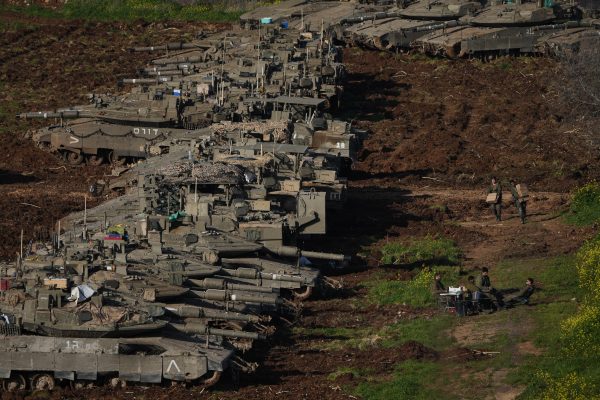
Israeli tanks at a staging area near the Lebanon border on Friday.
Ariel Schalit/AP
Quick Questions for Ellie Geranmayeh on What the Iran War Will Leave Behind
The regional war underway between Israel, the US, and Iran has swept in roughly a dozen countries over the past week, as Iran has targeted Saudi Arabia, Qatar, and even Turkey, among others, and Israel has bombarded Lebanon. On Tuesday, Jewish Currents spoke with Ellie Geranmayeh, a senior policy fellow and deputy head of the Middle East and North Africa program at the European Council on Foreign Relations, about how the war could change balances of power in the Middle East.
Josh Nathan-Kazis: Assuming this war leaves Iran diminished, how will other countries in the region contend with an emboldened Israel as the dominant regional power?
Ellie Geranmayeh: The Arab Gulf countries realize that Israel, and particularly Benjamin Netanyahu, is able to single-handedly trump their great financial and political investments in the Republican Party. No amount of lavish planes, or billions of dollars worth of investment in the US and even in the Trump family, was able to persuade the White House to avoid this war. Instead of looking at it as a binary where they have to either join forces with Israel and the US or stay quiet and acquiesce to Iranian continued bombing, we might start to see the emergence of a third path.
Countries like Qatar, Saudi Arabia, Turkey, Egypt, even Pakistan, may say that they are going to put in place a third infrastructure for security for themselves and any other Islamic or Arab power that wants to come under that security umbrella, which both sees Israel’s ambitions in the region as a major threat to their stability, but also sees Iran as a major threat to their stability. I think they are trying to carve out this alternative space, but it remains to be seen if they are going to be able to succeed.
JNK: There has been reporting that one Trump administration plan for Iran is for elements in the Islamic Revolutionary Guard Corps who would be more friendly to US interests to take control of the country. Is this a plausible scenario?
EG: It’s possible that you have, let’s say, a former military uniformed strongman who comes up into the political arena and preserves the interest of the IRGC—which is, by the way, the very same terrorist organization that the US is supposedly fighting in this war. But I only see that as a feasible outcome if Trump, behind the scenes, is currently messaging very clearly to the Iranian establishment that that is his end goal, and secondly, if Israel allows that to happen.
Currently, Israel is on an assassination spree, promising to take out any former, current, and potential future leadership figures within the Islamic Republic of Iran. I think it sends a very dangerous message that actually, Israel is not interested in allowing that CIA plan to roll out, because their preference is either for a complete regime change that brings in people that are no longer adversarial towards Israel—perhaps the exiled former Crown Prince Reza Pahlavi. Or, if that regime change is not possible, the preference is to just have regime collapse and state failure inside Iran, which busies Iran with itself and removes it from the regional power balance threat.
