Letters / On “Portrait of a Campus in Crisis”
I appreciated Will Alden’s well-researched exposé on UCLA’s excessive militarization in response to the student-led Palestine solidarity movement, which brought much-needed attention to the scale of the university’s violence. However, I believe this piece would have been strengthened by foregrounding the agency and dynamism of grassroots student organizing. What might we gain if, instead of focusing on the inner workings of institutional power, we told this story from below?
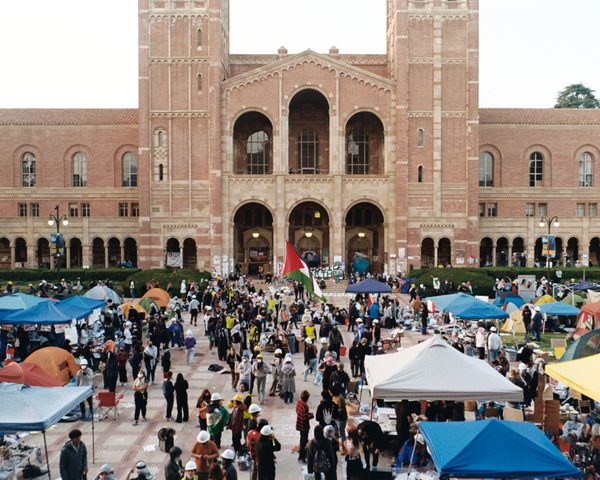
Like others across the globe, the UCLA Palestine solidarity encampment was a site of creativity, collaboration, and liberatory learning. We students took our education into our own hands, shutting down the university for an entire week and continuing to contest power for months. Together we organized lectures and teach-ins, attended workshops and skillshares, animated our spaces with dance and song. We had a free library stationed under a tree, with books donated by our chapter of Faculty for Justice in Palestine. We operated a kitchen and medical tent. We learned from one another’s faith traditions: Muslim students joined with Jews celebrating Passover and Shabbat, while Jews provided protective presence for daily Muslim prayers. As a multiracial group of students, we connected this country’s essential role in the genocide of Palestinians with the forces of US imperialism that continue to shape our lives and the lives of our families. We organized processes for collaborative decision-making and systems of collective safety. We were so steadfast in our commitment to building this alternative world—a world against institutional complicity in genocide and outside the logic of capitalism—that the university had no choice but to halt operations and unleash thousands of cops from across the state of California in order to sweep us out. I am in awe of the thousands of us who effectively worked together to achieve a liberatory takeover that wholly transformed the landscape of our campus. What story could be told if we framed students not merely as recipients of institutional repression and violence—which we certainly were—but also as proactive agents of change?
The stakes for this reframing are high: Highlighting student agency and its creative, collective force illuminates how grassroots organizers can generate real power. We must celebrate the complexity of building from below so that we can learn from and replicate successful resistance. The creativity, care, and collective power of the campus movement is a story that deserves to be told. The student activists are the center of that story.
Los Angeles, CA
The letter writer is a PhD student at the University of California, Los Angeles.