Letters / On “Against Zionist Realism”
For Jon Danforth-Appell, Jewish anti-Zionist organizing wrongly reinforces the bond between Judaism and Zionism, obscuring the more central role played by the United States in supporting Israel’s actions. But in arguing against “Zionist realism,” the author reifies nationalist realism—the idea that the only real polities out there are nation-states. This obscures a long tradition of Jewish thinkers and movements who supported Jews collectively taking responsibility for their futures outside the context of an ethnostate—a tradition whose esteemed successors now include IfNotNow and Jewish Voice for Peace.
Danforth-Appell argues that we are not responsible for the actions of mainstream American Jewish organizations because they are undemocratic and don’t accurately represent the community they purport to speak for. Yet the same is true, to varying degrees, of US state institutions, which seemingly serve elite and special interests above those of their constituencies. In this moment of ongoing catastrophe, what is called for is political action, undertaken both as Jews and as Americans—because if we act like only national identity matters, we will fail to build a world beyond nationalism.
Berkeley, CA
There was a time in recent history when “Jewish” was an identity category utterly unaffiliated with state power, imperialism, and genocidal violence. The slogan “Not In Our Name” hearkens back to this time. There was, however, never a point in time when the identity category “American” was not affiliated with an empire that was, and remains, “the greatest purveyor of violence in the world,” in the words of Dr. Martin Luther King, Jr. Thus Jon Danforth-Appell’s implicit suggestion that the slogan “Not In Our Name” ought to refer to our Americanness over our Jewishness misses the crucial recognition that “American” is necessarily an identity category affiliated with genocide and empire. The hope of appending the phrase “Jews say” to our protest slogans is that Jewishness might yet be rescued from such an affiliation.
At its best, “Americans Say Not In Our Name” is an overly optimistic misdiagnosis of the possibilities of Americanness; at its worst, it gives fodder to “anti-Zionist” groups like If Americans Knew that posit Zionism as an aberration from true (white, Christian) “American values,” rather than continuous with genocidal histories of European and American imperialism. Danforth-Appell is right to note that American Jews are not uniquely complicit in Zionism’s atrocities, but his suggestion to de-center Jewishness and uplift Americanness in our protest of Zionism misses the moral bankruptcies of American identity. It also obscures the hope, which we imagine Danforth-Appell shares, that we might (re)create a Jewishness that stands in unwavering opposition to empire, Zionism, and American nationalism.
We aspire to a Jewish life that does not center or hallowany state or national identity. As American Jewish life becomes more and more defined by Zionist or anti-Zionist identification, we ask ourselves what of Jewishness remains or can be instigated otherwise. We’ve debated whether to release the term “Jew” from inherited identity toward literary use as a political symbol, or to limit “Jew” to its religious underpinnings, or, in our more enraged moments, to repudiate Jewishness entirely due to its inescapable implications in historical and contemporary violence. But we agree that replacing a Jewish protest identity with an American one leaves us on unstable, corrupted ground for political advocacy, while forsaking the possibilities present in explicitly Jewish protest that aims to undermine national allegiances as such. We look to identity as generative creative ground that strengthens us to disengage our ties to nationalist state projects.
New York, NY
Moriel Rothman-Zecher
Philadelphia, PA
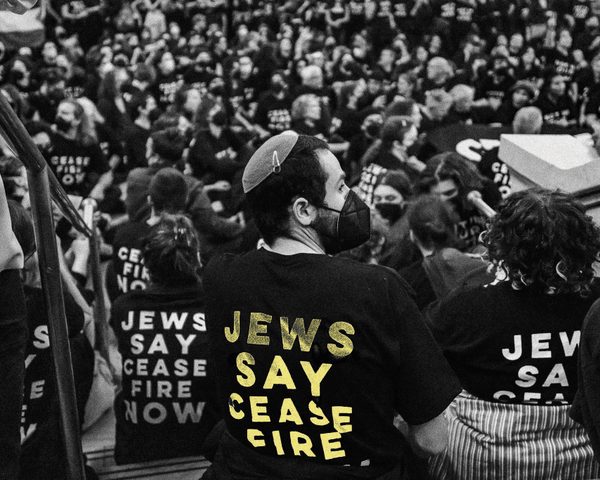
It’s important for Jews working toward Palestinian liberation to ask ourselves whether our tactics and formations are more self-soothing than strategic, and to question the value of organizing as Jews at all. It’s true, as Jon Danforth-Appell says, that “the American empire’s support for Israel is rooted in geopolitics and the global capital of the arms trade, not a love for Jews.” But love for Jews is how the US’s foreign policy toward Israel is sold. Lawmakers invoke that love in appropriating endless billions of dollars for US-made weapons sent to slaughter Palestinians. As long as this is marketed as being on our behalf, we have to visibly oppose it as Jews—to attack the stated justification for, and thereby facilitation of, the genocide. Yelling “Not In Our Name” isn’t a plea for absolution (or a way of ignoring the responsibility of Americans). Rather, it’s an attempt to use the leverage we have. Let a politician announce that they’re doing it for Boeing’s shareholders or to bring about the rapture—we can change our t-shirts without missing a step.
On a personal note, this mode of organizing feels unavoidable to me: Because I’m a Jew, everything I do is as a Jew; because of my love for my community and my understanding of history, I’m unable to cede the public expression of Jewishness to supporters of genocide. Whether I hold a banner saying so depends on the venue, but when I say “I’m a Jew against this genocide,” I consider it both strategic and the most honest thing I can do.
New York, NY
I appreciated Jon Danforth-Appell’s pragmatic analysis of who is providing the most significant material support for genocide and occupation. However, I take issue with the claim (which was also repeated on the On the Nose episode discussing the article) that Jewish Voice for Peace (JVP) is one of the leading groups organizing direct action in solidarity with Palestine. As a current sophomore at Barnard College, I have witnessed the dynamics between many groups in the Palestine solidarity movement over the past year. While Jewish students are certainly part of campus movements, the vast majority of direct actions on campuses have been led by Students for Justice in Palestine and other Palestinian-led organizations; focusing only on JVP thus wrongly marginalizes the work of Palestinian-led groups.
At Columbia University, we’ve seen the administration target and penalize our Black, brown, and Palestinian comrades the most harshly, often utilizing the flimsy justification of “combating antisemitism.” Given this reality, white Jews on campus absolutely should use our privilege to participate in riskier actions. But this does not mean that we must turn to Jewish-centered organizing; those who have US citizenship or those who aren’t reliant on financial aid are also in a position to take risks. Identity politics are often shallow; it’s more important to identify the broadest base of people who can exploit their positionality and act together to shift the balance of power.
New York, NY
We at Halachic Left, a grassroots organization of halachically-observant Jews working against the occupation, don’t disagree with Jon Danforth-Appell’s claim that a main axis of our complicity in the ongoing genocide in Gaza is our Americanness, not our Judaism. But we believe that deep cultural shifts are crucial for creating long-term change and that this work is most impactful when done within a communal framework. We know that our schools send graduates to the Israeli military, that politicians are often afraid to alienate Jewish voting blocs over Israel, and that American Jewish organizing under the banner of opposing antisemitism has helped the current administration in its campaign of repression on university campuses. Our religious communities are also intricately connected to the Israeli Religious Zionist community, which is at the forefront of the settler movement and a crucial constituency in the right-wing, Jewish supremacist political coalition in Israel. As the Talmud teaches, “Kol Yisrael arevim zeh b’zeh” (“All Jews are responsible for one another”). We organize as religious Jews because we see ourselves as responsible for helping to facilitate political transformation in all Jewish communities, and hope that this ethos will maximize our impact.
Jerusalem
The letter writer is a co-founder of Halachic Left.
In his recent piece, Jon Danforth-Appell writes that “the Jewish left as a whole has yet to articulate a project that is not just the negation of Zionism.” But in searching for the positive content of anti-Zionist Judaism, might we consider . . . Judaism? Our traditions of dialectic argumentation and empathy for the vulnerable, to give just two examples, ought to be rich enough to furnish the positive content we seek.
Silver Spring, MD
As Jon Danforth-Appell rightly notes, anti-Zionism, perhaps counterintuitively, still centers Israel. As if to dramatize the “realism” Danforth-Appell describes, in my view, even the article itself (and the podcast discussing it) reproduce terms and concepts common to both Zionism and anti-Zionism, which feel so embedded that it’s hard to imagine it any other way.
For example, Danforth-Appell writes: “The mobilization of American Jews around a conception of our unique responsibility to oppose the Israeli government entangles the anti-Zionist Jewish left in an overbroad definition of Jewish peoplehood that necessarily centers the state of Israel.” But I am not sure that there is any conception of Jewish peoplehood that exists absent Israel. As my colleague Noam Pianko argues in his book Jewish Peoplehood: An American Innovation, the term “Jewish peoplehood” only emerged in the 20th century and was coined by rabbis like Stephen Wise and Mordecai Kaplan who had strong Zionist commitments.
Indeed, historically, there was no consensus on the idea of a single Jewish people or nation—a concept deeply connected to the emergence of highly dubious “racial science” discourses. Arthur Ruppin, a founder of the city of Tel Aviv and of the sociology department at Hebrew University, argued that Sephardic and Middle Eastern Jews were closer to Arabs and Muslims than to Ashkenazi Jews, the latter of whom he saw as the real Jews. In response to experiences of discrimination that Jews from the Ottoman Empire endured at the hands of Eastern and Central European Jews in early 20th-century New York, Salonican-born intellectual Henry Besso argued in 1939 that Ashkenazi and Sepharadi Jews are as far apart from each other “ethnologically” as a “German Catholic and a Spanish Catholic.” The implication was that although both groups ostensibly shared a religion, they constituted different peoples. He thus opened up the possibility that there could be multiple Jewish nations, just as there were multiple Catholic ones. Likewise, some Ladino newspapers in New York as far back as the early 20th century argued for the existence of “puevlos djudios” (“Jewish peoples,” in the plural).
Both Zionist and anti-Zionist Jews tend to use other terms uncritically as well, such as the oft-repeated category of “diaspora Jews.” The term implies that “diaspora” is always in relation to Israel; that, as I discussed with editor-in-chief Arielle Angel back in 2020, “Israel is the center and we are dispersed from the center—even as we attempt to assert that that former periphery is a new center.” I worry that our correctives to Zionism sometimes reinforce the same binary. Take, for example, the idea of “doikayt,” often translated as “hereness.” As I explained then, I worry about the dichotomy it sets up between “here” and “there.” I continue to advocate for the idea of “multi-rootedness” to help shift our frameworks away from Zionist realism. We need concepts that allow for pluralities, for multiple diasporas, and for multiple nodes of connection. I hope this concept can also help provide the “positive” content that Danforth-Appell provocatively suggests is needed to move beyond anti-Zionism.
If one wants to challenge Zionist realism, one has to challenge the underlying nationalist logic encoded in our everyday language, which shapes our structures of thought. Maybe rethinking peoplehood and diaspora is a place to start.
Seattle, WA
The letter writer is an associate professor of history and Jewish studies and the Isaac Alhadeff Professor in Sephardic Studies at the University of Washington. He serves on the Jewish Currents advisory board.